Facts
The petitioner, Accused No. 3 in S.C. No. 103 of 2020 before the Additional Sessions Court-II, Kasaragod, faced prosecution under Sections 20(b)(ii)(C) and 29 of the Narcotic Drugs and Psychotropic Substances Act, 1985, arising from Crime No. 517 of 2017 of Manjeshwar Police Station.
Source reference: para. 1During final hearing, the defence pointed out that the seized samples had not been forwarded to the Forensic Science Laboratory. The prosecution thereafter sought further investigation, which the Trial Court permitted on 31 May 2025, without hearing the accused.
Source reference: paras. 2–3, 7After receipt of the chemical analysis report, the prosecution applied to reopen the evidence, mark the forwarding note and chemical analysis report, and examine an additional witness. Despite the petitioner’s objection, the Trial Court allowed the applications by a common order dated 15 September 2025.
Source reference: paras. 2, 8–10The petitioner challenged that order, alleging that the further investigation was conducted after an unexplained delay, in secrecy, to fill a lacuna in the prosecution case, and that the handling and unsealing of the material objects compromised the chain of custody and his right to a fair trial.
Source reference: paras. 2, 5Issues
Whether the Trial Court’s permission for further investigation was invalid because the accused was not heard before such permission was granted?
Source reference: paras. 10–13Whether the Trial Court was justified in reopening the prosecution evidence to mark the chemical analysis report and forwarding note and to examine an additional witness?
Source reference: paras. 10, 14–17Whether the alleged defects in sampling, sealing, storage, handling, and forwarding of the seized samples rendered the chemical analysis report inadmissible or required its exclusion at the interlocutory stage?
Source reference: paras. 17–19Law Applied
The Court applied Section 173(8) of the Code of Criminal Procedure, and the corresponding principles under the Bharatiya Nagarik Suraksha Sanhita, 2023, holding that further investigation requires permission of the jurisdictional court, which must apply its judicial mind; however, the statutory framework does not require the accused to be heard before such permission is granted.
Source reference: paras. 11–13Relying on Peethambaran v. State of Kerala, Pramod Kumar v. State of Uttar Pradesh and Raveendran v. State of Kerala, the Court held that further investigation cannot be undertaken solely on the unilateral discretion of the investigating agency.
Source reference: para. 11Section 348 of the BNSS, pari materia with Section 311 of the CrPC, empowers the Court at any stage of an inquiry or trial to summon or examine a witness if the evidence is essential for a just decision; the power must be exercised cautiously and not merely to fill a lacuna, prejudice the accused, or confer an unfair advantage.
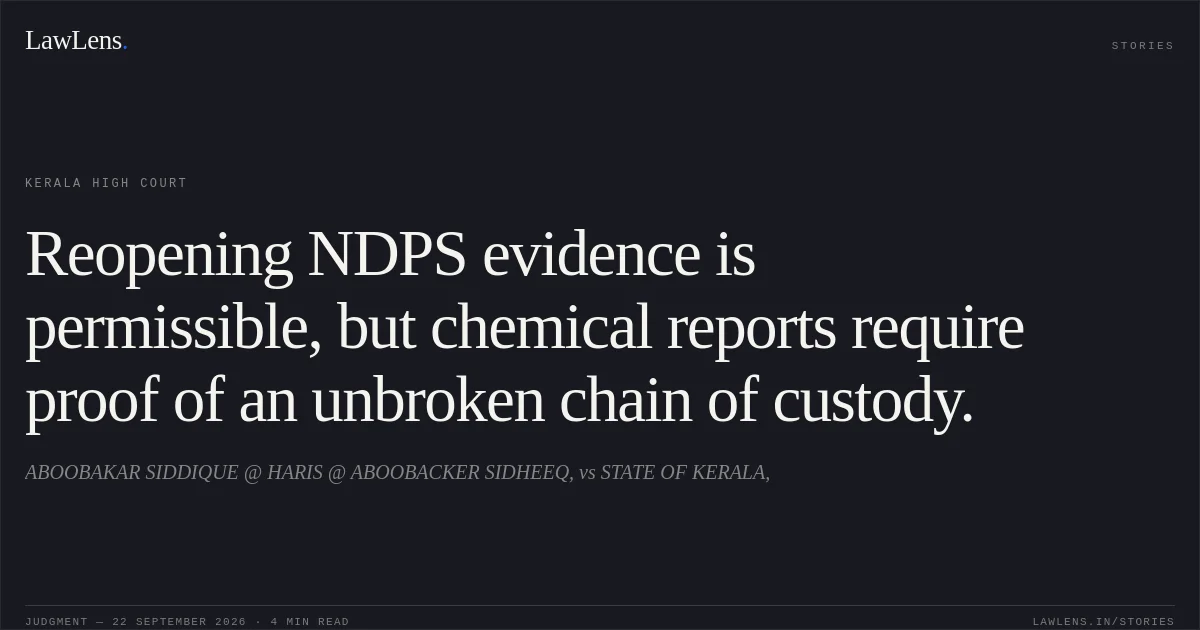
Source reference: paras. 15–16In relation to NDPS prosecutions, the prosecution must establish the integrity of the samples and an unbroken chain of custody from seizure to receipt at the FSL. Non-compliance with Section 52A of the NDPS Act or procedural delay is not automatically fatal, but unexplained gaps or serious defects affecting sample integrity may undermine the evidentiary value of the FSL report, as recognised in Abdul Rajik v. State of M.P., Narcotics Control Bureau v. Kashif, Bharat Aambale v. State of Chhattisgarh, Nadeem Ahamed v. State of West Bengal and State of Rajasthan v. Tara Singh.
Source reference: para. 18Reasoning
The Court held that although the Trial Court’s order permitting further investigation was brief, the petitioner had not challenged that order and the applicable law did not mandate a prior hearing to the accused.
Source reference: para. 13It was therefore presumed, in the circumstances, that the Trial Court had exercised its jurisdiction upon due application of mind.
Source reference: para. 13The subsequent reopening of evidence was considered permissible because Section 348 of the BNSS authorises the Court to receive evidence essential for a just decision, and the chemical analysis report was directly relevant to determining whether the seized substance constituted narcotic material.
Source reference: paras. 14–17The petitioner’s objections concerning the eight-year delay, possible tampering, unsealing, custody, and forwarding of the samples were treated as matters going to the admissibility, reliability, and weight of the evidence—not as grounds to quash the reopening order at that stage.
Source reference: para. 17Nevertheless, the Court emphasised that the prosecution would ultimately have to prove, through proper oral and documentary link evidence, the integrity and continuous custody of the samples.
Source reference: paras. 18–19Any unexplained gap or serious failure in the sampling and chain-of-custody process could be considered by the Trial Court while evaluating the chemical analysis report and the prosecution case.
Source reference: paras. 18–19Holding
The Kerala High Court dismissed the criminal miscellaneous case and declined to interfere with the Trial Court’s order permitting the reopening of evidence and examination of an additional witness under Section 348 of the BNSS.
The petitioner was expressly permitted to raise before the Trial Court all objections concerning the legality of the further investigation, delay, handling of the material objects, sampling procedure, chain of custody, and evidentiary value of the chemical analysis report.
Source reference: para. 20The Trial Court was directed to decide the case in accordance with law, particularly the principles stated in Abdul Rajik, and as expeditiously as possible.
Source reference: para. 20Acts & Sections Cited
5 provisions across 3 statutes referred to in this judgment. Each provision opens on LawLens.
Narcotic Drugs and Psychotropic Substances Act, 19852
Code of Criminal Procedure, 19731
Bharatiya Nagarik Suraksha Sanhita, 20232
Original Court PDF
ABOOBAKAR SIDDIQUE @ HARIS @ ABOOBACKER SIDHEEQ,vsSTATE OF KERALA,
Click to open original judgment
Original judgment, available to read, download and summarize on LawLens.in