Facts
The deceased, Priya Chaudhary, married the respondent, Manoj Kumar, on 20.02.2022 and died within ten months of marriage on 12.12.2022 after falling from the balcony of her matrimonial home.
Source reference: p. 2, 9The complainant (father) alleged that after two months of marriage, the respondent and his family subjected the deceased to continuous taunts and harassment regarding insufficient dowry, specifically citing a demand for a larger car and more gold.
Source reference: p. 3-4Medical records from IHBAS indicated the deceased had been diagnosed with schizophrenia and showed symptoms like self-muttering and hearing voices.
Source reference: p. 13-14The respondent was at his workplace (Delhi Fire Services) during the incident.
Source reference: p. 8, 20The Sessions Court discharged the respondent of all charges on 09.12.2023, logicizing that the allegations were merely "taunts" and that the respondent had no motive for cruelty as he married to seek a caregiver for his children.
Source reference: p. 2, 16Issues
1. Whether the allegations of repeated taunts regarding dowry-related demands constitute "cruelty" under Section 498A of the IPC.
Source reference: p. 9-102. Whether the material on record establishes a proximate and "live link" between the alleged harassment and the death of the deceased to sustain a charge under Section 304B of the IPC.
Source reference: p. 19-20Law Applied
Section 498A of the IPC, which defines "cruelty" as both wilful conduct likely to drive a woman to suicide and harassment for unlawful property demands.
Source reference: p. 10Aluri Venkata Ramana v. Aluri Thirupathi Rai regarding the expansive meaning of cruelty and Dara Lakshmi Narayana v. State of Telangana requiring specific rather than omnibus allegations.
Source reference: p. 11, 12Section 304B (Dowry Death) and the "soon before death" requirement as interpreted in Satbir Singh v. State of Haryana and Kans Raj v. State of Punjab, which mandates a "proximate and live link" between the cruelty and the death.
Source reference: p. 21-22Manendra Prasad Tiwari v. Amit Kumar Tiwari, holding that the court must seek "grave suspicion" rather than final proof of guilt for framing of charge.
Source reference: p. 17Reasoning
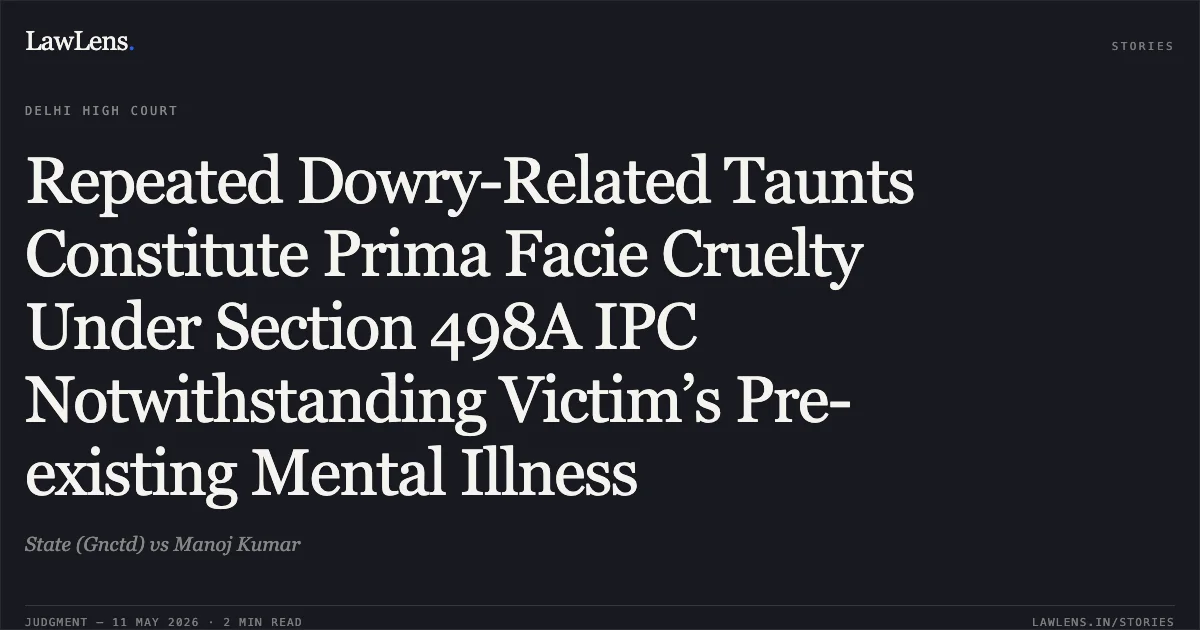
The High Court found that the Sessions Court erred in dismissing the Section 498A allegations as mere "taunts," holding that specific, repeated remarks regarding the car and gold provided prima facie constitute harassment for dowry.
Source reference: p. 15-17The Court rejected the Sessions Judge's conjecture that a widower seeking a mother for his children would not commit cruelty, stating that marriage motives cannot legally rule out subsequent harassment.
Source reference: p. 17-18Regarding Section 304B, the Court noted the absence of any specific incident of harassment occurring "soon before" the death.
Source reference: p. 20, 22Combined with the medical evidence of the deceased’s schizophrenia (which carries suicidal tendencies) and the respondent’s proven absence from the scene (alibi), the Court found no proximate nexus or "live link" to sustain the charge of dowry death.
Source reference: p. 20, 23Holding
The High Court set aside the discharge order concerning Section 498A of the IPC, holding that a prima facie case exists against the respondent-husband for that offence, but upheld the discharge for Section 304B of the IPC due to lack of evidence showing a proximate link.
The Sessions Court was directed to frame charges under Section 498A IPC and proceed with the trial.
Source reference: p. 24Acts & Sections Cited
4 provisions across 3 statutes referred to in this judgment. Each provision opens on LawLens.
Indian Penal Code, 18601
Code of Criminal Procedure, 19732
Dowry Prohibition Act, 19611
Original Court PDF
State (Gnctd)vsManoj Kumar
Click to open original judgment
Original judgment, available to read, download and summarize on LawLens.in


