Facts
The petitioner, a former Deputy Registrar of Co-operative Societies, was accused of irregularities in confirming auction sales of land belonging to defaulting farmers between 2006 and 2009.
Source reference: para. 2Following an inquiry based on a collective complaint, the Special Police Establishment (Lokayukta) registered twenty-four separate FIRs against him under the IPC and the Prevention of Corruption Act.
Source reference: para. 3The petitioner was convicted in three of these cases, with appeals currently pending.
Source reference: para. 4He approached the High Court seeking to quash the remaining nineteen trials and two pending investigations, arguing that since the cases arose from the same transaction and inquiry, they were barred by the prohibition against double jeopardy.
Source reference: para. 1, 5Issues
1. Whether the continuation of multiple trials arising from a single inquiry report violates the protection against double jeopardy under the Constitution and the statutory bar in the CrPC.
Source reference: para. 72. Whether the court should exercise its power to quash or club trials that have reached an advanced stage.
Source reference: para. 6, 11Law Applied
The court applied Article 20(2) of the Constitution of India, which protects against being prosecuted and punished for the same offense more than once, and Section 300 of the CrPC (now relevant under the BNSS), which bars a second trial for the same offense or on the same facts involving identical ingredients.
Source reference: para. 7, 8It distinguished the precedent in T.P. Gopalakrishnan v. State of Kerala, which requires an identity of facts for the bar to operate.
Source reference: para. 9The court also referenced T.T. Antony v. State of Kerala regarding the impermissibility of a second FIR for the same occurrence and Sections 447, 448, and 449 of the BNSS regarding the transfer of cases.
Source reference: para. 12, 13, 14Reasoning
The court reasoned that for the bar of double jeopardy to apply, the subsequent trial must involve the "same offense" or identical ingredients.
Source reference: para. 7In this instance, while the petitioner's role as a confirming authority was a common thread, each FIR represented a distinct transaction involving different auctions, specific defaulting agriculturists, and unique financial calculations.
Source reference: para. 9Therefore, each case constituted a separate offense rather than a single continuous occurrence.
Source reference: para. 12Furthermore, the court noted that the Supreme Court had already rejected a prayer for clubbing these cases due to the advanced stage of the trials; consequently, quashing them would be an impermissible indirect override of that higher court's observation.
Source reference: para. 10, 11Holding
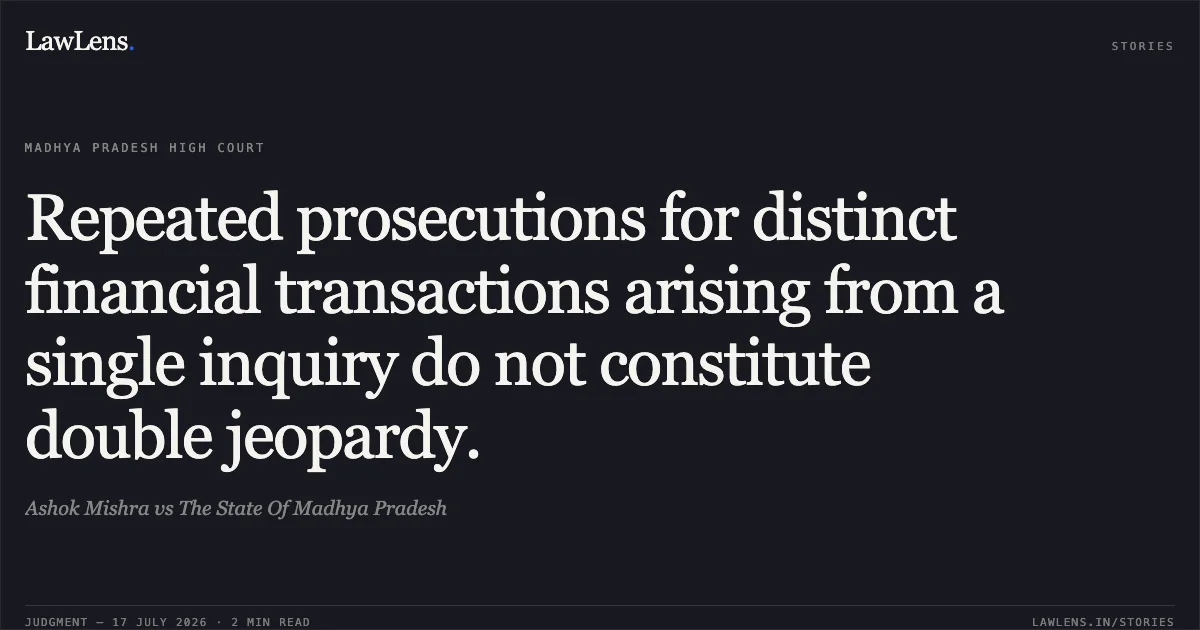
The Court dismissed the plea to quash the proceedings, holding that the bar of double jeopardy does not extend to distinct financial transactions involving separate victims.
The Court exercised its power under Section 447 of the BNSS to direct the Sessions Judge, Bhopal, to transfer all pending cases to a single Special Court. Each case must be decided separately on its own merits.
Source reference: para. 15The writ petition was disposed of with these directions, and all interim orders were vacated.
Source reference: para. 16, 17Acts & Sections Cited
13 provisions across 4 statutes referred to in this judgment. Each provision opens on LawLens.
Code of Criminal Procedure, 19733
Indian Penal Code, 18605
Prevention of Corruption Act, 19881
Bharatiya Nagarik Suraksha Sanhita, 20234
Original Court PDF
Ashok MishravsThe State Of Madhya Pradesh
Click to open original judgment
Original judgment, available to read, download and summarize on LawLens.in


