Facts
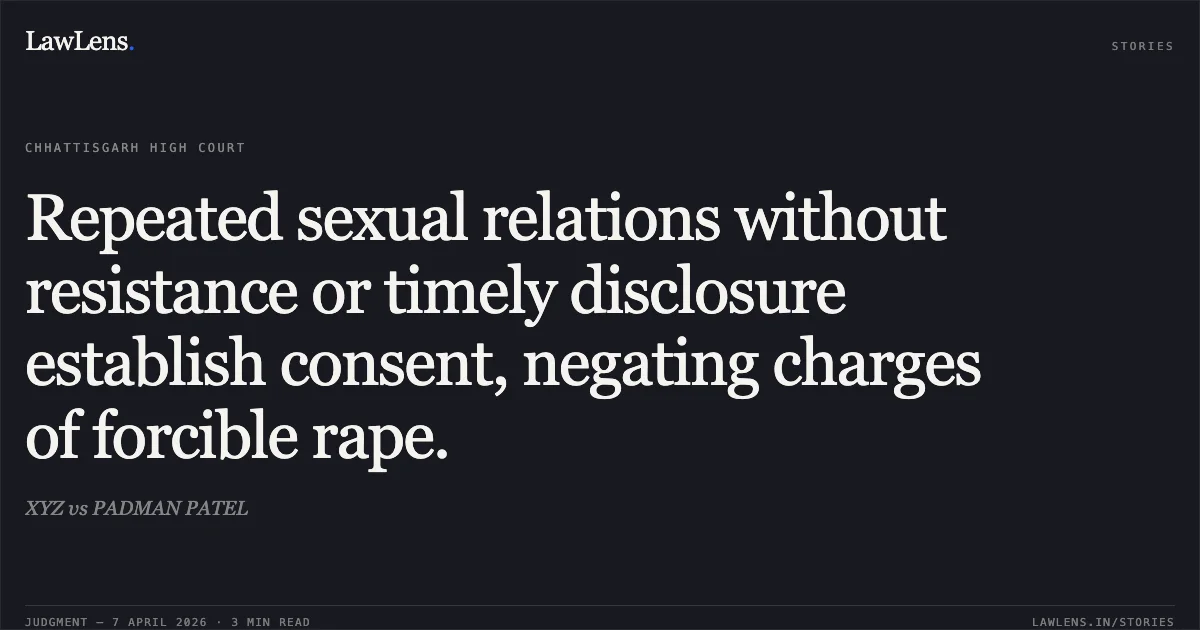
The appellant (victim) filed an acquittal appeal against the judgment dated 24.05.2023 passed by the Additional Sessions Judge (F.T.S.C.), Sakti, which acquitted Respondent No. 1 of charges under Section 376(2)(n) of the IPC.
Source reference: para. 1The prosecution alleged that from June 2021 to June 2022, the accused, who is the victim’s brother-in-law, repeatedly established physical relations with her against her will by using photographs and videos to threaten her.
Source reference: para. 2Medical examinations (MLC) showed no internal or external injuries.
Source reference: para. 3The FSL report found no seminal stains on the seized articles.
Source reference: para. 3During the trial, the victim (PW-1) admitted to having physical relations 20 to 30 times over the year and only disclosed the incident after her husband (PW-2) witnessed the accused fleeing their home in May 2022.
Source reference: para. 10, 11The trial court granted the benefit of doubt, finding the victim to be a consenting party.
Source reference: para. 13Issues
1. Whether the trial court’s finding of acquittal was perverse or contrary to the evidence on record, justifying interference by the appellate court.
Source reference: para. 6, 152. Whether the victim’s conduct and the long-term nature of the physical relations established a case of consensual relationship rather than rape.
Source reference: para. 12, 13Law Applied
The court primarily applied Section 376(2)(n) of the Indian Penal Code regarding repeated sexual assault.
Source reference: para. 1Regarding the scope of interference in appeals against acquittal, the court relied on the principles established in Jafarudheen and others v. State of Kerala (2022) 8 SCC 440, which held that an order of acquittal strengthens the presumption of innocence and should only be disturbed upon thorough scrutiny of legal parameters.
Source reference: para. 9It further applied the criteria from Mallappa and Ors. v. State of Karnataka (2024), which mandates that if two views are possible, the view favoring the accused must be followed, and acquittal can only be reversed if there is manifest illegality or perversity.
Source reference: para. 14Reasoning
The court analyzed the testimony of the victim (PW-1) and found significant inconsistencies that suggested consent.
Source reference: para. 10, 12It noted that the victim remained silent for a full year despite the accused establishing physical relations 20 to 30 times.
Source reference: para. 10, 12The court observed that the victim’s explanation for her silence—threats involving viral videos—was undermined by her admission that the accused possessed no such media during the first instance of intercourse.
Source reference: para. 12Furthermore, the court highlighted that the victim failed to report the matter even when her husband saw the accused leaving the house, only disclosing it later at her parental home.
Source reference: para. 12The medical evidence (PW-9) corroborated the absence of struggle or resistance.
Source reference: para. 12Applying the Jafarudheen and Mallappa standards, the court reasoned that the trial court’s view was a "plausible and reasonable" interpretation of the evidence, as the prosecution failed to prove the absence of consent beyond a reasonable doubt.
Source reference: para. 13, 15Holding
The High Court dismissed the acquittal appeal at the admission stage, upholding the trial court's judgment.
The Court held that in the absence of patent illegality or perversity, there were no grounds to interfere with the acquittal.
Source reference: para. 15The court affirmed that the victim appeared to be a consenting party and that the prosecution failed to establish the guilt of the accused beyond a reasonable doubt.
Source reference: para. 13, 15Acts & Sections Cited
1 provisions across 1 statute referred to in this judgment. Each provision opens on LawLens.
Indian Penal Code, 18601
Original Court PDF
XYZvsPADMAN PATEL
Click to open original judgment
Original judgment, available to read, download and summarize on LawLens.in