Facts
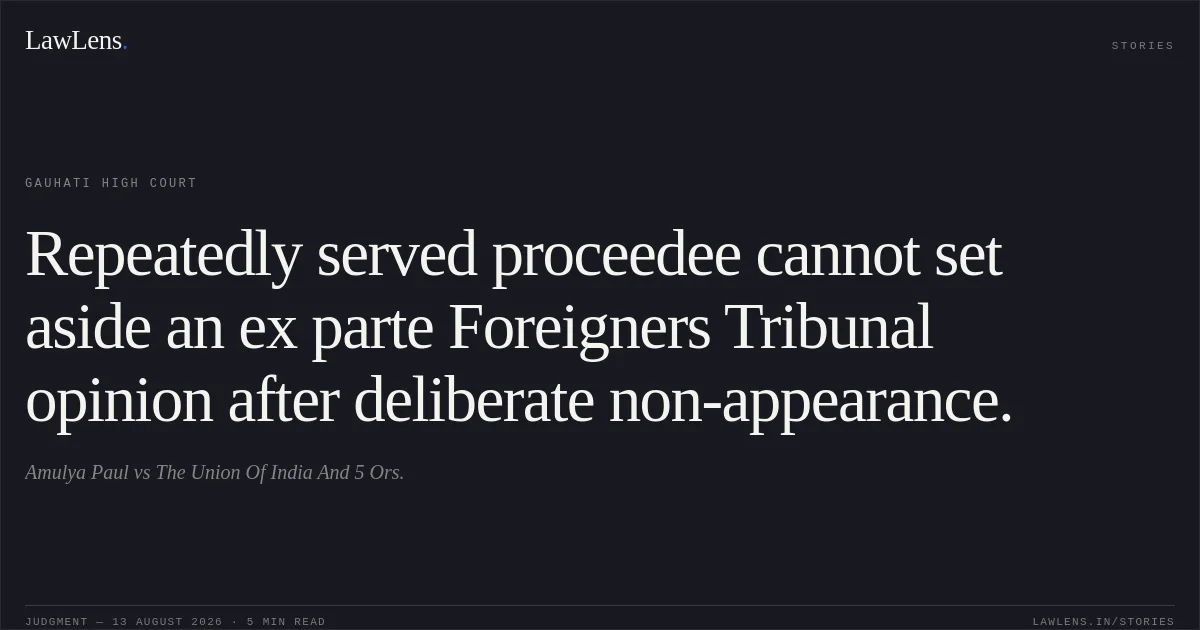
The petitioner challenged, under Article 226 of the Constitution, the ex parte opinion dated 13 September 2018 of the Foreigners Tribunal (2nd), Darrang, Mangaldai, in F.T. Case No. 620/2008 arising from Reference Case No. 7380/98, declaring him a foreigner who had entered Assam after 25 March 1971.
Source reference: p.3, para. 2The reference originated during the 1997 intensive revision of electoral rolls, when the Electoral Registration Officer doubted the petitioner’s citizenship and forwarded the matter for reference to the Tribunal.
Source reference: p.7, para. 15The proceedings had initially been instituted before the erstwhile Illegal Migrants (Determination) Tribunal and were subsequently transferred to the Foreigners Tribunal following the Supreme Court’s decision declaring the IM(DT) Act unconstitutional.
Source reference: p.7, para. 16The Tribunal’s record showed that the petitioner was served notices on three occasions, appeared once and filed his attendance on 19 April 2010, but thereafter remained absent for more than eight years despite further notices and repeated adjournments.
Source reference: pp.5–6, paras. 8–12Issues
Whether the ex parte opinion was vitiated because the process-server’s report did not specify the date on which the notice was served.
Source reference: pp.14–16, para. 22(a)Whether the Foreigners Tribunal exceeded the scope of the reference by declaring the petitioner a post-25 March 1971 foreigner when the notice referred to entry between 1 January 1966 and 25 March 1971.
Source reference: pp.17–24, para. 22(b)Whether the entry in the enquiry form stating that the petitioner was born in 1965 established his Indian citizenship under Section 3 of the Citizenship Act.
Source reference: pp.24–26, para. 22(c)Whether the petitioner was entitled to interference under Article 226 despite having been served repeatedly, having appeared initially, and thereafter deliberately remaining absent before the Tribunal.
Source reference: pp.5–6, 23–26, paras. 8–14 and 23–25Whether the initiation and transfer of the reference from the erstwhile IM(DT) Tribunal to the Foreigners Tribunal could be challenged at the writ stage.
Source reference: pp.7–14, paras. 15–21Law Applied
Under Section 2(a) of the Foreigners Act, 1946, a foreigner is a person who is not an Indian citizen, while Section 9 places the burden on the proceedee to prove that he is not a foreigner.
Source reference: p.8, paras. 17–18; p.16, para. 22(a)(ix)Order 2(1) of the Foreigners (Tribunals) Order, 1964 permits reference of the question whether a person is or is not a foreigner; paragraph 3(14) requires expeditious disposal of the reference, ordinarily within sixty days.
Source reference: pp.8, 11, 16, paras. 17.1, 20 and 22(a)(v)Section 6-A of the Citizenship Act, 1955 governs the special Assam Accord categories: persons entering before 1 January 1966 may be deemed citizens, persons entering between 1 January 1966 and 25 March 1971 fall within the statutory registration regime, and persons entering on or after 25 March 1971 are foreigners.
Source reference: pp.17–23, para. 22(b)The Court applied Article 226 of the Constitution and the limited scope of certiorari jurisdiction, holding that the High Court does not ordinarily reappreciate evidence or permit a party to introduce material not produced before the Tribunal, as explained in Sabitri Dey @ Swasthi Dey v. Union of India, Civil Appeal No. 2820/2024, 2026 INSC 694, and Council for Research in Ayurvedic Sciences v. Bikartan Das, 2023 INSC 733.
Source reference: pp.14–17, para. 22(a)(ix); p.14, para. 21The Court relied on Sarbananda Sonowal v. Union of India, (2005) 5 SCC 665, and Sarbananda Sonowal v. Union of India, (2007) 1 SCC 174, regarding the statutory burden under Section 9; and on Sayam Uddin, including its affirmation in W.A. No. 170/2019, and Shukurjan Nessa @ Sukurjan v. Union of India, W.P.(C) No. 245/2019, concerning references arising from electoral-roll verification and the transfer of IM(DT) proceedings.
Source reference: pp.8–14, paras. 18–21Reasoning
The Court examined the Tribunal record and found that the petitioner had been served three times, had personally appeared and filed his attendance on 19 April 2010, and had thereafter remained absent despite repeated opportunities.
Source reference: pp.5–6, paras. 8–12His non-disclosure of these facts in the writ petition amounted to suppression, although the Court nevertheless examined the merits because citizenship was involved.
Source reference: p.6, para. 14The omission of the date of service in one process-server’s report was held non-fatal because actual service was acknowledged by the petitioner’s signature, and he did not allege that service occurred after the date fixed for appearance.
Source reference: pp.14–16, para. 22(a)The Court held that a reference under Order 2(1) is fundamentally a reference on whether the person is a foreigner. The reference to the period between 1 January 1966 and 25 March 1971 merely invoked the possible application of Section 6-A; it did not prevent the Tribunal from determining, on the available material, that the petitioner was a post-25 March 1971 foreigner.
Source reference: pp.17–24, para. 22(b)The petitioner had not appeared to claim or prove the benefit of Section 6-A. Likewise, the 1965 birth entry in the former IM(DT) enquiry form was expressly based on his oral statement and did not constitute documentary proof of citizenship.
Source reference: pp.24–26, para. 22(c)The same form recorded that neither the petitioner nor his father was registered as an elector, and the petitioner failed to discharge the burden imposed by Section 9 of the Foreigners Act.
Source reference: pp.24–26, para. 22(c)Since the reference had originated under the earlier statutory regime and had been transferred pursuant to Sarbananda Sonowal, and because the petitioner did not challenge the reference despite repeated notices, the Court declined to reopen its initiation or transfer in certiorari proceedings.
Source reference: pp.13–14, paras. 19–21Holding
The Court answered all issues against the petitioner. It held that the ex parte opinion was not invalid merely because the process-server’s report omitted the date of service; the Tribunal did not exceed the reference by identifying the petitioner as a post-25 March 1971 entrant; and the 1965 birth entry did not prove Indian citizenship.
The writ petition was dismissed, and the ex parte opinion dated 13 September 2018 was not interfered with.
Source reference: p.26, paras. 25–26The interim bail granted to the petitioner on 13 May 2020 was recalled, and the consequences of the Foreigners Tribunal’s opinion were directed to follow.
Source reference: p.27, para. 27The parties were left to bear their own costs.
Source reference: p.27, para. 28Acts & Sections Cited
3 provisions across 2 statutes referred to in this judgment. Each provision opens on LawLens.
Citizenship Act, 19552
Illegal Migrants (Determination by Tribunals) Act, 19831
Original Court PDF
Amulya PaulvsThe Union Of India And 5 Ors.
Click to open original judgment
Original judgment, available to read, download and summarize on LawLens.in