Facts
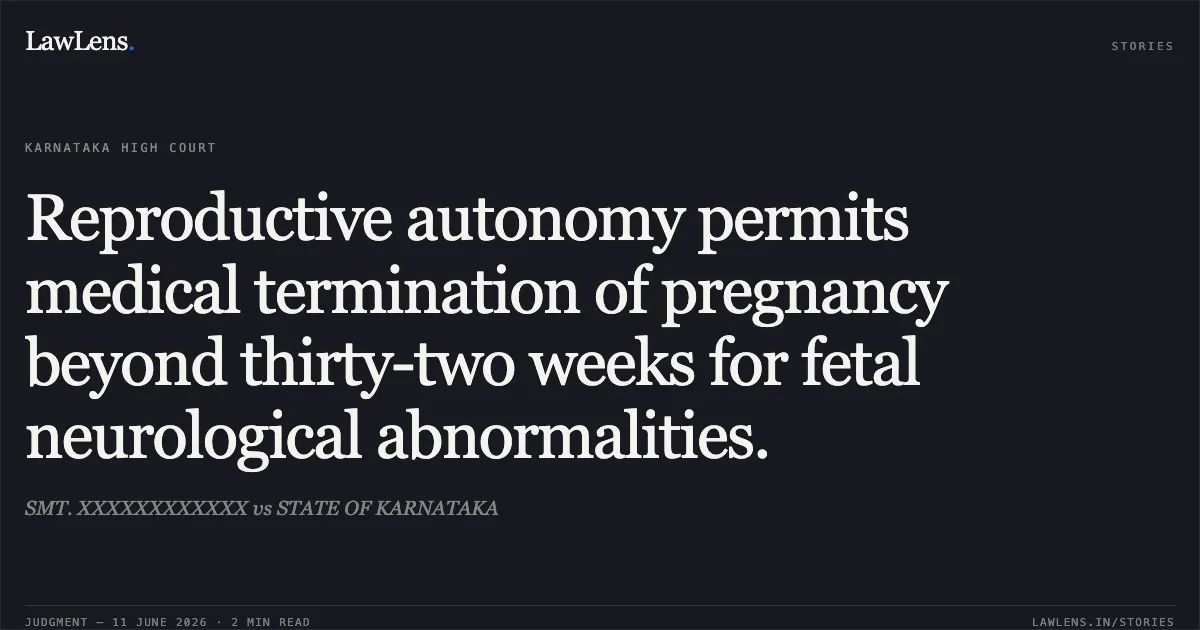
The Petitioner, a 36-year-old married woman with a healthy 10-year-old child, sought a writ of mandamus to medically terminate her pregnancy which had exceeded 32 weeks
Source reference: p. 2, para. 1-2Diagnostic scans conducted on 06.05.2026 and 07.05.2026 revealed significant structural fetal brain abnormalities, specifically partial agenesis of the corpus callosum and bilateral ventriculomegaly (enlargement of fluid-filled ventricles)
Source reference: p. 3-6, para. 4-11Medical experts advised that the condition provided a "poor neurological prognosis," including risks of motor dysfunction, spasticity, and severe intellectual disability
Source reference: p. 7-8, para. 14-15The court-ordered Medical Board confirmed these findings, noting that while the condition was not "invariably incompatible with life," there was a significant risk of profound developmental disability
Source reference: p. 9-11, para. 20-21.6Issues
1. Whether a pregnant woman can be permitted to terminate a pregnancy exceeding the statutory limit of 24 weeks when diagnostic imaging reveals significant congenital fetal abnormalities
Source reference: p. 18-20, para. 30-322. Whether the right to reproductive choice and bodily autonomy under Article 21 of the Constitution outweighs statutory limitations in cases of late-term fetal anomalies
Source reference: p. 20-22, para. 33-37Law Applied
Article 21 of the Constitution of India, which encompasses reproductive autonomy, bodily integrity, and the right to make decisional choices regarding pregnancy
Source reference: p. 19-20, para. 32-33The precedent of S v. The Union of India & Ors. (SLP (C) No. 14454/2026), which established that the passage of time does not extinguish a woman's right to reproductive choices and that Constitutional Courts should not take a prohibitory approach solely based on statutory periods or fetal normalcy
Source reference: p. 12-13, para. 22Medical Termination of Pregnancy Act, 1971, interpreting it through the lens of constitutional imperatives rather than mechanical statutory adherence
Source reference: p. 13, para. 15.4Reasoning
The Court reasoned that reproductive choice is a fundamental right that includes the "right not to procreate"
Source reference: p. 20, para. 34It rejected a technical approach to the 32-week gestation period because the abnormalities were only detectable via later scans; the Petitioner had been diligent, as an earlier scan on 04.04.2026 showed no anomalies
Source reference: p. 23, para. 39-40While the Medical Board noted the fetus might survive birth, the Court emphasized that "survival alone" is not the sole metric; the quality of life, neurological prognosis, and the emotional/financial burden on the parents must be considered
Source reference: p. 25, para. 43-44The Court concluded that compelling a woman to carry a pregnancy to term against her will after such a diagnosis constitutes a substantial intrusion into her bodily autonomy
Source reference: p. 26-27, para. 47It further noted that the Petitioner was prepared to bear all medical costs and that the selected facility, Anupama Hospital, was a registered medical establishment
Source reference: p. 16-17, para. 23.7, 24Holding
The Court allowed the Writ Petition and granted permission for the medical termination of the pregnancy
The Court held that the Petitioner’s right to bodily integrity and dignity necessitated the exercise of the Court’s extraordinary jurisdiction and directed Anupama Hospital to perform the procedure at the earliest, adhering to strict medical protocols and confidentiality
Source reference: p. 27, para. 51; p. 29-30, para. 54-59It further ordered that if the fetus is delivered alive, the medical team must provide all necessary care as per legal and ethical standards, and the Registry was directed to redact the Petitioner's identity to safeguard her privacy
Source reference: p. 31, para. 61; p. 32, para. 65Acts & Sections Cited
1 provisions across 1 statute referred to in this judgment. Each provision opens on LawLens.
Medical Termination of Pregnancy Act, 19711
Original Court PDF
SMT. XXXXXXXXXXXXvsSTATE OF KARNATAKA
Click to open original judgment
Original judgment, available to read, download and summarize on LawLens.in