Facts
The Appellant awarded the Respondent an EPC contract dated 09.05.2018 for rehabilitation and upgradation of approximately 31.918 km of NH-752H, at a contract price of approximately ₹153.59 crore.
Source reference: p.1, para. 2Disputes arose concerning delays, right-of-way issues, pavement defects and defective PQC panels.
Source reference: pp.2–3, paras. 3, 6The Appellant relied on 22 Non-Conformity Reports and alleged that defective panels increased from 66 in 2024 to 259 by June 2025.
Source reference: pp.2–3, paras. 3, 6After issuing directions for rectification and undertaking risk-and-cost rectification, the Appellant issued a Notice of Intention to Terminate dated 13.06.2025 under Article 23.1.2 of the EPC Agreement.
Source reference: p.2, para. 4The Respondent contended that the project was substantially complete, that PCOD had been recommended, and that delays were attributable to the Appellant.
Source reference: pp.3–4, paras. 8–12The Arbitral Tribunal restrained the Appellant from acting on the termination notice and from invoking the Performance Bank Guarantee pending arbitration.
Source reference: p.4, para. 5The Appellant challenged that order under Section 37(2)(b) of the Arbitration and Conciliation Act, 1996.
Source reference: p.4, paras. 14–16Issues
1. Whether the Arbitral Tribunal erred in restraining the Appellant from acting upon the Notice of Intention to Terminate issued under Article 23.1.2 of the EPC Agreement.
Source reference: p.4, para. 162. Whether the Arbitral Tribunal was justified in restraining invocation and encashment of the Performance Bank Guarantee pending arbitration.
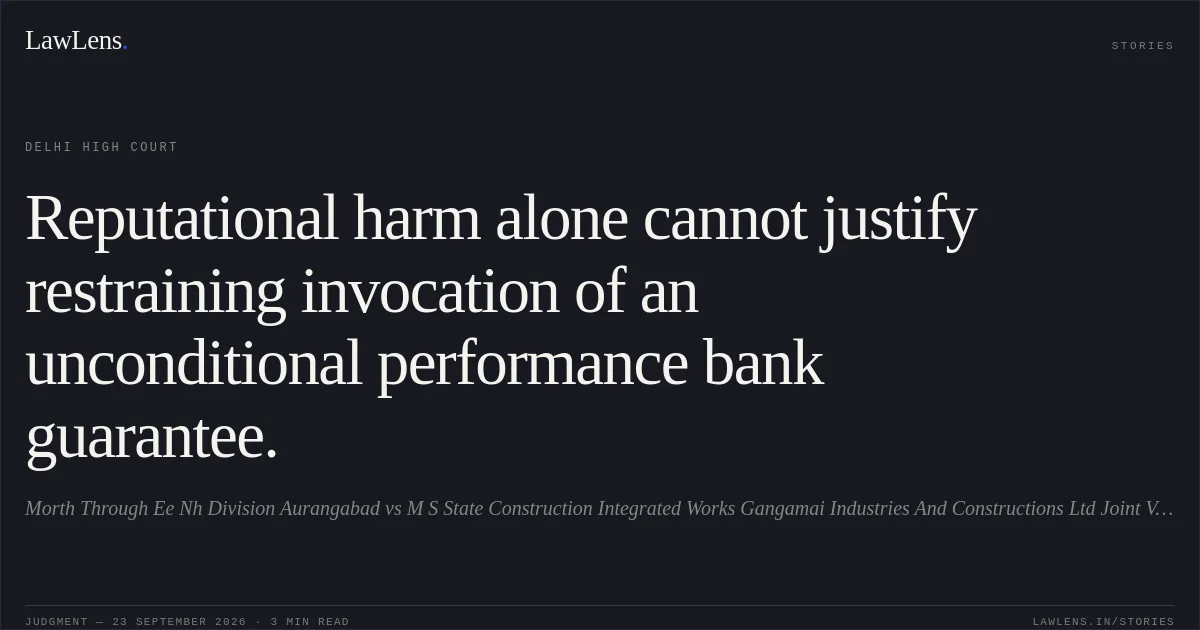
Source reference: p.4, para. 16; p.22, para. 353. Whether alleged reputational injury constituted irretrievable harm or special equity sufficient to restrain invocation of an unconditional bank guarantee.
Source reference: pp.23–26, paras. 42–48Law Applied
The Court applied the limited scope of appellate interference under Section 37(2)(b) of the Arbitration and Conciliation Act, 1996.
Source reference: p.4, paras. 14–16Under Articles 11 and 17 of the EPC Agreement, the contractor remains responsible for defective work and must rectify defects; failing such rectification, the Authority may engage another agency and recover the costs.
Source reference: pp.20–21, paras. 22–24Article 23.1 permits termination for Contractor Default only after the contractual default, cure-period and notice requirements are satisfied, whereas Article 23.3 separately permits termination for convenience.
Source reference: pp.17–21, paras. 26–30Article 26.3.5 keeps the Agreement and the parties’ rights and obligations in force pending the arbitral award.
Source reference: p.20, para. 21Relying on K.S. Manjunath v. Moorasavirappa, 2025 INSC 1298, the Court distinguished contracts terminable without cause from contracts terminable only upon specified breach and compliance with notice and cure requirements.
Source reference: pp.21–22, paras. 26–30Regarding bank guarantees, the Court applied U.P. State Sugar Corporation v. Sumac International Ltd., (1997) 1 SCC 568: an unconditional bank guarantee should ordinarily be honoured, and injunction is permissible only for egregious fraud or exceptional, irretrievable injustice or special equity.
Source reference: pp.23–24, paras. 36–39Reasoning
The Tribunal had considered the PCOD recommendation, successful Schedule-K tests, prior rectification, the highway’s continued operation and the disputed technical evidence, and had prima facie found that the alleged default remained contested.
Source reference: pp.5–6, para. 18; p.22, paras. 31–34Since the Appellant’s notice invoked Article 23.1.2, it had to establish the contractual basis for termination for default and could not rely on the separate convenience-termination power under Article 23.3.
Source reference: p.22, paras. 29–30The contractual scheme also provided alternative remedies under Articles 11.13.2 and 17.4, including risk-and-cost rectification, without necessarily terminating the Agreement.
Source reference: p.20, paras. 22–25Given the narrow scope of review and the Tribunal’s preservation of the contractual relationship pending arbitration, the restraint on acting upon the termination notice did not warrant interference.
Source reference: p.22, paras. 31–34However, the bank guarantee was an independent and undisputed unconditional guarantee. No fraud was pleaded, and the Tribunal itself accepted that encashment could be compensated financially.
Source reference: pp.23–25, paras. 40–43Reputational injury arising from termination did not demonstrate exceptional and irretrievable harm specifically caused by encashment of the guarantee.
Source reference: pp.25–26, paras. 44–48Accordingly, the second exception to the rule against restraining unconditional bank guarantees was not established.
Source reference: no citationHolding
The Court partly allowed the appeal.
It upheld the restraint against the Appellant acting upon the Notice of Intention to Terminate under Article 23.1.2, since the alleged Contractor Default was disputed and the Tribunal’s prima facie assessment was not shown to be perverse or warranting appellate interference.
Source reference: p.22, paras. 30–34However, it set aside the restraint on invocation and encashment of the Performance Bank Guarantee because neither egregious fraud nor irretrievable injustice was established, and reputational injury was insufficient in the circumstances.
Source reference: pp.25–26, paras. 46–50Acts & Sections Cited
2 provisions across 1 statute referred to in this judgment. Each provision opens on LawLens.
Arbitration and Conciliation Act, 19962
Original Court PDF
Morth Through Ee Nh Division AurangabadvsM S State Construction Integrated Works Gangamai Industries And Constructions Ltd Joint Venture
Click to open original judgment
Original judgment, available to read, download and summarize on LawLens.in