Facts
The eight applicants, belonging to the unreserved category, are employed in various capacities (Firemen, Leading Firemen, and Sub-Officers) within the Delhi Fire Services
Source reference: p. 1-3They challenged the respondents' practice of applying reservation policies in promotions without adhering to the constitutional mandates established by the Supreme Court
Source reference: para 2.4Specifically, the applicants alleged that the respondents conducted several Departmental Promotion Committees (DPCs) between 2006 and 2014, allowing reserved category candidates to "steal a march" over unreserved candidates without first collecting quantifiable data on backwardness and inadequacy of representation
Source reference: para 2.4-2.5The respondents contended that the Original Application (OA) was barred by limitation, having been filed nearly 9.5 years after the judgment in M. Nagaraj, and was further bad for the non-joinder of the Department of Personnel and Training (DOP&T)
Source reference: para 3.1-3.2Issues
1. Whether the respondents were required to review past promotions and DPCs in the Delhi Fire Service cadres to ensure compliance with the requirement of collecting quantifiable data as per M. Nagaraj v. Union of India
Source reference: para 1(i), 2.52. Whether the principles laid down in M. Nagaraj regarding reservation in promotions operate retrospectively or prospectively
Source reference: para 5.3, 5.4Law Applied
The Tribunal primarily applied the principles from M. Nagaraj & Ors. v. Union of India (2006), which held that while the State is not bound to make reservations in promotion under Articles 16(4-A) and 16(4-B), if it chooses to do so, it must collect quantifiable data showing the backwardness of the class and inadequacy of its representation
Source reference: para 5.2It further relied on the clarifying judgment in Jarnail Singh & Ors. v. Lachhmi Narain Gupta (2022), which established that the unit for collecting such data must be a "cadre" and not a "group" or "service"
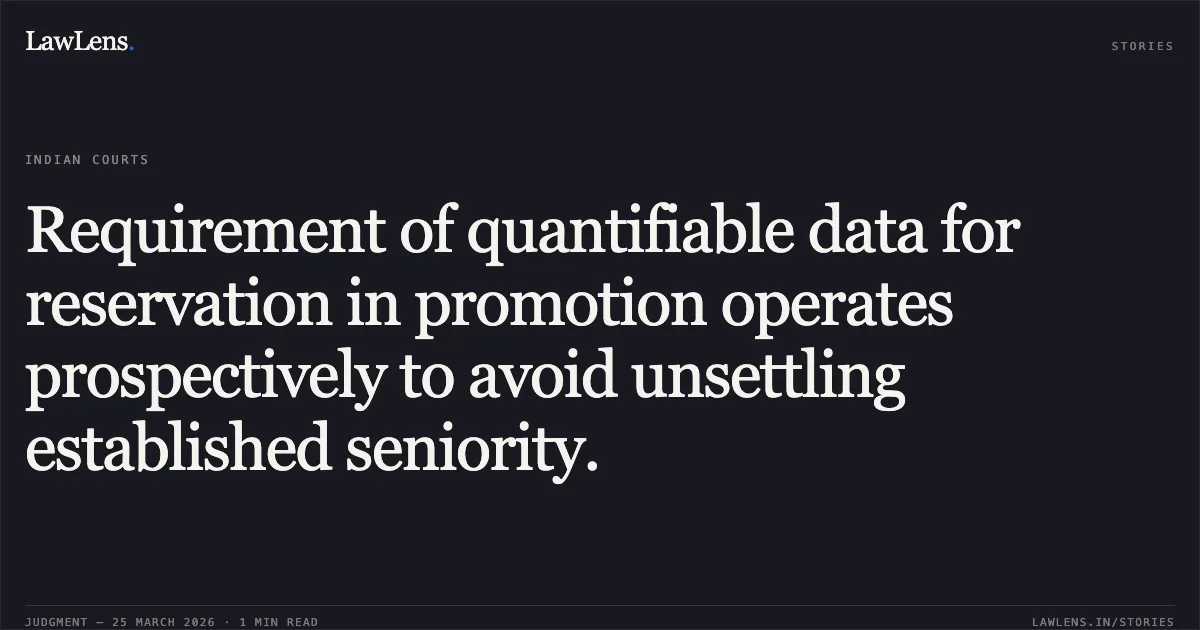
Source reference: para 45-47Crucially, Jarnail Singh invoked Article 142 to declare that the judgment in M. Nagaraj shall have prospective effect only, to avoid unsettling long-standing seniority and causing administrative chaos
Source reference: para 5.4Reasoning
The Tribunal analyzed the applicants' prayers for the review of illegal DPCs and reversions of promoted staff in light of the evolving jurisprudence on reservation in promotions
Source reference: para 5.1The court observed that while M. Nagaraj set the criteria for reservation in promotions, the subsequent ruling in Jarnail Singh explicitly restricted the application of these criteria to future actions
Source reference: para 5.4The Tribunal noted that the Supreme Court intended to avoid the "debilitating effect" on employees who had already availed promotions or retired since 1995
Source reference: para 5.4, para 42Since the applicants sought to challenge and review DPCs that occurred years prior (between 2006 and 2014) based on the M. Nagaraj standards, the Tribunal reasoned that granting such relief would contravene the "prospective effect" mandate established in Jarnail Singh
Source reference: para 6Holding
The Tribunal held that in view of the prospective application of M. Nagaraj as clarified in Jarnail Singh, no relief could be granted to the applicants regarding the review of past DPCs or promotions
The OA was disposed of with the observation that the ratio in Jarnail Singh must be followed in letter and spirit for future actions
Source reference: para 6The Tribunal granted the applicants liberty to agitate individual grievances in the future, provided they are in accordance with the law
Source reference: para 6No order was made as to costs
Source reference: para 7Original Court PDF
Bijender SinghvsGovt. Of Nctd
Click to open original judgment
Original judgment, available to read, download and summarize on LawLens.in