Facts
Respondent No. 1 owned agricultural lands bearing Revenue Survey Nos. 571–574 at Village Nava, Deesa, while the petitioners owned lands bearing Survey Nos. 331 and 332 at Village Khareda, Saraswati, District Patan.
Source reference: paras. 2.1–2.2Respondent No. 1 instituted proceedings under Section 5(2) of the Mamlatdar’s Courts Act, 1906, alleging that the petitioners had obstructed a pathway historically used for access to his agricultural fields.
Source reference: para. 2.3Although a panchnama was prepared, the Mamlatdar, Deesa rejected the proceedings by order dated 11 August 2021.
Source reference: paras. 2.4–2.5On revision, the Deputy Collector, Deesa quashed the Mamlatdar’s order and directed that the pathway be opened for Respondent No. 1.
Source reference: para. 2.6The petitioners challenged the Deputy Collector’s order under Article 226 of the Constitution, contending principally that an earlier proceeding concerning the same pathway had been rejected in their favour and that the subsequent claim was barred by res judicata; they also disputed the existence of the pathway and raised limitation-related objections.
Source reference: paras. 3–4Respondent No. 1 contended that the earlier proceeding involved different parties and a distinct cause of action, and relied on village maps, panchnamas and governmental sketches showing the existence of the pathway and absence of an alternative access route.
Source reference: paras. 6–9Issues
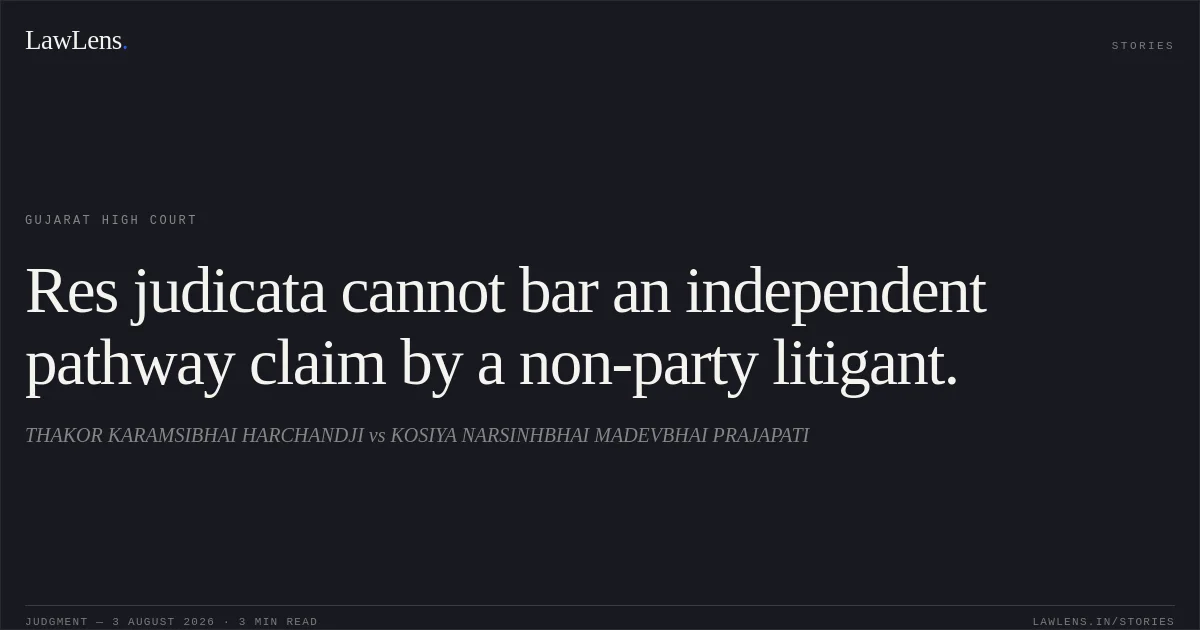
Whether the Mamlatdar could reject Respondent No. 1’s independent proceedings under Section 5 of the Mamlatdar’s Courts Act, 1906, on the ground of res judicata arising from an earlier proceeding involving different parties?
Source reference: paras. 14–18Whether the Deputy Collector committed any patent illegality, perversity or jurisdictional error in reversing the Mamlatdar’s order and directing restoration of the pathway?
Source reference: paras. 13, 22–23Law Applied
The Court applied Section 5(2) of the Mamlatdar’s Courts Act, 1906, concerning summary relief against obstruction of a customary or existing right of way.
Source reference: no citationIt relied on Section 11 of the Code of Civil Procedure, 1908, under which res judicata requires, among other conditions, that the matter was directly and substantially in issue in a former proceeding between the same parties, or parties claiming under them, litigating under the same title, and that it was finally decided by a competent court.
Source reference: paras. 16–18The Court further relied on Union of India v. Pramod Gupta, (2005) 12 SCC 1, for the principle that res judicata applies only where the lis is inter partes and has attained finality concerning the issues involved; the doctrine does not ordinarily bind a person who was not a party to the earlier litigation.
Source reference: para. 20A distinct obstruction or independent cause of action must therefore be examined on its own merits under the applicable statute.
Source reference: para. 21Reasoning
The Court held that the earlier proceeding had been instituted by a different litigant and that Respondent No. 1 was neither a party to it nor claiming as a successor or representative of that litigant.
Source reference: paras. 16–18Consequently, the essential requirement of identity of parties or privity was absent, and the earlier decision could not operate as res judicata against Respondent No. 1’s independent claim for access.
Source reference: paras. 16–21The Court also found that the materials relied upon by Respondent No. 1—including village maps, the plaint, affidavit, panchnama and sketches prepared by the Public Works Department—supported the existence of the disputed pathway and its use by Respondent No. 1, with no apparent alternative access route.
Source reference: para. 22On review of the Deputy Collector’s factual findings, the Court found no patent perversity, illegality or other ground warranting interference under Article 226.
Source reference: para. 23Holding
The Court answered the principal issue in the negative: the Mamlatdar could not dismiss Respondent No. 1’s proceedings on the basis of res judicata because the earlier litigation involved different parties and did not adjudicate Respondent No. 1’s independent claim.
Finding no legal or jurisdictional error in the Deputy Collector’s order, the Court dismissed the writ petition, discharged the notice, vacated any interim order, and disposed of the connected civil application.
Source reference: paras. 23–25Acts & Sections Cited
1 provisions across 1 statute referred to in this judgment. Each provision opens on LawLens.
Code of Civil Procedure, 19081
Original Court PDF
THAKOR KARAMSIBHAI HARCHANDJIvsKOSIYA NARSINHBHAI MADEVBHAI PRAJAPATI
Click to open original judgment
Original judgment, available to read, download and summarize on LawLens.in