Facts
SAIL issued a tender through the Government e-Marketplace (GeM) on 5 December 2025 for handling, processing and management of raw material, scrap and slag at the IISCO Steel Plant.
Source reference: paras. 3, 16–17The tender conditions provided that, where the lowest bidder was a non-MSE and the order could not be split, the entire order would be placed with an eligible MSE whose quoted price was within 15% of the L1 price, subject to the MSE matching the L1 price.
Source reference: paras. 3, 16–17The writ petitioner, Metal Traders Processing Company, was an MSE holding a valid Udyam registration certificate.
Source reference: paras. 4–6After the reverse auction, United Air Express was ranked L1, FSNL Private Limited L2, and the writ petitioner L3.
Source reference: paras. 4–6SAIL sought clarification from GeM because the GeM portal did not provide a price-matching option for the relevant ITC-enabled bid.
Source reference: paras. 18–21GeM informed SAIL that MSE purchase preference was not available through the system and advised SAIL to conduct the price matching with eligible MSEs offline.
Source reference: paras. 18–21No such opportunity was given to the writ petitioner.
Source reference: paras. 8–9Although a letter of award was issued to United Air Express, SAIL continued the existing contract up to 30 September 2026.
Source reference: paras. 8–9The learned Single Judge directed SAIL and the concerned authorities to invite the writ petitioner to match the L1 price and, if it did so in accordance with the procurement policy, to take appropriate consequential action, including recalling the work order issued to United Air Express.
Source reference: paras. 8–9United Air Express preferred the present appeal, contending that the Single Judge had impermissibly altered the tender process and undermined the sanctity of the reverse auction.
Source reference: paras. 10–11Issues
Whether SAIL and GeM committed procedural impropriety by failing to treat the writ petitioner as an eligible MSE and by denying it the opportunity to match the L1 price in accordance with the tender conditions?
Source reference: para. 15Whether the High Court, in exercise of judicial review under Article 226, could interfere with the award of the contract on the ground that the tender conditions had not been followed?
Source reference: paras. 23–24Whether the issuance of the letter of award in favour of United Air Express created an enforceable right to execute the contract despite the alleged violation of the tender conditions?
Source reference: paras. 22, 27–29Law Applied
The Court applied the tender conditions incorporating the Government of India’s MSE procurement preference policy, particularly the requirement that, where the order could not be split and the L1 bidder was a non-MSE, an eligible MSE quoting within L1 plus 15% had to be given an opportunity to match the L1 price.
Source reference: paras. 16–17It also referred to Rule 149 of the General Financial Rules, 2017, which governs procurement by government authorities through GeM.
Source reference: para. 12Under Article 226, judicial review in tender matters is concerned principally with the legality and fairness of the decision-making process, rather than with substituting the court’s commercial judgment for that of the tendering authority.
Source reference: para. 24The Court relied on Tata Cellular v. Union of India, (1994) 6 SCC 651, and Silppi Constructions Contractors v. Union of India, (2020) 16 SCC 489, for the principle that judicial intervention is permissible where there is an infirmity in the tender decision-making process.
Source reference: para. 24A contract awarded in breach of the express tender conditions cannot create a legally protected right in favour of the successful bidder.
Source reference: para. 27Reasoning
The tender expressly incorporated MSE purchase preference and required an eligible MSE whose bid was within 15% of L1 to be given an opportunity to match the L1 price.
Source reference: paras. 16–17The writ petitioner satisfied the relevant MSE eligibility requirements and its bid fell within the prescribed price band.
Source reference: paras. 16–17The communications between SAIL and GeM demonstrated that both authorities were aware that the GeM portal lacked an electronic price-matching mechanism and that GeM had specifically advised SAIL to complete the process offline.
Source reference: paras. 18–22SAIL nevertheless failed to offer the writ petitioner the contractually stipulated opportunity.
Source reference: para. 23The Court treated this omission as a violation of the tender conditions and a gross procedural infirmity, not as a permissible alteration of the commercial terms of the tender.
Source reference: para. 23The Court rejected the appellant’s contention that the direction to undertake price matching undermined the reverse auction.
Source reference: paras. 22, 25–27The direction merely required compliance with a pre-existing tender condition that had not been implemented because of a technical limitation of the GeM portal.
Source reference: paras. 22, 25–27Since the appellant participated in the tender with knowledge of the price-matching provision, it could not claim a legally protected right founded on an award that was itself made contrary to the tender terms.
Source reference: paras. 22, 25–27Any loss suffered by the appellant through mobilisation or overhead expenditure could be pursued as a claim for damages, but it did not prevent judicial correction of the defective procurement process.
Source reference: para. 28Holding
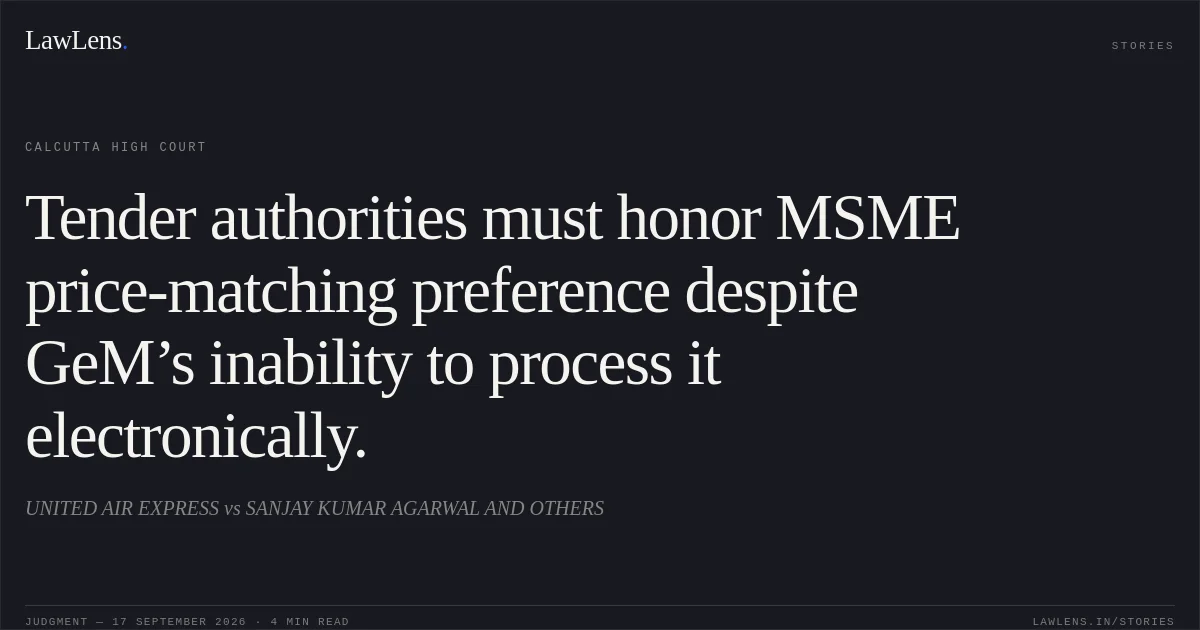
The Court held that SAIL had acted in breach of the tender conditions by failing to provide the eligible MSE writ petitioner an opportunity to match the L1 price.
The award in favour of United Air Express was therefore procedurally vitiated, and no enforceable right to execute the work arose from that award.
Source reference: paras. 23, 25–29The appeal and the connected application were dismissed, and the Single Judge’s direction requiring SAIL to invite the writ petitioner to match the L1 price was upheld.
Source reference: paras. 30–31The subsequent request by United Air Express for stay of the judgment was also rejected.
Source reference: paras. 33–34Original Court PDF
UNITED AIR EXPRESSvsSANJAY KUMAR AGARWAL AND OTHERS
Click to open original judgment
Original judgment, available to read, download and summarize on LawLens.in