Facts
The petitioner, an Appraiser in the Kolkata Customs Commissionerate, challenged a charge memorandum dated 25 May 2015.
Source reference: no citationIn OA 1025/2020, the Kolkata Bench of the Central Administrative Tribunal declined to interfere with the charge memorandum, directed that the petitioner be given a final opportunity to inspect the relied-upon documents, and ordered completion of the disciplinary proceedings within six months. It expressly stated that it had not considered the merits of the disciplinary proceedings.
Source reference: paras. 5–7The proceedings remained pending after the six-month period expired. The Inquiry Officer had also communicated that the requested articles were not in the possession of the Inquiry Officer or Presenting Officer.
Source reference: paras. 8–10After issuing a legal notice, the petitioner filed OA 2876/2026, which the Tribunal dismissed as barred by res judicata because of the earlier OA. The petitioner challenged that dismissal before the High Court.
Source reference: paras. 2–3, 11–14Issues
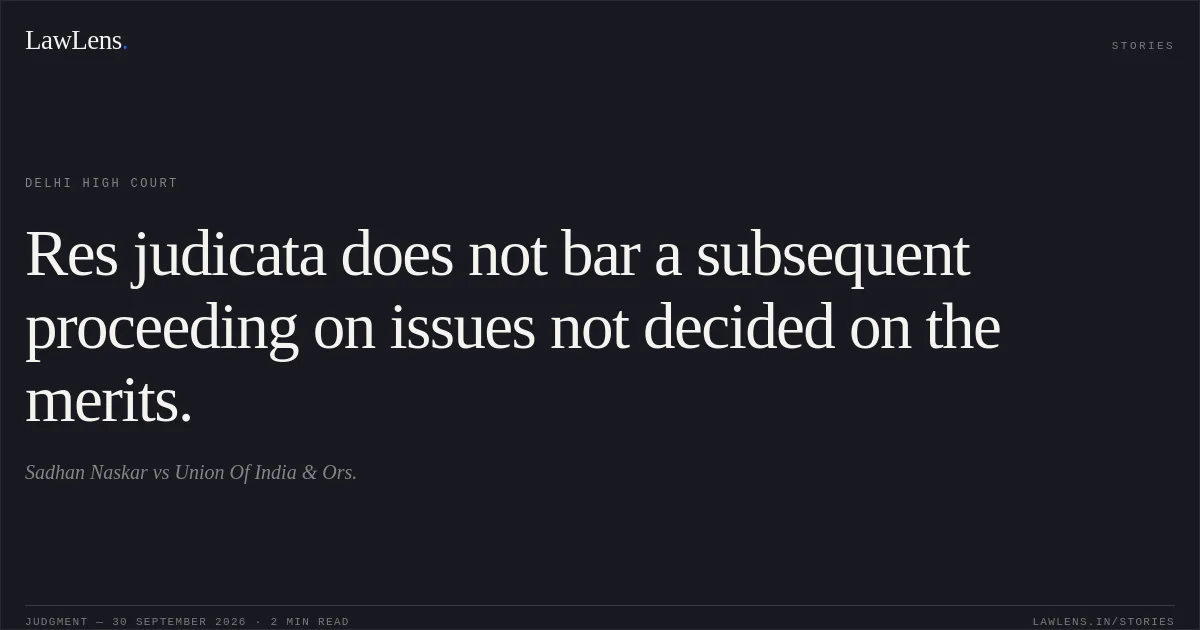
1. Whether OA 2876/2026 was barred by res judicata because of the order in the petitioner’s earlier OA 1025/2020.
Source reference: para. 32. Whether the earlier order had adjudicated on the merits the issues raised in the subsequent OA, so as to preclude their consideration.
Source reference: paras. 18–20, 23Law Applied
The Court applied the principle of res judicata, embodied in Section 11 of the Code of Civil Procedure and applicable, as a general principle, beyond proceedings strictly governed by that provision.
Source reference: para. 18Under Satyadhyan Ghosal v. Deorajin Debi, res judicata gives finality to matters heard and finally decided between parties, including at successive stages of litigation.
Source reference: p. 14, para. 18Ram Gobinda Dawan v. Smt. Bhaktabala and Sheodan Singh v. Daryao Kunwar affirm that the prior decision must finally determine the matter in question; however, dismissal of an appeal on a preliminary ground may still operate as res judicata where it confirms a decision on the merits.
Source reference: pp. 9–14, para. 18The Court also recognised that a Tribunal may be approached at the charge-sheet stage if circumstances warrant interference.
Source reference: p. 15, para. 24Reasoning
The Kolkata Bench had expressly refrained from deciding the merits of the disciplinary allegations, while directing an opportunity to inspect documents and completion of the proceedings within six months.
Source reference: paras. 7, 19The later OA raised issues that had not been adjudicated in the earlier proceeding and followed the expiry of the Tribunal’s deadline without completion of the inquiry; the Inquiry Officer’s communications also recorded that the requested articles were not held by the Inquiry Officer or Presenting Officer.
Source reference: paras. 8–10, 21–23Accordingly, the earlier order did not constitute a final merits decision on the issues raised in OA 2876/2026, and res judicata could not justify its dismissal. The High Court left the merits of the petitioner’s contentions open for the Tribunal to determine.
Source reference: para. 23Holding
The High Court held that the Tribunal had erred in dismissing OA 2876/2026 on the ground of res judicata.
It quashed the impugned order and remanded the OA to the Tribunal for hearing on the merits, directing the Tribunal Registry to notify counsel of the hearing date.
Source reference: paras. 25–26Acts & Sections Cited
1 provisions across 1 statute referred to in this judgment. Each provision opens on LawLens.
Code of Civil Procedure, 19081
Original Court PDF
Sadhan NaskarvsUnion Of India & Ors.
Click to open original judgment
Original judgment, available to read, download and summarize on LawLens.in