01Facts
The respondents—Mahananda, claiming to be the petitioner’s wife, and two sons—filed a petition under Section 125 Cr.P.C. seeking ₹12,000 per month as maintenance, alleging that the petitioner, a Head Constable, had neglected and subjected them to cruelty.
¶ 3–4The petitioner denied the marital and parental relationships and relied upon earlier maintenance proceedings, including Crl.Misc. Nos. 94/1997 and 47/2000, which had been dismissed on the ground that the relationships were not established.
¶ 5–6, 18The present maintenance petition, Crl.Misc. No. 406/2012, was initially dismissed and was twice remanded by the High Court in RPFC Nos. 100054/2015 and 100168/2023, including with an observation that strict proof of marriage was unnecessary in proceedings under Section 125 Cr.P.C.
¶ 7–8, 15On remand, the Family Court held that respondent No.1 was the petitioner’s wife and respondent No.3 was his son, awarding ₹5,000 per month to the wife and ₹3,000 per month to the minor son until majority; maintenance was not awarded to respondent No.2, who had attained majority.
¶ 9The husband challenged that order under Section 19(4) of the Family Courts Act, 1984, principally contending that the claim was barred by res judicata and that the relationships had not been proved.
¶ 10–1102Issues
i.1. Whether the Family Court’s finding that respondent No.1 was the petitioner’s wife and respondent No.3 was his son was perverse or contrary to law so as to require interference in revision?
¶ 14ii.2. Whether the earlier dismissal of maintenance proceedings operated as res judicata or otherwise barred the subsequent petition under Section 125 Cr.P.C.?
¶ 18–25iii.3. Whether the evidence on record sufficiently established the relationships for the limited purpose of claiming maintenance under Section 125 Cr.P.C.?
¶ 26–3103Law Applied
The Court applied Section 125 Cr.P.C., which provides a summary remedy for maintenance to a wife and children unable to maintain themselves, and Section 19(4) of the Family Courts Act, 1984, governing the revisional jurisdiction of the High Court over orders of a Family Court.
¶ 1, 3It relied on the principle that strict proof of a valid marriage is not required in proceedings under Section 125 Cr.P.C.
¶ 8, 15, 31The Court further applied the rule that res judicata does not ordinarily apply to summary proceedings under Section 125 Cr.P.C.; a subsequent application may be maintained where there is a change in circumstances or a fresh cause of action, as recognised in Mohd. Abdul Samad v. State of Telangana, (2025) 2 SCC 49, and discussed in Chanchlesh Singare v. Smt. Rashmi Singare.
¶ 22–24The Court also considered the principle that maintenance proceedings must be determined on the evidence and circumstances existing in the subsequent proceeding, rather than being rejected solely on the basis of an earlier dismissal.
¶ 23–27Provisions in the judgment · 6 · Linked ones open on LawLens
Family Courts Act, 1984 Section 19
Code of Criminal Procedure, 1973 Section 125Section 127
Indian Penal Code, 1860 Section 324Section 504Section 506
04Reasoning
The Court rejected the husband’s res judicata argument because the present proceedings involved subsequent developments, including the birth of respondent No.3 and the birth and subsequent death of another child, as well as the later disposal of the maintenance proceedings against Ramachandra.
¶ 25–27The earlier dismissal did not conclusively prevent consideration of a later maintenance claim in the context of changed circumstances and the summary nature of Section 125 proceedings.
¶ 23–27On the merits, the Court found substantial material supporting the claimed relationships: birth certificates identified the petitioner as the father of respondent No.3 and the deceased child; those documents had not been challenged; the petitioner’s departmental correspondence referred to the claimant as his wife and indicated the existence of a first marriage; and the petitioner admitted in cross-examination that he had lived with the respondents as wife and children.
¶ 27–30His payment of interim maintenance was also noted.
¶ 28In light of this evidence and the relaxed standard applicable under Section 125 Cr.P.C., the Family Court’s findings were neither perverse nor legally unsustainable.
¶ 31–3205Holding
The High Court answered the principal issue in the negative and held that the Family Court’s order did not warrant interference.
¶ 14–15The revision petition was dismissed, thereby affirming the award of ₹5,000 per month to respondent No.1 and ₹3,000 per month to respondent No.3 until he attained majority.
¶ 9, 32–33Respondents Nos.1 and 3 were permitted to pursue appropriate legal remedies for recovery of arrears, as the maintenance order had been stayed during the pendency of the revision petition.
¶ 33(ii)Original Court PDF
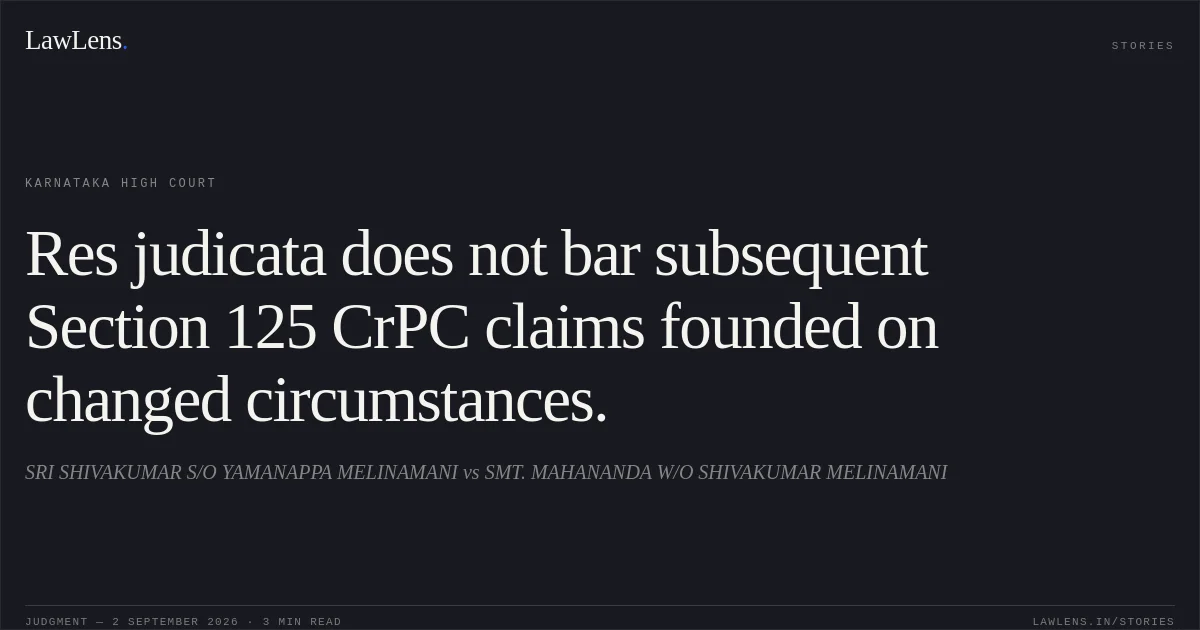
SRI SHIVAKUMAR S/O YAMANAPPA MELINAMANIvsSMT. MAHANANDA W/O SHIVAKUMAR MELINAMANI
Click to open original judgment
Original judgment, available to read, download and summarize on LawLens.in