01Facts
The petitioners were the judgment-debtors/legal heirs of Ranganayaki, against whom a decree for recovery of possession had been passed in respect of the suit property.
¶ 7, 11–12Ranganayaki had contested the original suit but had described herself as a permissive occupant and had not claimed co-ownership or inheritance rights in the property.
¶ 7, 11–12The decree for possession was ultimately passed by the High Court in S.A.No.1103 of 2002 and had attained finality.
¶ 7, 12–13During execution proceedings, the petitioners filed an application under Section 47 of the Code of Civil Procedure, contending that their maternal grandfather, Govindasamy Chettiar, had acquired the property, and that their mother, as his daughter, had inherited a share in it.
¶ 8–10They argued that the partition decree in O.S.No.9 of 1958, obtained only between the male heirs, was fraudulent and void for excluding the daughters.
¶ 8–10The executing Court dismissed the application, leading to the present revision petition.
¶ 102Issues
i.1. Whether the petitioners, as legal heirs of the original judgment-debtor, could invoke Section 47 CPC to challenge the executability of a final decree for possession on the ground that their mother was a co-owner of the property?
¶ 7, 15, 18ii.2. Whether Ranganayaki, whose father died in 1931, acquired an inheritable share in his self-acquired property under the Hindu Succession Act, 1956?
¶ 8, 16–17iii.3. Whether the exclusion of the daughters from the 1958 partition proceedings amounted to fraud on the Court, rendering the partition decree void or unenforceable?
¶ 9–10, 17, 1903Law Applied
The Court applied Section 47 CPC, under which questions relating to the execution, discharge or satisfaction of a decree must be determined by the executing Court, but which cannot ordinarily be used to reopen matters concluded by a final decree.
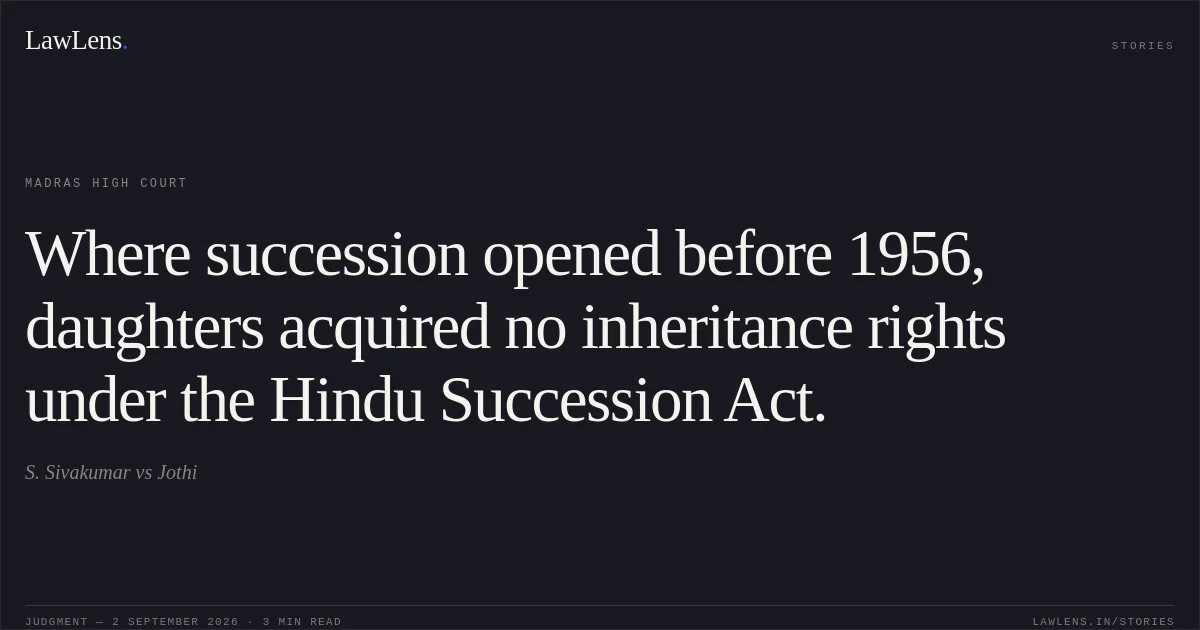
It held that succession is governed by the law applicable when succession opens; since Govindasamy Chettiar died in 1931, succession was governed by the prevailing customary Hindu law, under which the daughters were not entitled to inherit in the circumstances of the case.
¶ 16–17, 19The Hindu Succession Act, 1956 was treated as prospective and applicable only where the succession opened after its commencement on 17 June 1956, relying on Eramma v. Veerupana .
¶ 22The Court distinguished Arunachala Gounder v. Ponnusamy because succession in that case opened after 1956, and also found A. John v. Vasanthi and A.V. Papayya Sastry v. Government of A.P. inapplicable on their facts.
¶ 19, 21The Court also relied on Radhabai Balasaheb Shirke v. Keshav Ramchandra Jadhav , following Kasabai Tukaram Karwar v. Nivruti , on the principle that inheritance must be determined with reference to the date on which succession opened.
¶ 22Provisions in the judgment · 4 · Linked ones open on LawLens
Code of Civil Procedure, 1908 Section 115Section 47
Hindu Succession Act, 1956 Section 8Section 15
04Reasoning
The Court held that the petitioners’ claim was untenable for both factual and legal reasons.
Factually, Ranganayaki had expressly accepted the character of a permissive occupant in the original proceedings, and the petitioners’ father had also admitted that she entered possession by permission in 1968.
¶ 11–13The issue of her alleged right to remain in possession as a co-owner had therefore neither been pleaded nor established in the original suit, and the decree for possession had become final.
¶ 7, 12, 15Legally, Govindasamy Chettiar’s death in 1931 meant that succession opened before the Hindu Succession Act came into force; consequently, the Court held that Ranganayaki had no inheritable share under the law then applicable.
¶ 16–17Since no subsisting co-ownership right existed, the exclusion of the daughters from the 1958 partition decree could not constitute fraud on the Court, and the petitioners could not use Section 47 CPC to assert a right that their parents had not pleaded and that was inconsistent with the final decree.
¶ 17–1905Holding
The Court answered the issues against the petitioners.
¶ 22–24It held that Ranganayaki was not entitled to inherit a share in the property because succession opened in 1931, before the commencement of the Hindu Succession Act, 1956.
¶ 22–24Her admission that she was a permissive occupant, together with the finality of the decree for possession, barred the petitioners from challenging execution on the basis of alleged co-ownership.
¶ 22–24The Court found no fraud, illegality or perversity in the executing Court’s order and dismissed the Civil Revision Petition.
¶ 22–24No costs were imposed, and the connected miscellaneous petition was closed.
¶ 22–24Original Court PDF
S. SivakumarvsJothi
Click to open original judgment
Original judgment, available to read, download and summarize on LawLens.in