01Facts
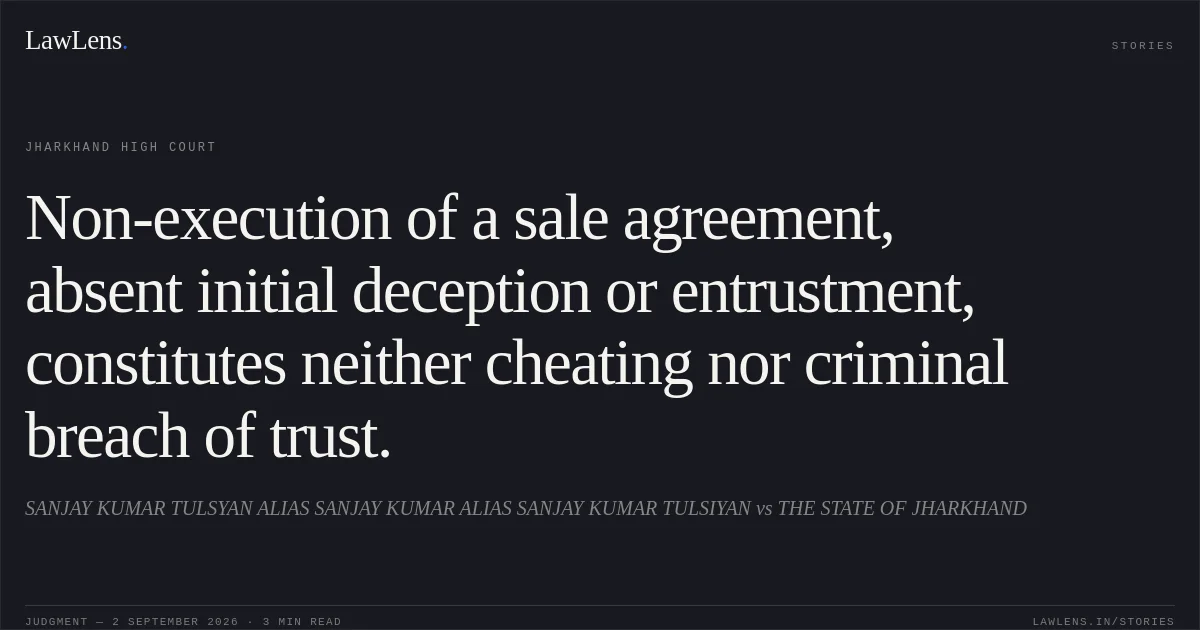
The complainant alleged that petitioner No. 1 received ₹60,000 in 2002 towards the sale of his land but neither transferred the land nor executed the sale deed.
¶ 2 · p. 2It was further alleged that petitioner No. 1 subsequently sold the same land to his wife, petitioner No. 2, in 2015.
¶ 2 · p. 2On the basis of the complaint, the complainant’s solemn-affirmation statement and the statements of inquiry witnesses, the Additional Chief Judicial Magistrate, Seraikella found a prima facie case under Sections 420 and 406 of the Indian Penal Code and issued summons by order dated 22 February 2024.
¶ 1, 3 · p. 2The petitioners invoked Section 528 of the Bharatiya Nagarik Suraksha Sanhita, 2023, seeking quashing of the entire criminal proceedings in Complaint Case No. 1426 of 2023 and the summoning order.
¶ 1 · p. 202Issues
i.Whether the allegations, even if accepted in their entirety, disclosed the offence of cheating under Section 420 IPC in the absence of an allegation that the petitioners intended to deceive the complainant from the inception of the transaction?
¶ 7–8 · pp. 4–5ii.Whether the advance payment made towards the proposed sale of land constituted “entrustment” of property so as to attract criminal breach of trust under Sections 405/406 IPC?
¶ 9–10 · pp. 5–6iii.Whether continuation of the criminal proceedings and the summoning order amounted to an abuse of the process of law warranting exercise of the High Court’s jurisdiction under Section 528 BNSS?
¶ 11–13 · pp. 6–703Law Applied
The Court exercised its inherent jurisdiction under Section 528 of the Bharatiya Nagarik Suraksha Sanhita, 2023, to prevent abuse of process and secure the ends of justice.
¶ 1 · p. 2In relation to Section 420 IPC, it applied the principle in Uma Shankar Gopalika v. State of Bihar, (2005) 10 SCC 336, that a mere breach of contract does not constitute cheating unless deceptive or fraudulent intention existed at the inception of the transaction.
¶ 7 · p. 4The Court also relied on Gurukanwarpal Kirpal Singh v. Surya Prakasam, 2022 LiveLaw (SC) 519, and Dalip Kaur v. Jagnar Singh, (2009) 14 SCC 696, recognising that a dispute arising essentially from non-refund or non-performance of a contractual obligation is ordinarily civil in nature.
¶ 4 · p. 3For Section 406 IPC, relying on Radheyshyam v. State of Rajasthan, 2024 SCC OnLine SC 2311, the Court held that an advance or part-payment made towards consideration under an agreement to sell is not property “entrusted” to the recipient, and refusal to complete the sale does not by itself amount to dishonest misappropriation or criminal breach of trust.
¶ 9 · p. 5Provisions in the judgment · 4 · Linked ones open on LawLens
Bharatiya Nagarik Suraksha Sanhita, 2023 Section 528
Indian Penal Code, 1860 Section 405Section 406Section 420
04Reasoning
The Court held that the alleged transaction originated in 2002, whereas the subsequent sale by petitioner No. 1 to petitioner No. 2 occurred in 2015.
¶ 8 · p. 5The complaint contained no allegation that the petitioners had practised deception or possessed an intention to cheat at the inception of the 2002 transaction. Accordingly, even if the allegations were accepted as true, the essential ingredient of initial fraudulent intention under Section 420 IPC was absent.
¶ 8 · p. 5With respect to Section 406 IPC, the ₹60,000 was alleged to have been paid as consideration for the proposed sale of land, not entrusted for a specific purpose or subject to a fiduciary obligation.
¶ 10 · p. 6Since there was neither entrustment nor dishonest misappropriation of entrusted property, the ingredients of criminal breach of trust were also not satisfied.
¶ 10 · p. 6The dispute therefore remained essentially contractual or civil in character, and continuation of the criminal case would constitute an abuse of process.
¶ 11 · p. 605Holding
The Court answered both substantive issues in favour of the petitioners. It held that the allegations did not make out offences under Sections 420 or 406 IPC, even if taken at their highest.
¶ 11–12 · pp. 6–7Consequently, the entire criminal proceedings in Complaint Case No. 1426 of 2023, including the Additional Chief Judicial Magistrate’s summoning order dated 22 February 2024, were quashed and set aside against the petitioners.
¶ 11–12 · pp. 6–7The Criminal Miscellaneous Petition was accordingly allowed.
¶ 13 · p. 7Original Court PDF
SANJAY KUMAR TULSYAN ALIAS SANJAY KUMAR ALIAS SANJAY KUMAR TULSIYANvsTHE STATE OF JHARKHAND
Click to open original judgment
Original judgment, available to read, download and summarize on LawLens.in