01Facts
The South Eastern Railway awarded the appellant a construction contract for an electric locomotive shed at Bokaro Steel City Station for approximately Rs. 7.32 crore, with a stipulated completion period of 24 months.
¶ 12–14The contract required reciprocal performance: the Railway was to provide layout and GAT drawings, while the appellant was to execute the construction work.
¶ 14The appellant repeatedly sought drawings and extensions of time, which the Railway granted without imposing liquidated damages.
¶ 15–16After the Railway directed the appellant to mobilise and resume the work, the appellant requested closure of the contract under Clause 61 of the General Conditions of Contract. The Railway thereafter issued a seven-day notice, followed by a 48-hour notice, and terminated the contract under Clause 62 on 29 May 2007.
¶ 17–19The disputes were referred to arbitration. The appellant raised 13 claims and the Railway raised seven counterclaims. The Arbitral Tribunal allowed, inter alia, the appellant’s claims for the final bill, refund of security deposits and PVC price escalation, and allowed certain counterclaims relating to risk and costs, royalty and unreturned materials.
¶ 19–20, 33–40The Railway challenged the award under Section 34 of the Arbitration and Conciliation Act, 1996, while the appellant initiated execution proceedings.
¶ 21The learned Single Judge allowed the Section 34 challenge, held the termination valid, found the award of refund of security deposit patently illegal, treated the award concerning risk and costs as perverse, and dismissed the execution petition. The appellant challenged that decision under Section 37.
¶ 22–24, 102Issues
i.1. Whether the learned Single Judge exceeded the limited scope of jurisdiction under Section 34 by re-evaluating the evidence and substituting the Arbitral Tribunal’s findings on security deposit and risk-and-cost claims.
¶ 23–24, 32–33ii.2. Whether the Arbitral Tribunal’s reasoned and plausible findings, including its assessment of the parties’ reciprocal breaches and the appellant’s entitlement to refund of security deposit, were liable to be set aside for patent illegality or perversity.
¶ 35–42iii.3. Whether the Court could sever or modify portions of the arbitral award while exercising jurisdiction under Sections 34 and 37 of the Act.
¶ 26–2703Law Applied
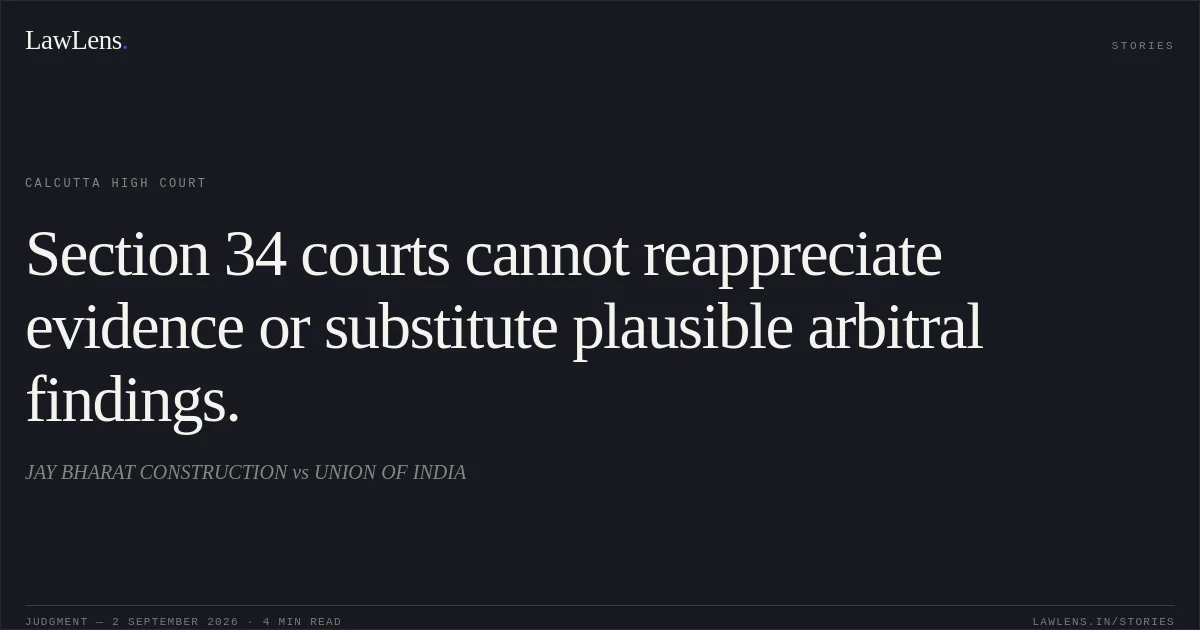
The Court applied Sections 34 and 37 of the Arbitration and Conciliation Act, 1996. A Section 34 court does not sit as a court of appeal and cannot reappreciate evidence, correct mere errors of fact or substitute its own view for a plausible view taken by the Arbitral Tribunal.
¶ 28–29, 32Interference is confined to the statutory grounds, including patent illegality, fundamental policy of Indian law and the basic notions of justice, which are to be applied narrowly and in exceptional cases.
¶ 25Ssangyong Engineering & Construction Co. Ltd. v. NHAI, (2019) 15 SCC 131, restricts expansion of “public policy” and patent illegality beyond the statutory framework.
¶ 25Parsa Kente Collieries Ltd. v. Rajasthan Rajya Vidyut Utpadan Nigam Ltd., (2019) 7 SCC 236, and Delhi Airport Metro Express Pvt. Ltd. v. DMRC, (2022) 1 SCC 131, prohibit appellate reassessment of factual and legal findings under Section 34.
¶ 28–29Project Director, NHAI v. M. Hakeem, (2021) 9 SCC 1, holds that Section 34 does not ordinarily confer power to modify an award, while Gayatri Balasamy v. ISG Novasoft Technologies Ltd., (2025) 7 SCC 1, recognises limited modification, including severance of invalid and valid portions and correction of clerical or manifest errors, where no impermissible merits review is undertaken.
¶ 26–27The Court also relied on Kailash Nath Associates v. DDA, (2015) 4 SCC 136, concerning compensation and forfeiture principles under Section 74 of the Indian Contract Act.
¶ 31Provisions in the judgment · 5 · Linked ones open on LawLens
Arbitration and Conciliation Act, 1996 Section 28Section 34Section 37Section 48
Indian Contract Act, 1872 Section 34
04Reasoning
The Arbitral Tribunal had examined each claim and counterclaim and provided reasons for allowing or rejecting them.
¶ 33, 40–41Its finding on the security deposit was based on the Railway’s failure to provide drawings in advance and the conclusion that both parties had contributed to the incomplete project; the Tribunal therefore considered the appellant’s breach insufficient to justify forfeiture.
¶ 34–36This was a plausible contractual and factual assessment, not a perverse or patently illegal conclusion.
Similarly, the Tribunal’s treatment of risk and costs arose from its evaluation of the parties’ reciprocal obligations and the available drawings.
The Single Judge, by preferring a different interpretation of the evidence and documents, effectively conducted an appellate review, which Section 34 does not permit.
¶ 24, 32, 41–42The Section 37 court’s role was consequently limited to examining whether the Single Judge applied the correct Section 34 parameters; since the Tribunal’s findings were reasoned and plausible, interference was unwarranted.
¶ 3205Holding
The High Court held that the learned Single Judge impermissibly re-evaluated the evidence and substituted the Arbitral Tribunal’s plausible findings.
¶ 33, 41–42The Tribunal’s award was not shown to be perverse, patently illegal or contrary to the fundamental policy of Indian law.
¶ 33, 41–42Accordingly, the judgment and order dated 10 September 2024 was set aside; AP 780 of 2012, the Section 34 challenge, was dismissed; the execution petition, EC No. 3 of 2024, was restored to its original file and number; and APOT 10 of 2025 along with the connected applications was disposed of without costs.
¶ 43–44Original Court PDF
JAY BHARAT CONSTRUCTIONvsUNION OF INDIA
Click to open original judgment
Original judgment, available to read, download and summarize on LawLens.in