Facts
The Petitioner, a co-operative society registered under the Maharashtra Co-operative Societies Act, 1960, challenged the validity of a Government Resolution (GR) dated April 1, 2004, and consequential orders dated April 7, 2006, and March 1, 2016, which mandated compliance with state reservation policies.
Source reference: para 1The Respondents contended that the Petitioner fell under the definition of an "establishment" as defined by the Maharashtra State Public Services [Reservation for Scheduled Castes, Scheduled Tribes, De-notified Tribes (Vimukta Jatis), Nomadic Tribes, Special Backward Category and Other Backward Classes] Act, 2001 (the "Reservation Act") because it received financial aid, subsidies, and land at concessional rates from the State.
Source reference: paras 6.1-6.5The Petitioner maintained that the State held no share capital in the society, thus exempting it from the Act.
Source reference: para 5Issues
1. Whether the Petitioner co-operative society falls within the ambit of an “establishment” under Section 2(c) of the Maharashtra State Public Services [Reservation for Scheduled Castes, Scheduled Tribes, De-notified Tribes (Vimukta Jatis), Nomadic Tribes, Special Backward Category and Other Backward Classes] Act, 2001.
Source reference: para 2Law Applied
The court primarily interpreted Section 2(c) and Section 2(i) of the Reservation Act, which define "establishment" and "public services and posts" respectively, noting that for a co-operative society to be covered, the Government must be a shareholder.
Source reference: paras 3, 9The court applied the principle that executive instructions (GRs) cannot supplant or run contrary to the statutory mandate of a parent Act, relying on Madhya Pradesh v. GS Dal and Flour Mills.
Source reference: para 18It further followed the precedents established in Madhya Pradesh Rajya Sahakari Bank Maryadit v. State of Madhya Pradesh, Bank Karmachari Sangh, Pune v. State of Maharashtra, and Jalgaon Zilha Sahakari Dudh Utpadak Sangh Maryadit v. State of Maharashtra, all of which held that government shareholding is a mandatory prerequisite for the application of reservation laws to co-operative societies.
Source reference: paras 12, 13, 16Reasoning
The Court conducted a textual analysis of Section 2(c) and Section 2(i) of the Reservation Act, concluding that the legislative intent was to include only those co-operative societies in which the Government holds share capital.
Source reference: paras 8, 10It rejected the Respondents' argument that the "Explanation" to Section 2(c)—which includes "Government aided institutions"—could bring the Petitioner within the Act’s fold solely based on financial assistance or land concessions.
Source reference: para 8The Court reasoned that Section 2(i)(ii) specifically qualifies co-operative societies as those "in which Government is a shareholder," creating a specific requirement that overrides general categorizations.
Source reference: para 9, 10Furthermore, the Court held that the GR dated February 11, 2014, could not expand the scope of the Reservation Act, as executive instruments cannot override or enlarge statutory provisions.
Source reference: para 17-18Since the State did not hold any share capital in the Petitioner society, the regulatory authorities lacked the jurisdiction to enforce the state reservation policy.
Source reference: para 11, 15Holding
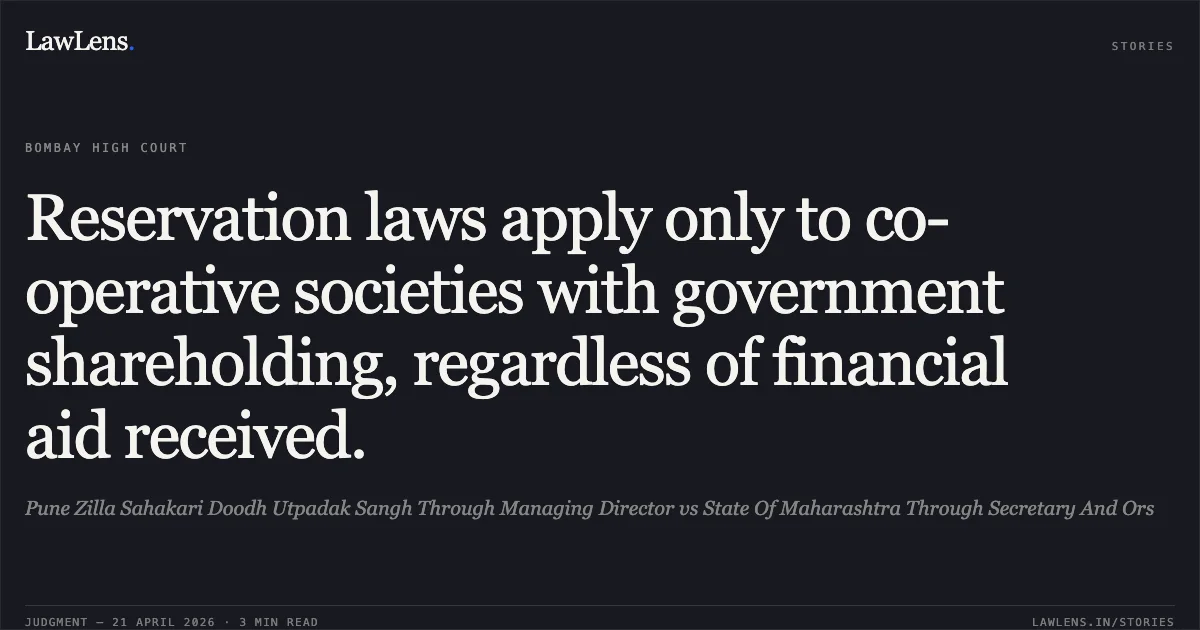
The Court answered the issue in the negative, holding that the Petitioner is not an "establishment" under the Reservation Act because the Government holds no share capital in it.
Consequently, the Court allowed the Writ Petition and quashed the impugned GR and consequential orders as they were applied to the Petitioner. Rule was made absolute, granting relief in terms of prayer clauses (b) and (c).
Source reference: para 19, 19.1Acts & Sections Cited
2 provisions across 1 statute referred to in this judgment. Each provision opens on LawLens.
Original Court PDF
Pune Zilla Sahakari Doodh Utpadak Sangh Through Managing DirectorvsState Of Maharashtra Through Secretary And Ors
Click to open original judgment
Original judgment, available to read, download and summarize on LawLens.in


