Facts
The Petitioner (Contractor) was awarded a tender by the Respondent (Employer) for the construction of an office building via a Letter of Award dated 28.05.2018
Source reference: para 2A contract was executed on 09.07.2018 containing an arbitration clause (Clause 19.13)
Source reference: para 3During the project, the Petitioner entered Corporate Insolvency Resolution Process (CIRP) on 11.12.2019
Source reference: para 6The Respondent terminated the contract on 25.02.2020 and submitted a claim of approx. Rs. 12.26 Crores to the Resolution Professional (RP)
Source reference: paras 8-9The RP admitted the Respondent's claim but allegedly determined no dues were payable by the Respondent to the Petitioner
Source reference: para 10A Resolution Plan was approved by the NCLT on 05.04.2022, providing operational creditors (including Respondent) a 0.71% payout
Source reference: paras 11, 14.5Post-resolution, the Petitioner invoked arbitration for its own claims against the Respondent (delays, illegal bank guarantee invocation, etc.)
Source reference: paras 4-6The Respondent resisted, citing the "Clean Slate" doctrine under the IBC, arguing all claims were extinguished
Source reference: para 12Issues
1. Whether Clause 19.13 of the Conditions of Contract constitutes a valid arbitration agreement that survives termination and the approval of a Resolution Plan under the IBC
Source reference: para 18(i)2. Whether the scope of Section 11(6-A) of the Arbitration Act allows the Court to examine the "Clean Slate" doctrine or is confined to a *prima facie* existence of the agreement
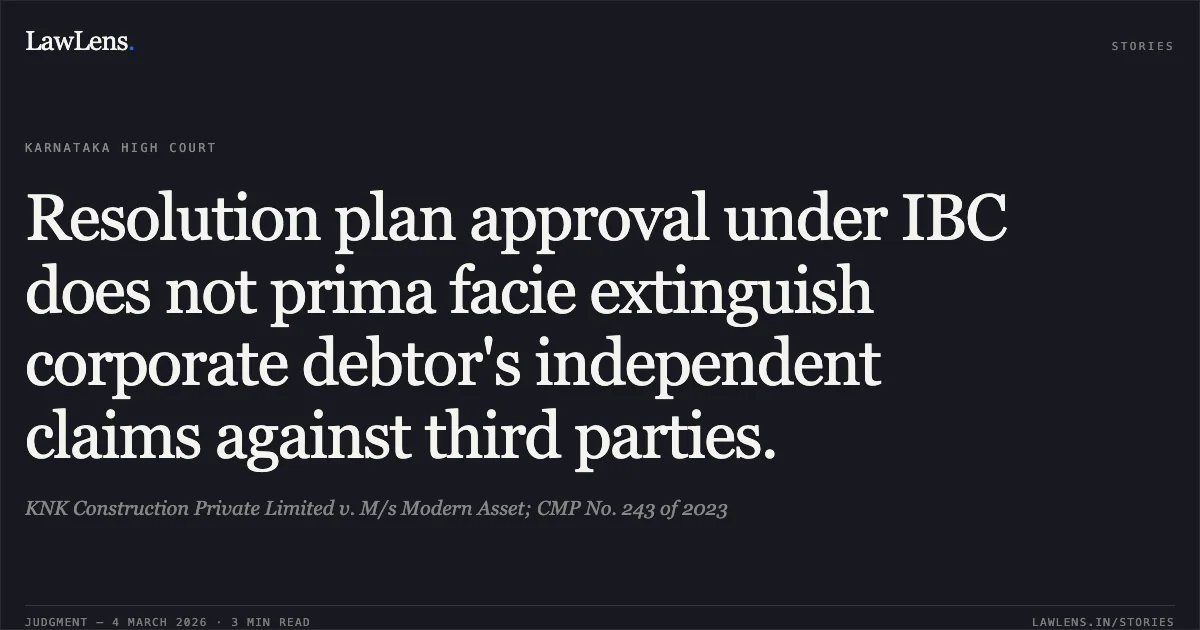
Source reference: para 18(ii)3. Whether the approval of a Resolution Plan under Section 31 of the IBC extinguishes the claims of the Corporate Debtor against third parties
Source reference: para 18(iii)4. Whether the disputes constitute "deadwood" or are live, arbitrable disputes
Source reference: para 18(vi)Law Applied
The Court applied Section 11(6-A) of the Arbitration and Conciliation Act, 1996, which mandates confining judicial examination to the "existence" of an arbitration agreement
Source reference: para 21.1It relied on the "Doctrine of Separability" under Section 16, holding that an arbitration clause survives the contract's termination
Source reference: para 20.24Precedents including *SBI General Insurance v. Krish Spinning* [2024 12 SCC 1] and *In Re: Interplay between Arbitration Agreements* [2024 6 SCC 1] were applied to restrict the referral court's role to a *prima facie* scrutiny, leaving "accord and satisfaction" to the tribunal
Source reference: paras 13.2, 21.12Regarding the IBC, the Court applied Section 31 and the "Clean Slate" doctrine but distinguished its application based on *Gluckrich Capital Pvt. Ltd. v. State of West Bengal* [2023 SCC Online SC 1187], which clarifies that while claims *against* the debtor are extinguished, the debtor/resolution applicant retains rights to pursue recovery against third parties
Source reference: paras 22.5, 22.18Reasoning
The Court reasoned that under the amended Section 11(6-A), its jurisdiction is "extremely narrow" and confined to verifying the formal existence of an arbitration agreement
Source reference: paras 21.9-21.16It observed that Clause 19.13 was undisputed and met all requirements of Section 7
Source reference: para 20.21The Court rejected the Respondent's argument that the IBC Resolution Plan created a jurisdictional bar, noting that the Clean Slate doctrine primarily shields the successful resolution applicant from "surprise" creditor claims to ensure a fresh start, rather than stripping the debtor of its assets or receivables
Source reference: paras 22.13, 22.16Relying on *Krish Spinning*, the Court held that whether the CIRP process resulted in "statutory accord and satisfaction" is a mixed question of law and fact to be determined by the Arbitral Tribunal under Section 16
Source reference: paras 23.10-23.11The Court found that the Petitioner’s claims (e.g., illegal invocation of BG during moratorium) were potentially "live" and not "deadwood" at this preliminary stage
Source reference: para 25.10Holding
The Court allowed the petition and appointed a Sole Arbitrator
It held that a valid arbitration agreement exists and survived both the termination of the contract and the CIRP process
Source reference: para 20.31The Court ruled that the "Clean Slate" doctrine under Section 31 IBC does not automatically extinguish a Corporate Debtor's claims against third parties
Source reference: para 22.24The Arbitrator is granted full liberty to adjudicate on the IBC-related threshold objections, including whether the specific claims were extinguished or settled by the Resolution Plan
Source reference: para 26.1(iv)Finally, the Court referred the parties to the Karnataka Mediation Centre to attempt an amicable settlement before commencing arbitration
Source reference: para 28Acts & Sections Cited
20 provisions across 7 statutes referred to in this judgment. Each provision opens on LawLens.
Indian Stamp Act, 18993
Companies Act, 20131
Competition Act, 20021
Code of Civil Procedure, 19081
Indian Contract Act, 18721
Insolvency and Bankruptcy Code, 2016.6
Arbitration and Conciliation Act, 19967
Original Court PDF
KNK Construction Private Limited v. M/s Modern Asset; CMP No. 243 of 2023
Click to open original judgment
Original judgment, available to read, download and summarize on LawLens.in