Facts
Petitioner No. 1, Mohammad Kaleem, was married to respondent No. 2, Afsana Bi, on 06.12.2020, and they had one child.
Source reference: para. 2Following matrimonial disputes, respondent No. 2 left the matrimonial home and began residing with her parents.
Source reference: para. 2Petitioner No. 1 subsequently instituted proceedings under Muslim law seeking restitution of conjugal rights; the Family Court, Jabalpur, directed respondent No. 2 to reside with him by judgment dated 10.03.2026.
Source reference: para. 2Thereafter, respondent No. 2 lodged Crime No. 40/2024 at Police Station Nohta, District Damoh, alleging cruelty and dowry demands against the petitioners under Sections 498-A and 34 of the IPC and Sections 3/4 of the Dowry Prohibition Act.
Source reference: para. 2The petitioners invoked Section 528 of the Bharatiya Nagarik Suraksha Sanhita, 2023, seeking quashing of the FIR and consequential proceedings.
Source reference: para. 2Issues
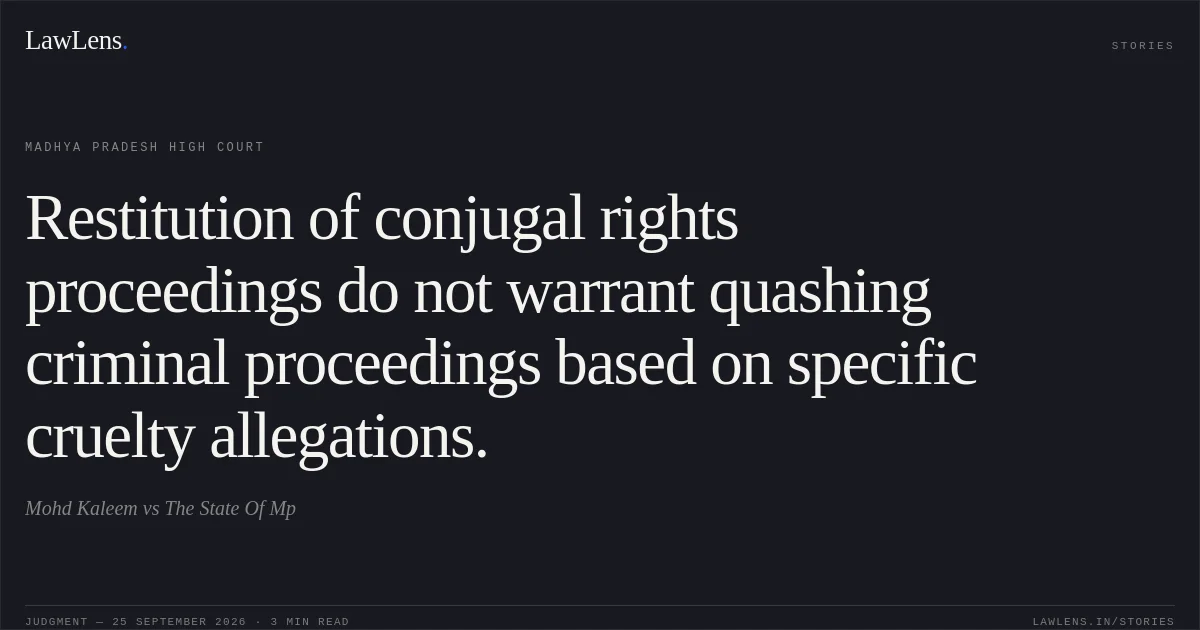
Whether the FIR and consequential criminal proceedings against petitioner No. 1 could be quashed on the ground that they were allegedly instituted as a counterblast to the proceedings for restitution of conjugal rights?
Source reference: paras. 5–9Whether the FIR and consequential proceedings against petitioners Nos. 2 to 4 were liable to be quashed because the allegations against them were vague, general, and omnibus?
Source reference: para. 10Law Applied
The Court exercised its inherent jurisdiction under Section 528 of the BNSS to examine whether continuation of the criminal proceedings would constitute an abuse of process or defeat the ends of justice.
Source reference: para. 1It applied the principle that where the allegations in the FIR prima facie disclose the commission of an offence, proceedings should not ordinarily be quashed in the absence of material demonstrating abuse of process or injustice, relying on Smt. Chand Dhawan v. Jawahr Lal and Others, 1992 AIR 1379, and Y. Sham Kumar and Others v. State of A.P. and Another.
Source reference: para. 6The Court further relied on Pratibha v. Rameshwari Devi and Others, 2007 AIR SCW 5933, for the rule that civil and criminal proceedings are independent and that filing or pendency of civil or matrimonial proceedings does not, by itself, justify quashing criminal proceedings; the High Court must not assess extraneous material beyond the allegations in the FIR.
Source reference: para. 7The Court also held that proceedings for restitution of conjugal rights under Muslim law do not, merely because they preceded the FIR, constitute a ground for quashing criminal proceedings.
Source reference: para. 5However, vague, general, and omnibus allegations unsupported by specific attribution may justify quashing proceedings against family members.
Source reference: para. 10Reasoning
The Court found that the FIR contained specific allegations of cruelty and dowry demands against petitioner No. 1, the husband, thereby prima facie disclosing offences under Section 498-A IPC and Sections 3/4 of the Dowry Prohibition Act.
Source reference: para. 9The petitioners produced no material establishing that respondent No. 2 had prior notice or knowledge of the restitution proceedings before registration of the FIR; consequently, the allegation that the FIR was a counterblast was not established.
Source reference: para. 5The pendency or outcome of the restitution proceedings could not determine the criminal allegations, since matrimonial and criminal proceedings had to be adjudicated independently on their own merits.
Source reference: paras. 7–8Conversely, the Court found no specific allegations against petitioners Nos. 2 and 3, the sisters-in-law, or petitioner No. 4, the mother-in-law.
Source reference: para. 10The allegations against them were vague, general, and omnibus, and therefore continuation of the proceedings against them was unwarranted.
Source reference: para. 10Holding
The petition was partly allowed.
The challenge to the FIR and consequential proceedings was dismissed as against petitioner No. 1, since the specific allegations against him prima facie constituted offences under Section 498-A IPC and Sections 3/4 of the Dowry Prohibition Act.
Source reference: para. 9The FIR and all consequential proceedings arising from Crime No. 40/2024 were quashed as against petitioners Nos. 2 to 4, namely Kaushar Bee, Ku. Gudiya alias Samina, and Amina Bee, because the allegations against them were vague and omnibus.
Source reference: para. 10–11Acts & Sections Cited
5 provisions across 4 statutes referred to in this judgment. Each provision opens on LawLens.
Bharatiya Nagarik Suraksha Sanhita, 20231
Code of Criminal Procedure, 19731
Indian Penal Code, 18601
Original Court PDF
Mohd KaleemvsThe State Of Mp
Click to open original judgment
Original judgment, available to read, download and summarize on LawLens.in