Facts
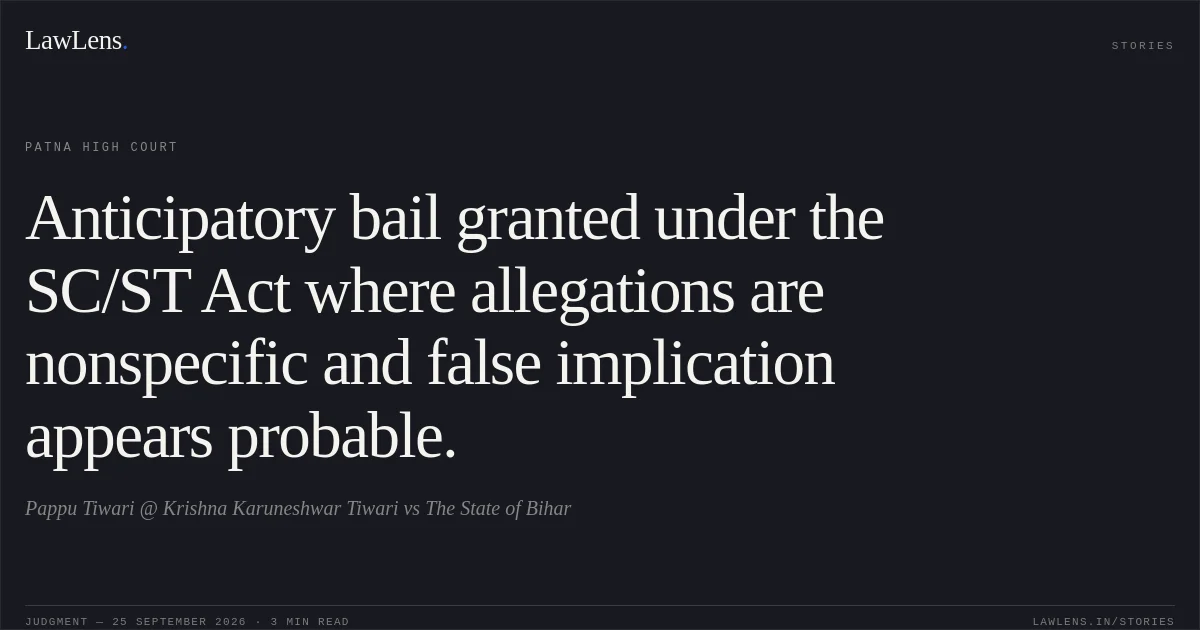
The appellants challenged the order dated 12 February 2026 passed by the District and Additional Sessions Judge-I-cum-Special Judge, SC/ST (PoA) Act, Buxar, rejecting their anticipatory-bail application in Complaint Case No. 65(C) of 2022.
Source reference: p. 2, para. 3The complaint alleged that the appellants, allegedly forming an unlawful assembly and armed with weapons, abused the complainant by referring to her caste, assaulted her and her daughter-in-law with lathis and dandas, removed jewellery worth approximately ₹40,000, and assaulted the complainant’s husband and son when they intervened.
Source reference: p. 2, para. 3The alleged offences were under Sections 323, 504 and 506 of the Indian Penal Code and Sections 3(1)(r) and 3(1)(s) of the Scheduled Castes and Scheduled Tribes (Prevention of Atrocities) Act, 1989.
Source reference: p. 2, para. 2The appellants pleaded false implication arising out of an existing land dispute, the absence of specific overt acts, and a delay of approximately forty days in filing the complaint.
Source reference: pp. 2–3, para. 4They also contended that the complainant did not belong to a Scheduled Tribe and relied on a genealogical report issued by the village Sarpanch.
Source reference: pp. 2–3, para. 4They further referred to earlier civil and preventive proceedings between the parties.
Source reference: pp. 2–3, para. 4The respondent opposed anticipatory bail, submitting that cognizance had been taken under the SC/ST (PoA) Act and that the allegations concerned caste-based abuse and assault.
Source reference: p. 4, para. 5Issues
Whether the appellants were entitled to anticipatory bail in an appeal under Section 14(A)(2) of the SC/ST (PoA) Act, considering the allegations under Sections 3(1)(r) and 3(1)(s) of that Act?
Source reference: pp. 1–2, para. 2Whether the land dispute, delayed complaint, non-specific allegations, and the appellants’ contention regarding the complainant’s caste status justified interference with the order rejecting anticipatory bail?
Source reference: pp. 2–4, paras. 4–6Law Applied
The Court exercised appellate jurisdiction under Section 14(A)(2) of the Scheduled Castes and Scheduled Tribes (Prevention of Atrocities) Act, 1989, against the order refusing anticipatory bail.
Source reference: p. 2, para. 2The alleged substantive offences included Sections 3(1)(r) and 3(1)(s) of the SC/ST (PoA) Act, concerning intentional caste-based insult or intimidation and abuse by caste name, as well as Sections 323, 504 and 506 of the IPC.
Source reference: p. 2, para. 2In granting protection, the Court applied the general principles governing anticipatory bail, including consideration of the nature and specificity of the allegations, the possibility of false implication, and the surrounding circumstances.
Source reference: no citationBail was made subject to the conditions prescribed under Section 482(2) of the Bharatiya Nagarik Suraksha Sanhita, 2023, along with additional conditions imposed by the Court.
Source reference: p. 4, para. 6Reasoning
The Court found that the parties were involved in an ongoing land dispute and that the allegations against the appellants were non-specific.
Source reference: p. 4, para. 6It also considered the appellants’ contention that the complaint was delayed and that there was a possibility of false accusation.
Source reference: p. 4, para. 6Although the prosecution alleged caste-based abuse and assault and the respondent pointed out that cognizance had been taken under the SC/ST (PoA) Act, the Court, at the anticipatory-bail stage, treated the background dispute and the absence of specific overt acts as significant factors favouring protection from arrest.
Source reference: p. 4, para. 5The Court therefore concluded that the circumstances justified setting aside the rejection of anticipatory bail.
Source reference: p. 4, para. 6Holding
The appeal was allowed, and the order dated 12 February 2026 rejecting anticipatory bail was set aside.
The Court directed that, in the event of arrest or surrender within eight weeks, the appellants be released on bail on furnishing a bond of ₹10,000 each with two sureties of the like amount to the satisfaction of the Special Judge, SC/ST (PoA) Act, Buxar.
Source reference: p. 4, para. 6One bailor was required to be a close relative, and the appellants were directed to remain present on every date fixed by the trial court if so required.
Source reference: pp. 4–5, para. 6Acts & Sections Cited
6 provisions across 4 statutes referred to in this judgment. Each provision opens on LawLens.
Scheduled Castes and the Scheduled Tribes (Prevention of Atrocities) Act, 19891
Indian Penal Code, 18603
Code of Criminal Procedure, 19731
Bharatiya Nagarik Suraksha Sanhita, 20231
Original Court PDF
Pappu Tiwari @ Krishna Karuneshwar TiwarivsThe State of Bihar
Click to open original judgment
Original judgment, available to read, download and summarize on LawLens.in