Facts
The petitioner/accused was facing trial in Spl.S.C.No.161 of 2025 for offences under Sections 9(m), 10, 11(1) and 12 of the Protection of Children from Sexual Offences Act, 2012, and Section 127(2) of the Bharatiya Nyaya Sanhita, 2023.
Source reference: para. 2The prosecution had cited 14 witnesses, and when the case was posted for examination of the Investigating Officer, the petitioner filed two applications before the Special Court.
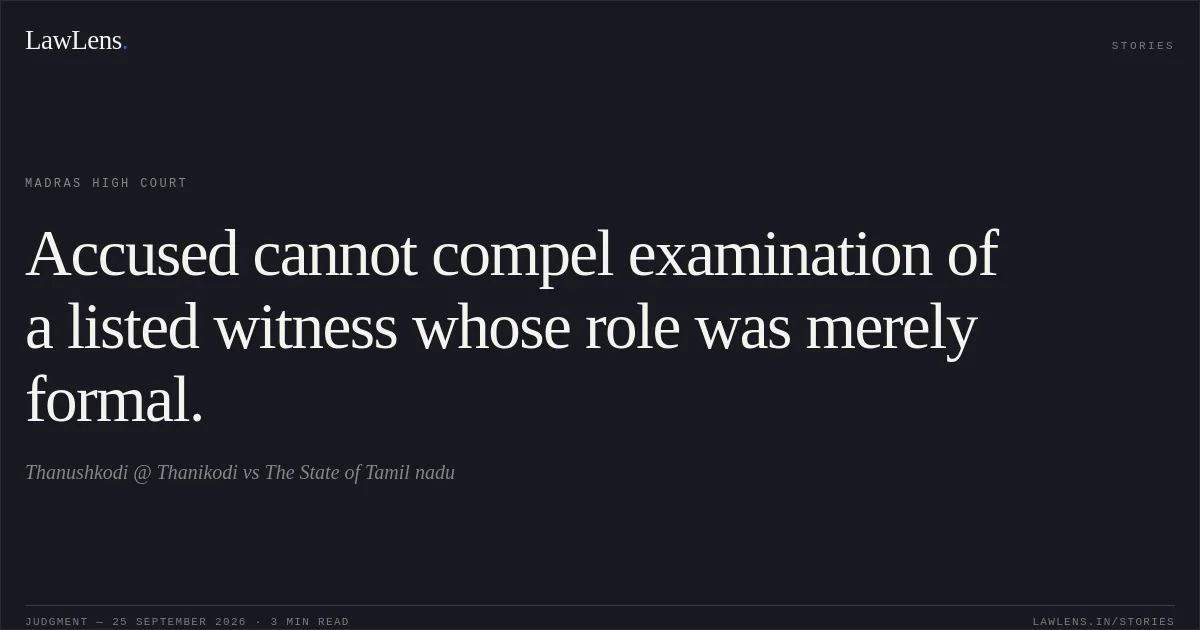
Source reference: para. 3In Crl.M.P.No.354 of 2026, the petitioner sought examination of L.W.12, a woman police constable who had merely produced the victim before the Court for recording her statement. The prosecution had treated her as a formal witness and dispensed with her examination; the trial Court dismissed the application.
Source reference: para. 3In Crl.M.P.No.355 of 2026, the petitioner sought forensic examination of the personal mobile phone of P.W.9, a woman police constable who had recorded the victim’s complaint when the police-station CCTV camera was under repair. The trial Court also dismissed this application.
Source reference: paras. 4–5The petitioner challenged both dismissal orders under Section 528 of the Bharatiya Nagarik Suraksha Sanhita, 2023.
Source reference: para. 1Issues
Whether the accused could compel the prosecution to examine L.W.12 merely because she was included in the list of prosecution witnesses, when her role was confined to producing the victim before the Court?
Source reference: paras. 3, 6, 8Whether the personal mobile phone of P.W.9 was required to be produced and subjected to forensic examination despite the recording having already been downloaded onto a pen-drive, supported by the requisite electronic-record certificate, and P.W.9 having been extensively cross-examined?
Source reference: paras. 4–6, 9Whether the trial Court’s dismissal of the applications warranted interference when the applications were filed at the fag end of the trial and allegedly had the effect of prolonging the proceedings?
Source reference: paras. 7, 10–11Law Applied
The Court exercised its jurisdiction under Section 528 of the Bharatiya Nagarik Suraksha Sanhita, 2023, which permits the High Court to prevent abuse of process and secure the ends of justice.
Source reference: para. 1It applied the principle that an accused cannot compel the prosecution to examine a particular person merely because that person’s name appears in the witness list; the relevance and necessity of the witness must be assessed in the context of the witness’s actual role.
Source reference: para. 8The Court also applied Section 63(4)(c) of the Bharatiya Sakshya Adhiniyam, 2023, concerning certification of electronic records, noting that the recording had already been transferred to a pen-drive and accompanied by the statutory certificate.
Source reference: para. 9The Court further relied on the principle that belated applications lacking a legally acceptable justification, particularly when filed at the concluding stage of trial, should not be permitted to protract proceedings.
Source reference: para. 10Reasoning
The Court held that L.W.12 was only a formal witness whose limited function was to produce the victim before the Court for recording her statement; she had no role in the investigation. Her inclusion in the witness list therefore did not create a right in the accused to compel her examination.
Source reference: para. 8Regarding P.W.9’s mobile phone, the Court found that the recording made on the phone had already been downloaded onto a pen-drive and supported by a certificate under Section 63(4)(c) of the Bharatiya Sakshya Adhiniyam. Since P.W.9 had also been extensively cross-examined, a further forensic examination of her personal device was unnecessary.
Source reference: para. 9The timing of both applications—when the trial was posted for examination of the Investigating Officer—supported the trial Court’s conclusion that they were intended to delay the proceedings rather than address a genuine evidentiary necessity.
Source reference: para. 10Holding
The High Court answered all issues against the petitioner. It held that the petitioner could not compel the examination of L.W.12 and that no further forensic examination of P.W.9’s mobile phone was warranted.
Finding no legally acceptable ground to interfere with the trial Court’s orders, the Court dismissed Crl.OP(MD) Nos.21030 and 21031 of 2026 and closed the connected miscellaneous petitions.
Source reference: para. 11Acts & Sections Cited
7 provisions across 4 statutes referred to in this judgment. Each provision opens on LawLens.
Bharatiya Nagarik Suraksha Sanhita, 20231
Protection of Children from Sexual Offences Act, 20124
Bharatiya Nyaya Sanhita, 20231
Bharatiya Sakshya Adhiniyam, 20231
Original Court PDF
Thanushkodi @ ThanikodivsThe State of Tamil nadu
Click to open original judgment
Original judgment, available to read, download and summarize on LawLens.in