Facts
The appellant, Devi Singh Rawat, was convicted by the Second Additional Sessions Judge, Dabra, for the offence of cheating under Section 420 IPC and sentenced to 7 years R.I. with a fine of Rs. 13,50,000/-.
Source reference: p. 1The complainant, Ganpat, had land acquired by the State for a canal, for which compensation of Rs. 9,42,704/- was determined.
Source reference: para. 2The appellant, utilizing a Power of Attorney he was not authorized to use for such benefit, received the compensation and failed to remit it to the complainant.
Source reference: para. 2, 7On appeal, the appellant did not challenge the conviction (having already undergone the custodial sentence) but restricted his arguments to the quantum of the fine, claiming it was disproportionate to his pecuniary resources.
Source reference: para. 4Issues
1. Whether the quantum of fine imposed in a conviction for an economic offence under Section 420 IPC must be reduced based on the alleged limited financial capacity of the convict.
Source reference: para. 42. Whether the principles of sentencing regarding compensation in non-economic crimes apply to cases involving financial fraud and "unlawful gain."
Source reference: para. 8, 10Law Applied
Section 420 of the Indian Penal Code (IPC) regarding cheating and dishonestly inducing delivery of property.
Source reference: para. 1, 9The court distinguished the precedents of Rachhpal Singh v. State of Punjab (2006) and Manish Jalan v. State of Karnataka (2008), noting that while they require an inquiry into a convict’s capacity to pay, those cases pertained to murder and motor accidents rather than economic crimes.
Source reference: para. 8Principle of "restitutive justice," emphasizing that in economic offences, victims are the "forgotten people" of the justice system and deserve adequate financial restoration.
Source reference: para. 9Reasoning
The Court reasoned that since the appellant did not challenge the finding that he dishonestly obtained Rs. 9,42,704/-, he cannot simultaneously plead poverty to avoid repayment.
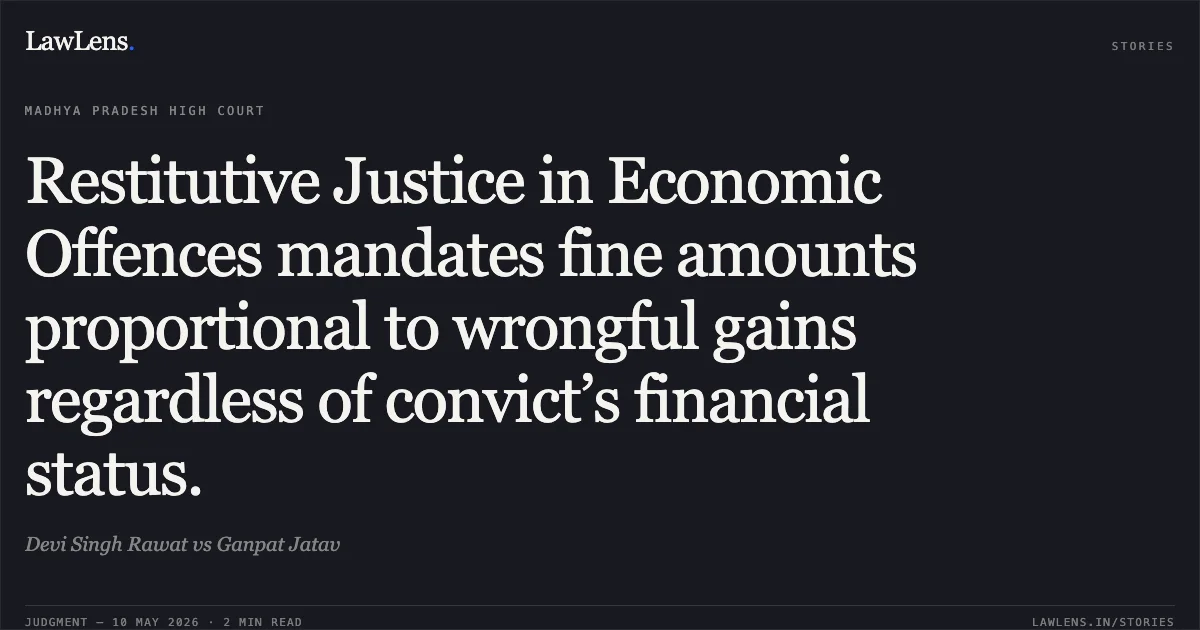
Source reference: para. 10The Court held that in economic crimes—such as tax evasion, money laundering, or cheating—the requirement to conduct a specialized inquiry into the convict's financial status before imposing a fine is answered in the negative.
Source reference: para. 10To allow such a plea would result in a failure of the justice system, as offenders would retain the proceeds of their crimes by simply claiming a lack of funds.
Source reference: para. 10The Court found that the fine (Rs. 13,50,000/-) was a reasonable application of restitutive justice, covering the principal amount stolen plus interest/costs.
Source reference: para. 9, 11Holding
The Court answered the issues in the negative, holding that the fine imposed was neither arbitrary nor disproportionate given the gravity of the economic fraud.
The appeal was dismissed, and the sentence of the trial court regarding the fine and default stipulations was upheld. Under Section 420 IPC, the appellant remains liable for the full fine amount.
Source reference: para. 11, 12Acts & Sections Cited
6 provisions across 3 statutes referred to in this judgment. Each provision opens on LawLens.
Indian Penal Code, 18604
Scheduled Castes and the Scheduled Tribes (Prevention of Atrocities) Act, 19891
Negotiable Instruments Act, 18811
Original Court PDF
Devi Singh RawatvsGanpat Jatav
Click to open original judgment
Original judgment, available to read, download and summarize on LawLens.in