Facts
The Appellant, Sunil Vadehra, joined the Respondent company in 1995 and was later inducted into the Board of Directors.
Source reference: para. 3, 31Due to a financial crisis in FY 2002-03, the company implemented a graded reduction in salaries (15% to 30%) for employees earning above ₹12,000/month.
Source reference: para. 4, 43The Appellant’s salary was reduced from ₹1,42,333 to ₹84,000 between April 2002 and March 2003.
Source reference: para. 35The Appellant alleged this was a "deferment" to be repaid later, along with a one-month bonus compensation.
Source reference: para. 4, 6He resigned on 19.11.2003 and later filed a suit for recovery of ₹8,89,381.
Source reference: para. 2, 32The Trial Court dismissed the suit, finding no contractual proof of deferment.
Source reference: para. 21Issues
1. Whether the salary reduction during FY 2002-2003 constituted a "deferment" creating a legally enforceable debt or a permanent "restructuring" necessitated by financial constraints?
Source reference: para. 30, 45, 602. Whether the Appellant established a contractual right to a one-month salary as bonus compensation?
Source reference: para. 21, 573. Whether the absence of an Annual General Meeting (AGM) resolution rendered the reduction of the Director's remuneration invalid?
Source reference: para. 23, 48Law Applied
The Court applied Section 96 and Order XLI of the Code of Civil Procedure, 1908, governing appeals from original decrees.
Source reference: para. 1The dispute centered on the law of contracts regarding the "burden of proof" (Onus Probandi), where the plaintiff must establish the existence of a binding contractual obligation.
Source reference: para. 21, 57The Court referenced the precedent in M/s Aithent Technologies Pvt. Ltd. v. Archana Verma (RFA 608/2014), which held that salary restructuring during the same period in the same company did not constitute a "deferment" without documented proof.
Source reference: para. 29, 59The Court also distinguished the principle in Dale & Carrington Invt. (P) Ltd. v. P.K. Prathapan [(2005) 1 SCC 212] regarding Board Resolutions, noting it was inapplicable to the facts of the present case.
Source reference: para. 25Reasoning
The Court observed that while the Appellant claimed the salary reduction was a deferment, he was a key member of the management team that formulated and implemented the arrangement during an "Open-House Meeting".
Source reference: para. 38-39, 47The Court noted a critical lack of formal documentation, such as Board Resolutions or written agreements, to prove that the company intended to repay the reduced amounts.
Source reference: para. 47, 49Significant weight was given to the separation document dated 11.11.2003 (Ex. DW-1/P3), signed by the Appellant upon resignation, which detailed final financial terms but remained silent on any "deferred salary" or "bonus".
Source reference: para. 51-52The CEO's letter dated 05.04.2004 (Ex. PW-1/3) was held insufficient as it neither quantified the dues nor specifically acknowledged the salary reduction as a debt.
Source reference: para. 55-58Consequently, the Court found the Appellant’s conduct inconsistent with his claims, as he did not protest the settlement at the time of resignation.
Source reference: para. 53-54Holding
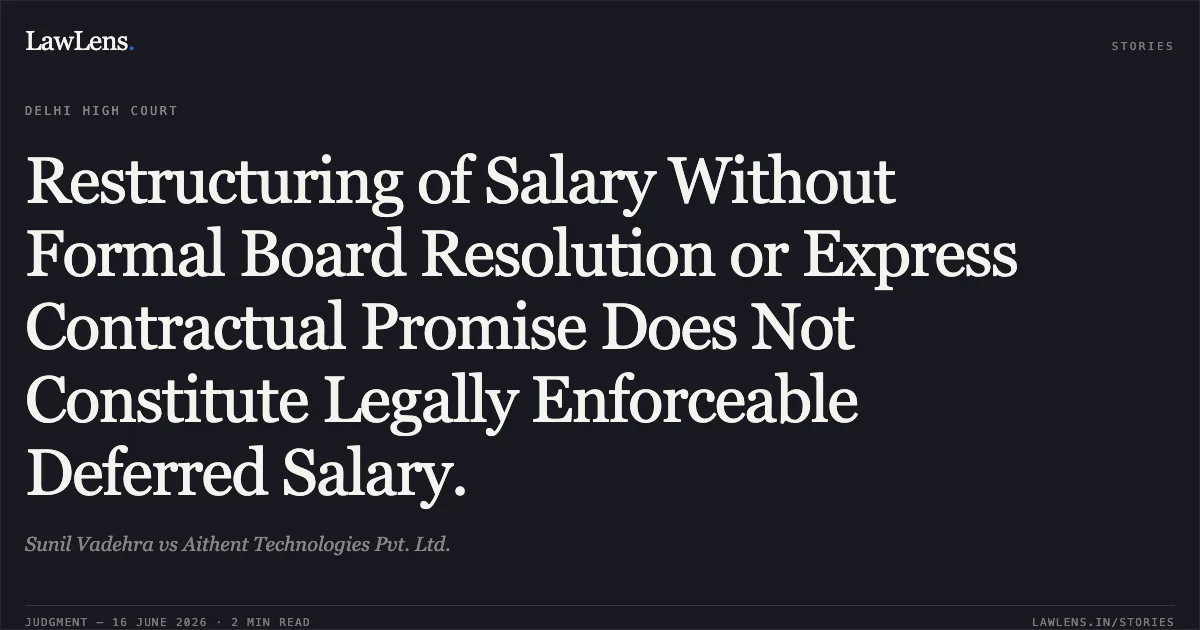
The Court answered the issues in the negative, holding that the Appellant failed to establish a contractual obligation for the payment of deferred salary or bonus.
The Court affirmed that the reduction was a "restructuring" and not a "deferment".
Source reference: para. 60-61The absence of an AGM resolution was deemed irrelevant as the suit was for recovery of debt, not for the invalidation of the salary reduction.
Source reference: para. 48The High Court dismissed the appeal and upheld the Trial Court’s Judgment and Decree dated 18.04.2024.
Source reference: para. 61Acts & Sections Cited
1 provisions across 1 statute referred to in this judgment. Each provision opens on LawLens.
Code of Civil Procedure, 19081
Original Court PDF
Sunil VadehravsAithent Technologies Pvt. Ltd.
Click to open original judgment
Original judgment, available to read, download and summarize on LawLens.in