Facts
The applicant-husband married respondent No. 1 on 14 July 2012 under Hindu rites. Respondent No. 1 was a widow whose minor son, respondent No. 2, was born from her earlier marriage; the applicant allegedly accepted responsibility for the child at the time of their marriage.
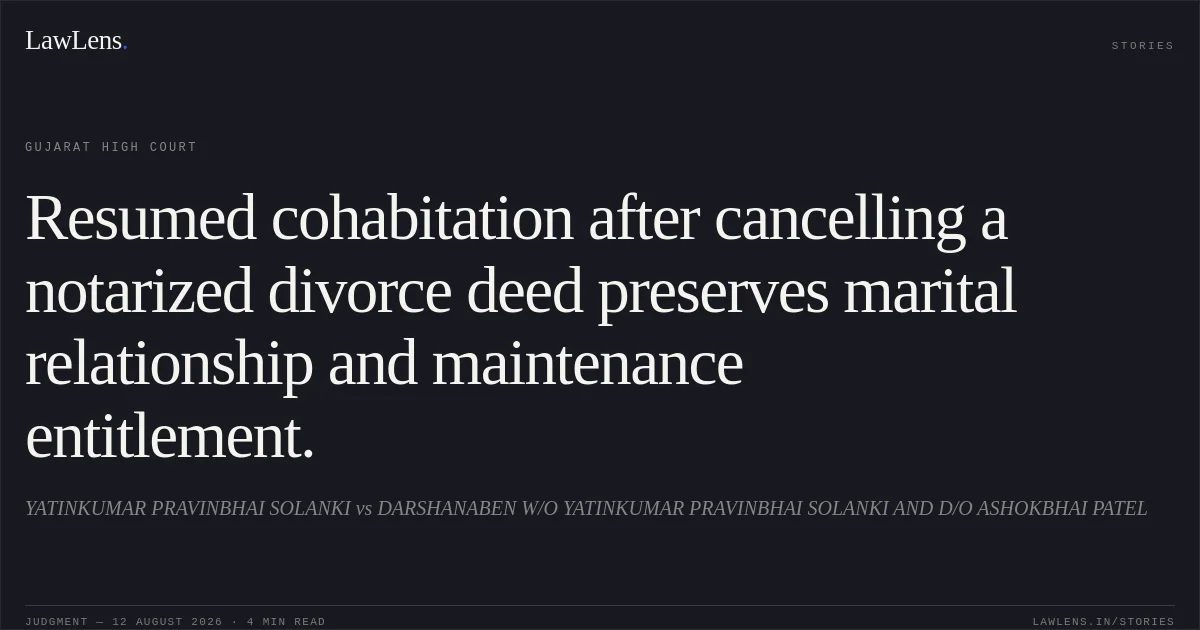
Source reference: para. 4.1Although the parties executed a notarised divorce deed in January 2016, they subsequently cancelled it by a deed dated 14 March 2016 and resumed cohabitation. On 18 March 2018, the applicant left respondent Nos. 1 and 2 and began residing with his aunt. Respondent No. 1 thereafter filed an application under Section 125 of the Code of Criminal Procedure, 1973, seeking maintenance for herself and the minor child.
Source reference: para. 4.1The Family Court, Surat, partly allowed the application by order dated 4 January 2023 and directed the applicant to pay monthly maintenance of ₹5,000 to respondent No. 1 and ₹3,000 to respondent No. 2 from 23 January 2020, the date of the maintenance application.
Source reference: para. 4.2The applicant challenged that order in revision under Sections 397 and 401 CrPC, contending, inter alia, that respondent No. 2 was not his biological child, that the divorce deed had dissolved the marriage, and that the respondents had deserted him without sufficient cause.
Source reference: paras. 5, 7Issues
Whether the Family Court erred in awarding maintenance to respondent No. 1 under Section 125 CrPC despite the parties’ notarised divorce deed and their subsequent separate residence?
Source reference: paras. 7, 12Whether respondent No. 2, being the child of respondent No. 1’s former husband and not the applicant’s biological child, was entitled to maintenance from the applicant?
Source reference: paras. 4.1, 7–8, 12Whether the Family Court’s findings were perverse, illegal, or otherwise unsustainable so as to warrant interference in the High Court’s revisional jurisdiction under Sections 397 and 401 CrPC?
Source reference: paras. 9–9.3, 11–12Law Applied
Section 125 CrPC is a social-justice provision intended to prevent destitution and vagrancy by providing a speedy remedy to a wife, child, or other eligible claimant unable to maintain themselves; proceedings under the provision are summary in nature and the applicable standard is preponderance of probabilities rather than proof beyond reasonable doubt.
Source reference: para. 10–10.1Revisional jurisdiction under Sections 397 and 401 CrPC is supervisory and is not equivalent to appellate jurisdiction; interference is justified only where the subordinate court’s order suffers from palpable error, illegality, perversity, arbitrary exercise of discretion, or causes miscarriage of justice.
Source reference: paras. 9–9.3Relying on State of Kerala v. Puttumana Illath Jathavedan Namboodiri, (1999) 2 SCC 452, the Court held that revision is not a second appellate jurisdiction and ordinarily does not permit reappreciation of evidence.
Source reference: para. 9.1Relying on Amit Kapoor v. Ramesh Chander, (2012) 9 SCC 460, the Court reiterated that revisional intervention is warranted for incorrect, illegal, improper, or palpably erroneous orders, but not merely because another view of the evidence is possible.
Source reference: para. 9.2Reasoning
The High Court found that the Family Court had properly appreciated the evidence and that its findings were neither perverse nor unsupported by the record.
Source reference: paras. 11–12The subsequent cancellation of the divorce deed and the parties’ resumed cohabitation demonstrated that their matrimonial relationship continued notwithstanding the earlier notarised document.
Source reference: para. 12The Family Court had therefore correctly treated respondent No. 1 as the applicant’s wife and found that she and the minor child had been neglected and were unable to maintain themselves.
Source reference: paras. 8, 12The applicant’s failure to cross-examine respondent No. 1 or lead evidence weakened his factual objections before the Family Court.
Source reference: para. 4.2; para. 8The High Court further held that the maintenance amounts of ₹5,000 per month for the wife and ₹3,000 per month for the minor child were modest, proportionate, and consistent with the protective purpose of Section 125 CrPC.
Source reference: para. 12Since no patent illegality, manifest error, or miscarriage of justice was established, the limited revisional jurisdiction could not be invoked to reassess the factual findings.
Source reference: paras. 9.3, 11–12Holding
The High Court answered the issues against the applicant and held that the Family Court had rightly awarded maintenance to respondent Nos. 1 and 2.
The notarised divorce deed did not defeat the claim because it had subsequently been cancelled and the parties had resumed living together as husband and wife.
Source reference: para. 12The revision application was dismissed, and the Family Court’s order dated 4 January 2023 directing payment of ₹5,000 per month to respondent No. 1 and ₹3,000 per month to respondent No. 2 from 23 January 2020 was confirmed.
Source reference: paras. 13–14The Rule was discharged and any interim relief was vacated; the Court clarified that its observations were confined to the revision proceedings and would not affect other independent proceedings between the parties.
Source reference: paras. 14–15Acts & Sections Cited
4 provisions across 1 statute referred to in this judgment. Each provision opens on LawLens.
Code of Criminal Procedure, 19734
Original Court PDF
YATINKUMAR PRAVINBHAI SOLANKIvsDARSHANABEN W/O YATINKUMAR PRAVINBHAI SOLANKI AND D/O ASHOKBHAI PATEL
Click to open original judgment
Original judgment, available to read, download and summarize on LawLens.in