01Facts
The petitioner applied under an advertisement for a 6-marla residential plot in Sector 26, Panchkula (Extension), paid 10% earnest money, and was allotted Plot No. 1924 by draw of lots. Allotment letter dated 22.05.1995 fixed a tentative price of ₹1,22,335, required ₹18,350 (15%) within one month, and allowed the balance of ₹91,751 in lump sum within 60 days or in six annual instalments, with 15% interest from the date of offer of possession.
¶ 2The allotment letter wrongly described the petitioner as the wife of Lachhman Dass Sethi, though she was his daughter and the wife of Kamal Kumar. The respondents admitted this as a "clerical error" in their written statement.
¶ 4The original letter was taken back by the dealing assistant, who assured the petitioner that a corrected letter would be issued. The petitioner submitted an application (Annexure P-2) and an affidavit dated 20.07.1995 (Annexure P-3), and on 08.08.1995 appeared before the Estate Officer with her school board certificate and marriage certificate, as directed by letter dated 31.07.1995.
¶ 6–7The corrected allotment letter was issued on 27.10.1995. The same day, a show-cause notice was issued for non-payment of the 15% amount. The petitioner deposited the amount on 06.11.1995 and replied explaining the delay.
¶ 8, 16Without a hearing and without considering the reply, the Estate Officer cancelled the allotment by cryptic order dated 27.12.1995, and forfeited the 10% earnest money. The order did not record that resumption was a last resort.
¶ 9On 22.05.1996 the High Court admitted the petition and stayed the impugned order, subject to timely payment of instalments. The petitioner then deposited the full balance (₹16,822 on 14.06.1996; ₹74,829 on 03.06.1997). The Court noted that a notional interest liability of ₹27,525 would arise at most.
¶ 10–1202Issues
i.1. Whether the cancellation of the allotment and forfeiture of earnest money for delay in paying the 15% instalment was sustainable where the delay arose from the authority's own clerical error and the petitioner's bona fide attempts to rectify it.
¶ 16–17ii.2. Whether the drastic power of resumption and forfeiture was exercised as a last resort and in a proportionate manner, as required by law.
¶ 17iii.3. Whether the cancellation without a hearing or consideration of the petitioner's reply was vitiated, given the respondents' contention that no natural justice was required for non-payment of money.
¶ 14, 903Law Applied
The Supreme Court's decision in M/s Teri Oat Estates (Pvt.) Ltd. v. U.T., Chandigarh (reported as 2004(1) RCR (Civil) 540) holds that resumption and forfeiture under Section 8A of the Act are drastic powers to be used only as a last resort. The Estate Officer must ask whether such action is warranted in the light of the facts, and the validity of the action must be tested against Article 14, with each case judged on its own factual matrix and no fixed rule laid down.
¶ 17, quoting paras. 22 and 24 of Teri Oat EstatesThe principle of proportionality applies to the exercise of the power of resumption and forfeiture.
¶ 17The respondents' admission of the clerical error in the written statement established the petitioner's explanation for the delay.
¶ 4Provisions in the judgment · 1
the Act (alias, unresolved) Section 8A
04Reasoning
Even on the respondents' case, the delay was about 4 months and 14 days (22.06.1995 to 06.11.1995). The petitioner had a plausible explanation, admitted by the respondents, that the delay was caused by the authority's clerical error in the allotment letter.
¶ 16The petitioner acted promptly after the correction: she filed the required documents, appeared in person as directed, and paid within a few days of receiving the corrected letter. Her conduct also showed bona fides in that she paid the entire balance well before the final instalment date of February 2001.
¶ 6–8, 12, 16–17The Estate Officer's order did not show that resumption was a last resort, nor did it weigh the facts or the petitioner's reply. Applying Teri Oat Estates, the Court found that the extreme sanction of cancellation and forfeiture was disproportionate and therefore unsustainable.
¶ 9, 17The Court did not separately decide the natural-justice question. Its reasoning rests on the absence of proportionality and the failure to consider relevant facts.
¶ 9, 17Because the market value of the plot was stated to exceed ₹3 crore, the petitioner offered ₹10,00,000 to settle the dispute, and the Court accepted this as a fair offer.
¶ 1805Holding
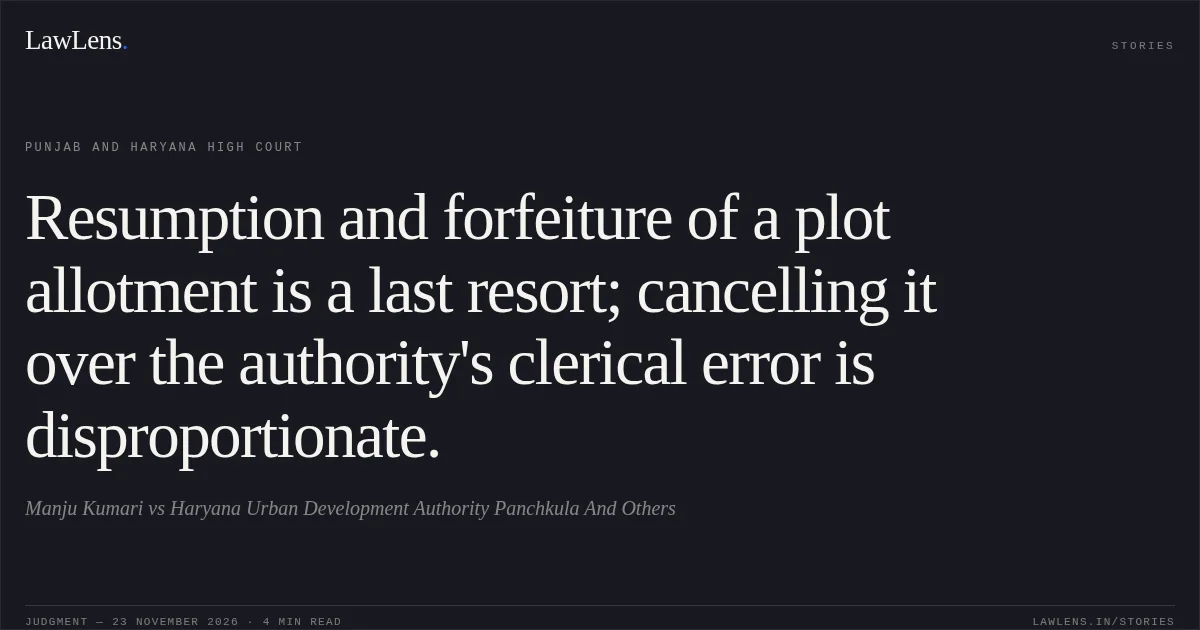
Cancellation of the allotment for delayed payment of the 15% instalment, where the delay stemmed from the authority's clerical error and the petitioner acted bona fide, was disproportionate and not sustainable in law under Teri Oat Estates.
¶ 16–17The writ petition was allowed and the Estate Officer's order dated 27.12.1995 (Annexure P-10) was set aside. Relief was conditioned on the petitioner depositing ₹10,00,000 within two months, failing which the petition would stand dismissed. On such deposit, the respondents were directed to execute ownership documents at the petitioner's expense and deliver vacant possession within six weeks. Pending applications stood disposed of.
¶ 19, 19(i)–(iii), 20Original Court PDF
Manju KumarivsHaryana Urban Development Authority Panchkula And Others
Click to open original judgment
Original judgment, available to read, download and summarize on LawLens.in