01Facts
The petitioner has served as Assistant Professor (Pay Level 11) at NIT Jalandhar since 27.12.2022.
¶ 2On 22.01.2026, the Institute advertised posts of Assistant Professor, Associate Professor and Professor, including seven Assistant Professor (Pay Level 12) posts in the Department of Computer Science and Engineering.
¶ 2–3Clause 6(3) of the General Instructions required serving faculty to apply for movement to a higher pay level "irrespective of any vacancy" and imposed no specialization constraint.
¶ 3–4Clause 2(b)(viii) made Schedule E of the First Statutes (as amended 07.06.2023) govern detailed eligibility, which requires a PhD plus three years' post-PhD experience (or six years' total experience) and 20 cumulative essential credit points.
¶ 5–6, 24–26Note 1(1) and 1(5) of Schedule E and Note 2 (Credit Point System) do not require that publications be "outside PhD work".
¶ 7–10, 27Clause 6(12) permitted shortlisting criteria "higher than the minimum" to restrict numbers, but referred to no external source.
¶ 11–13, 29–30The petitioner claimed 81.83 credit points, was awarded 57.83 against the minimum of 20, and was declared provisionally eligible.
¶ 14, 22She was nonetheless not shortlisted for failing a criterion of "two published papers in SCI/SCIE/ABDC/SSCI/AHCI journals outside PhD work".
¶ 15, 22, 31The respondents asserted that this criterion was posted on the website on 12.12.2023 and that 56 applicants were received, of whom 18 were shortlisted.
¶ 2, 4, 18, 3402Issues
i.1. Whether the respondents could apply a shortlisting criterion of "two publications in SCI/SCIE/ABDC/SSCI/AHCI journals outside PhD work" to an in-house candidate who was declared eligible under Schedule E, where the advertisement permitted only a "higher than the minimum" criterion and did not disclose the criterion.
¶ 16, 34–36, 51ii.2. Whether the impugned criterion constitutes a change in the essential qualifications prescribed by the advertisement and Schedule E, and is therefore arbitrary and beyond the scope of permissible shortlisting.
¶ 35, 37–39, 47, 5103Law Applied
Clause 6(3) of the advertisement dispenses with vacancy for in-house candidates.
¶ 3–4, 32Clause 6(12) permits only shortlisting "higher than the minimum" to restrict numbers.
¶ 11–12, 37Clause 2(b)(viii) and Schedule E fix the exclusive eligibility conditions and credit-point system without any "outside PhD work" restriction.
¶ 24–27B. Ramakichenin v. Union of India, (2008) 1 SCC 362 holds that shortlisting must rest on a rational and objective basis and that a method prescribed in the advertisement must alone be followed.
¶ 47, 49–50Manoj Kumar v. Union of India, AIR 2024 SC 1265 holds that additional selection criteria that alter prescribed qualifications are arbitrary and cannot be justified by general flexibility clauses.
¶ 50–51Tej Prakash Pathak v. Rajasthan High Court (2025) and similar authorities, which bar changing "rules of the game" midway, were noted as relevant to the analysis.
¶ 41The respondents' authorities (T. Sundaraman; Sandeep Shriram Warade; Navnit Kumar Potdar; Renu Kumari Rohal; Mahipal Singh) were considered and distinguished as concerning higher qualifications or preset screening methods rather than new eligibility conditions.
¶ 42–4604Reasoning
Under Clause 6(3), the petitioner was not required to compete for a vacancy, so the premise for restricting numbers under Clause 6(12) did not arise.
¶ 4, 32–33, 47The impugned criterion was not a "higher than minimum" measure. It did not raise the level of any prescribed qualification or experience but excluded publications arising from PhD work, a distinction absent from Schedule E and the Credit Point System.
¶ 27, 30, 35, 39, 45–46The respondents' reliance on a website notice dated 12.12.2023 failed because the advertisement made no reference to any external source, as it did for Schedule E, and the 2023 notice could not supply a criterion absent from the 2026 advertisement.
¶ 13, 30, 34, 36Applying Ramakichenin, the first requirement, a rational and objective basis, was unmet because there was no need to restrict numbers for in-house candidates. The second requirement was also breached because the advertisement prescribed the "higher than the minimum" method and the respondents adopted a different one. The respondents' authorities were distinguished because each involved a higher standard within the existing framework, whereas here a new substantive eligibility condition was introduced under the guise of shortlisting. Manoj Kumar was held to cover the case, since the criterion altered the prescribed qualifications and therefore amounted to arbitrary action.
¶ 20, 42–47, 5105Holding
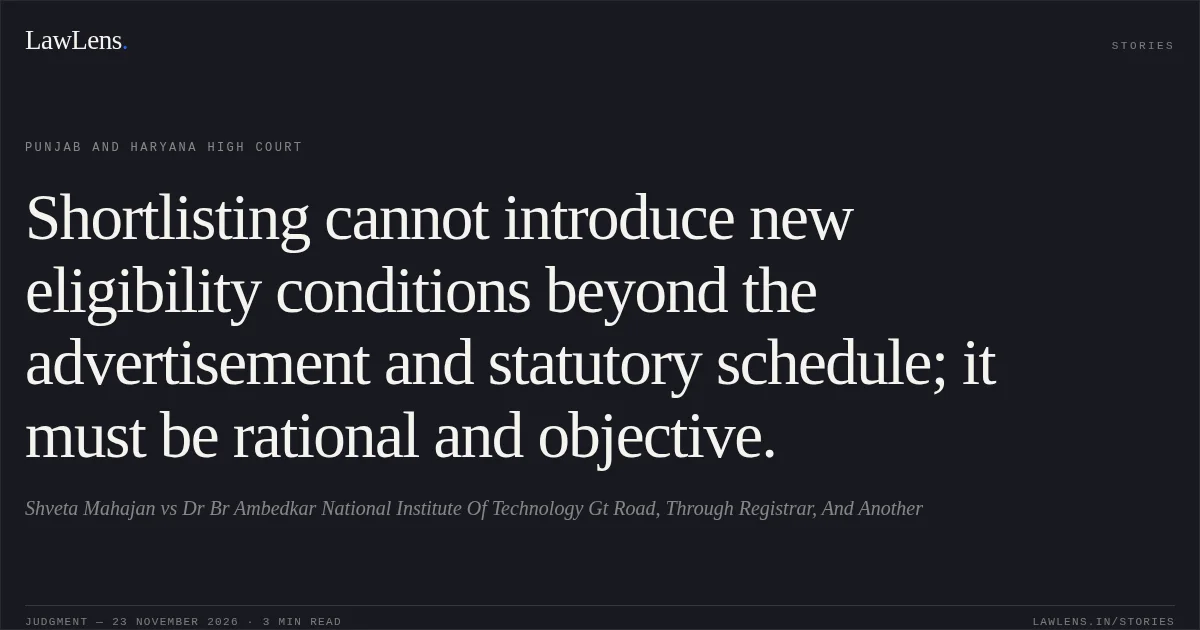
The shortlisting criterion requiring two publications "outside PhD work" was contrary to the advertisement and amounted to a change in essential conditions beyond the scope of permissible shortlisting.
¶ 51The writ petition is allowed, and pending applications are disposed of.
¶ 52–53Original Court PDF
Shveta MahajanvsDr Br Ambedkar National Institute Of Technology Gt Road, Through Registrar, And Another
Click to open original judgment
Original judgment, available to read, download and summarize on LawLens.in