01Facts
The subject land was granted in 1945 to the original grantee.
The land was alienated in 1992 by a sale deed, which settled the rights of the subsequent holders.
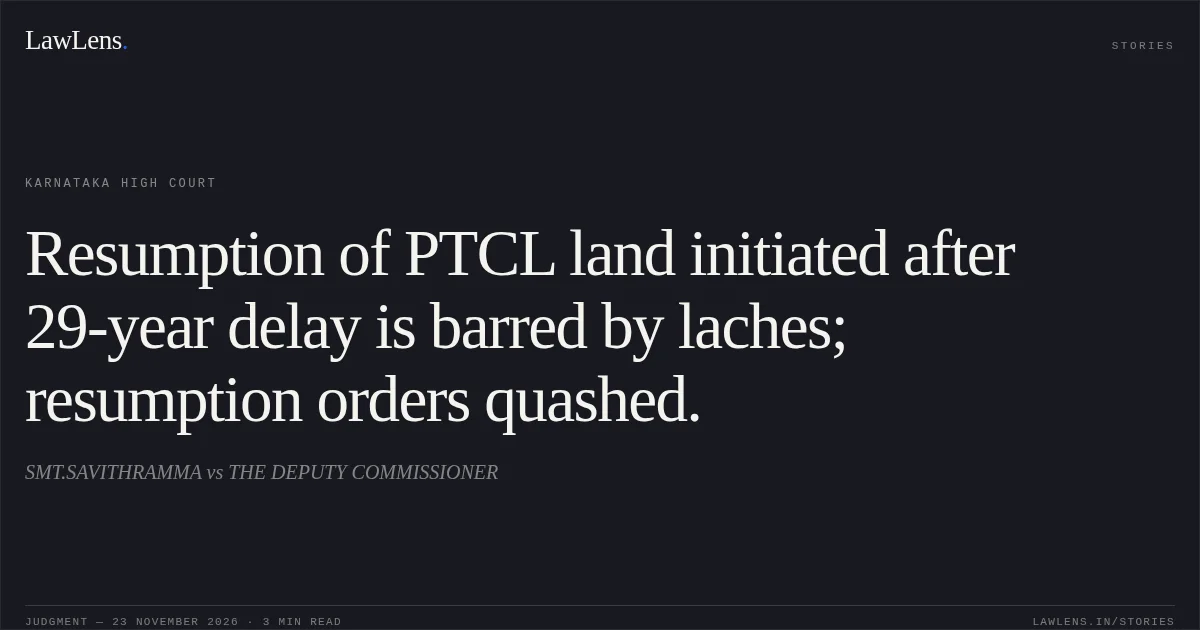
¶ 6Resumption proceedings under the PTCL Act were initiated only in 2021 (PTCL/22/2021), about 29 years after the alienation.
¶ 6The Assistant Commissioner allowed the resumption claim by order dated 09.09.2025.
¶ 6 · p. 3The Deputy Commissioner, in appeal, affirmed that order by order dated 27.01.2026 (PTCL/185/2025).
¶ 6 · p. 3The petitioner challenged both orders under Articles 226 and 227, specifically contending that the proceedings were initiated after an unreasonable and unexplained lapse of time.
¶ 6 · p. 5Respondent No. 3 contended that, in view of an amendment to the PTCL Act, laches does not arise, and that the resumption was justified.
¶ 4 · p. 402Issues
i.1. Whether resumption proceedings initiated nearly 29 years after the alienation, and after rights had been settled by a 1992 sale deed, are sustainable in the absence of an explanation for the delay and in light of the doctrine of laches.
¶ 6 · pp. 5–6ii.2. Whether the Assistant Commissioner and the Deputy Commissioner erred in law by failing to consider the inordinate delay and laches and the petitioner's specific contention on that point.
¶ 6 · p. 6iii.Respondent No. 3's contention that the statutory amendment excludes laches was recorded but not separately adjudicated.
¶ 4 · p. 403Law Applied
The court relied on the PTCL Act, the statute under which the resumption proceedings were conducted, though the judgment does not reproduce its specific provisions.
¶ 2–4 · pp. 3–4The court applied the principle, as stated in a Division Bench ruling, that laches is a primary requirement in resumption of granted lands and that a restoration or resumption action filed after a significant delay may be barred by laches.
¶ 6 · p. 6The Division Bench decision's name and reporter are not identified in the source text.
The court applied the settled writ jurisdiction under Articles 226 and 227 of the Constitution to quash orders that fail to consider a relevant and crucial issue raised by the petitioner.
¶ 6 · p. 6The statutory amendment to the PTCL Act relied on by respondent No. 3 was noted, but its text and effect were not discussed.
¶ 4 · p. 404Reasoning
The court found that the Assistant Commissioner, whose order was affirmed by the Deputy Commissioner, did not consider the nearly 29-year gap between the 1992 alienation and the 2021 initiation of proceedings.
¶ 6 · pp. 5–6Neither authority examined whether the delay was reasonable, nor addressed the petitioner's specific plea that the lapse was unexplained.
¶ 6 · p. 6The court weighed this delay against the fact that the rights in the land had been settled by the 1992 sale deed, which made the omission more serious.
¶ 6 · p. 6Applying the Division Bench principle that laches is a primary consideration in resumption, the court held that failure to address this relevant issue vitiated the orders.
¶ 6 · p. 6The court did not expressly decide respondent No. 3's argument on the statutory amendment, and its reasoning rests on the non-consideration of delay and laches.
¶ 4, 6 · p. 4, 605Holding
The resumption orders passed by the Assistant Commissioner and affirmed by the Deputy Commissioner cannot be legally sustained because they failed to consider the inordinate delay and laches.
¶ 6–7 · p. 6The writ petition is allowed. A writ of certiorari is issued quashing the Assistant Commissioner's order dated 09.09.2025 (Annexure-B) and the Deputy Commissioner's order dated 27.01.2026 (Annexure-A). The concerned authority is directed to mutate or restore the petitioner's name in the revenue records of the subject land. Interim orders stand discharged and pending interlocutory applications, if any, are disposed of.
¶ 8–9 · p. 7Original Court PDF
SMT.SAVITHRAMMAvsTHE DEPUTY COMMISSIONER
Click to open original judgment
Original judgment, available to read, download and summarize on LawLens.in