01Facts
The land was granted in 1940-41.
¶ 6 · p. 5It was sold through a registered sale deed in 1958, after which subsequent alienations took place.
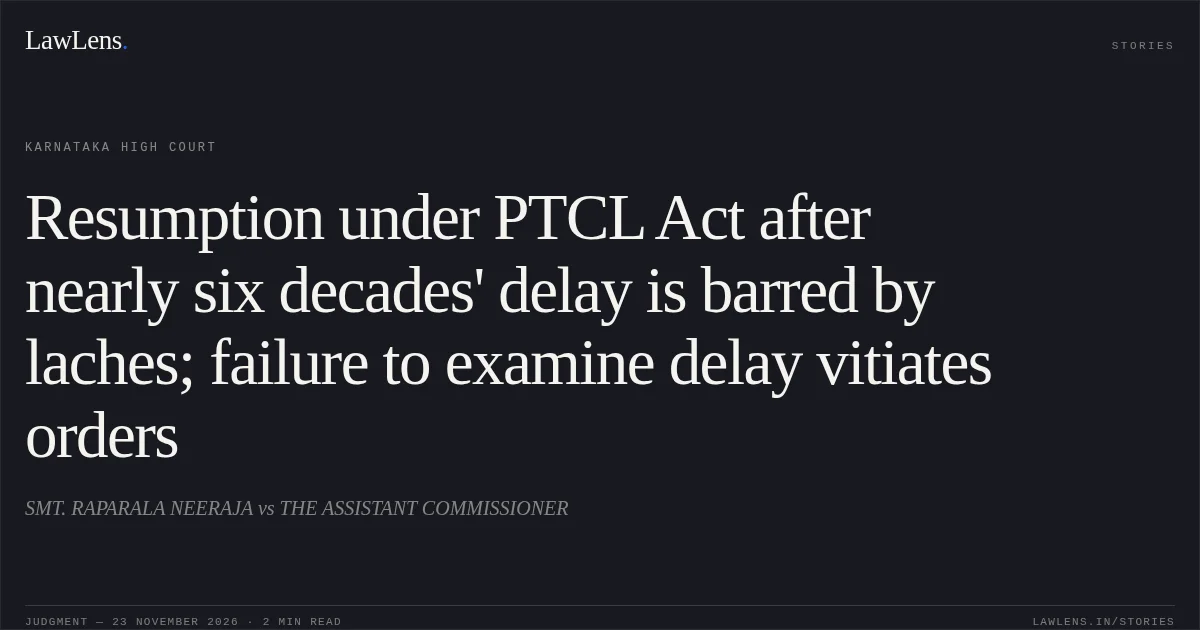
¶ 6 · p. 5Resumption proceedings were initiated before the Assistant Commissioner in 2018, nearly 60 years after the 1958 sale and 39 years after the commencement of the PTCL Act.
¶ 6 · p. 5The Assistant Commissioner allowed the petition and ordered resumption (order dated 10.09.2024, Annexure-K).
¶ 2 · p. 3 · ¶ 6 · p. 5The Deputy Commissioner dismissed the appeal and confirmed the resumption (order dated 30.04.2026, Annexure-L).
¶ 2 · p. 3 · ¶ 6 · p. 5The petitioner contended that both authorities overlooked the delay and failed to consider laches.
¶ 6 · pp. 5–6Respondent No. 3 was served but remained unrepresented; Respondent Nos. 1 and 2 were represented by the AGA.
cover page · pp. 1–202Issues
i.1. Whether the resumption of granted land under the PTCL Act, initiated about 60 years after the registered sale of 1958 and 39 years after the Act came into force, was legally sustainable where the authorities failed to consider delay and laches.
¶ 6 · pp. 5–6ii.2. Whether the failure to examine delay and laches, as a material and relevant consideration, vitiated the orders of the Assistant Commissioner and the Deputy Commissioner.
¶ 6 · p. 603Law Applied
The PTCL Act, under which the State may resume granted lands, and the doctrine of laches, which bars the exercise of such power after an unreasonable delay.
¶ 6 · pp. 5–6A Division Bench ruling, not named in the judgment, held that laches is the primary requirement in resumption of lands and that a restoration action filed after a significant delay may be barred by laches.
¶ 6 · pp. 6–7The consideration of delay is a material and relevant consideration, and its omission vitiates the resumption order.
¶ 6 · p. 604Reasoning
The resumption proceedings were initiated roughly six decades after the registered sale deed of 1958 and nearly four decades after the PTCL Act came into force.
¶ 6 · p. 5Rights in the land had crystallised under the 1958 sale deed, so the State's exercise of power after such a long lapse required justification.
¶ 6 · p. 6Both authorities failed to address whether the delay was unreasonable or whether laches applied, despite the petitioner raising the point.
¶ 6 · pp. 5–6Applying the Division Bench principle that laches is a primary requirement in resumption, the Court held that this omission was a failure to consider a material and relevant factor, which vitiated both impugned orders.
¶ 6 · pp. 6–7The Court did not record a finding on the merits of the original grant or subsequent alienations, and its reasoning rests on the omission of the delay and laches inquiry.
¶ 6 · pp. 6–705Holding
The resumption orders of the Assistant Commissioner (10.09.2024) and the Deputy Commissioner (30.04.2026) could not be sustained because the authorities failed to examine delay and laches.
¶ 6 · p. 7 · ¶ 7 · p. 7The writ petition was allowed, and both orders were quashed under a writ of certiorari. The first respondent was directed to mutate or restore the petitioner's name in the subject land in the revenue records. Interim orders stand discharged, and pending interlocutory applications, if any, stand disposed of.
¶ 8 · p. 7 · ¶ 9 · p. 8Original Court PDF
SMT. RAPARALA NEERAJAvsTHE ASSISTANT COMMISSIONER
Click to open original judgment
Original judgment, available to read, download and summarize on LawLens.in