Facts
The petitioners sought to quash proceedings under Section 482 of the Code of Criminal Procedure in C.C. No. 8369/2021, arising from a police complaint alleging offences under Sections 332, 353 and 504 read with Section 34 of the IPC.
Source reference: p.3–4The complaint alleged that, during a dispute over a shed, the petitioners abused police personnel and assaulted a woman constable who had accompanied the second respondent, an Assistant Sub-Inspector, to the scene.
Source reference: p.3–4The petitioners maintained that the incident occurred when private parties, with police assistance, attempted to dispossess them; they relied on pending civil litigation, photographs and a wound certificate, and contended that their complaint against the police had prompted a retaliatory prosecution.
Source reference: p.5–6After the police filed a charge sheet and the Magistrate took cognizance, the petitioners moved the High Court to quash the proceedings.
Source reference: p.4The State opposed the petition, relying on witness statements collected during the investigation.
Source reference: p.6Issues
1. Whether the charge-sheet proceedings against the petitioners should be quashed under Section 482 CrPC as an alleged retaliatory prosecution amounting to an abuse of process.
Source reference: p.3–4, p.9–102. Whether the surrounding circumstances and materials on record supported the petitioners’ contention that the complaint was lodged with mala fide intent, notwithstanding the charge sheet and witness statements.
Source reference: p.7–10Law Applied
Section 482 CrPC preserves the High Court’s inherent power to prevent abuse of the process of court and secure the ends of justice.
Source reference: p.3, p.13–16The Court relied on the Bhajan Lal categories, including cases where allegations do not make out an offence, are inherently improbable, or where proceedings are manifestly attended by mala fides and instituted to wreak vengeance.
Source reference: p.9–12Relying on Mohammed Ali v. State of U.P., 2023 (15) SCC 488, it noted that, when mala fide or vexatious proceedings are alleged, the court may examine attending circumstances and investigation materials, not merely the complaint’s wording.
Source reference: p.9–13It also referred to State of Andhra Pradesh v. Golconda Linga Swamy, (2004) 6 SCC 522, and R.P. Kapur v. State of Punjab, AIR 1960 SC 866, on the scope of quashing proceedings and the distinction between a manifest absence of legal evidence and an assessment of evidence ordinarily reserved for trial.
Source reference: p.13–16Reasoning
The Court considered the property dispute, the petitioners’ account of an attempted dispossession, the photographs showing police personnel at the scene, and the wound certificate recording the petitioners’ allegation that the Assistant Sub-Inspector and others had assaulted them.
Source reference: p.7–8It also noted that the woman constable allegedly assaulted had not lodged a complaint, while the Assistant Sub-Inspector had filed the case against the petitioners; the Court further observed that the record did not explain why the petitioners’ complaint against the police and Shivakumar had not been registered.
Source reference: p.8–9On these circumstances, the Court inferred that the prosecution was retaliatory and found the case to fall within the Bhajan Lal categories concerning absence of a prima facie offence, inherent improbability and mala fide institution.
Source reference: p.9–10Holding
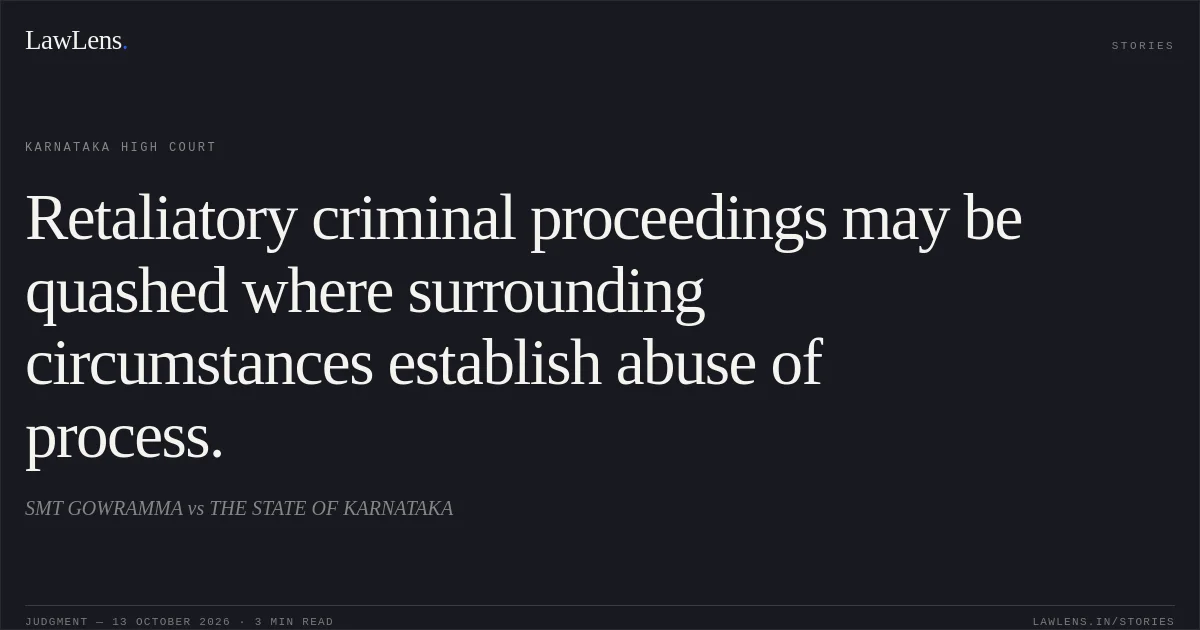
The High Court allowed the petition and quashed the proceedings against the petitioners in C.C. No. 8369/2021, arising out of Crime No. 4/2021, for offences under Sections 332, 353 and 504 read with Section 34 IPC, pending before the I Additional Chief Metropolitan Magistrate, Bengaluru.
Acts & Sections Cited
7 provisions across 2 statutes referred to in this judgment. Each provision opens on LawLens.
Code of Criminal Procedure, 19733
Indian Penal Code, 18604
Original Court PDF
SMT GOWRAMMAvsTHE STATE OF KARNATAKA
Click to open original judgment
Original judgment, available to read, download and summarize on LawLens.in


![Railway pensioners qualify for additional pension only upon completing 80 years of age.. OM PRAKASH MISHRA vs NORTH EASTERN RAILWAY. CAT - ['Allahabad']. LawLens](/stories/thumbnails/railway-pensioners-qualify-for-additional-pension-only-upon-completing-80-years-of-age-e4a0c68f01cd4886b5cdc93e3a4b5e33.webp)