01Facts
The petitioner, a Medical Officer appointed in 1971, faced disciplinary proceedings arising from an inspection conducted on 31 July 1987 concerning unrecovered payments to six persons and alleged loss to the Government.
pp. 3–4, 9–10A charge memo was issued on 8 July 1993, and the enquiry was entrusted to the Lokayukta in 1994.
pp. 3–4, 9–10The petitioner retired on 31 May 1999; the Lokayukta submitted its report on 28 February 2002.
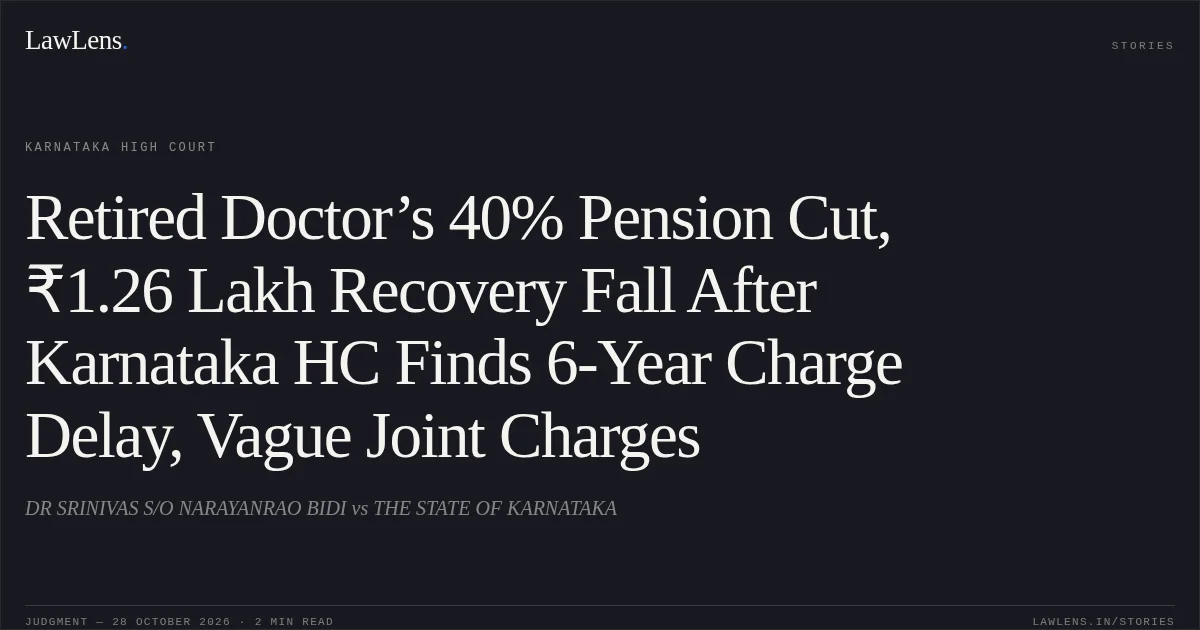
pp. 3–4, 9–10On 20 December 2002, the State ordered recovery of Rs. 1,26,393 from his retirement benefits and permanently withheld 40% of his pension.
pp. 3–4, 9–10The Karnataka Administrative Tribunal dismissed his challenge on 10 July 2017.
pp. 3–4, 9–10He then petitioned the High Court to set aside the Tribunal’s order and the consequential penalty
pp. 3–4, 9–1002Issues
i.Whether the unexplained six-year delay between the 1987 inspection and the 1993 charge memo, followed by prolonged enquiry proceedings, vitiated the disciplinary proceedings
pp. 9–11ii.Whether the charge memo and enquiry were invalid because the allegations against the petitioner and the other government servant were not particularised individually
pp. 9–1103Law Applied
The Court applied the principle in State of Andhra Pradesh v. N. Radhakishan, (1998) 4 SCC 154, that delay in disciplinary proceedings must be assessed by balancing relevant circumstances, including the nature and complexity of the charges, the explanation for delay, and resulting prejudice; unexplained abnormal delay may warrant quashing proceedings.
pp. 11–19It also relied on P.V. Mahadevan v. Managing Director, Tamil Nadu Housing Board, (2005) 6 SCC 636, which recognises that prolonged, unexplained disciplinary proceedings can cause prejudice and should not be continued where the employee should not bear the consequences of departmental delay.
pp. 11–19The Court further applied the principle that charges must specify the allegations attributable to each delinquent employee, rather than present undifferentiated or vague accusations
pp. 11–19Provisions in the judgment · 2
Tamil Nadu State Housing Board Act, 1961 Section 118Section 119
04Reasoning
The inspection report was available in 1987, yet the State gave no explanation for waiting six years to issue the charge memo; the enquiry then continued for years, with the report submitted in 2002.
pp. 9–11The Court held that the delay was unexplained and, in the circumstances, vitiated the proceedings
pp. 9–11The charge memo and enquiry findings also treated the two government servants’ alleged conduct as an undifferentiated whole, without identifying each person’s individual responsibility.
pp. 10–19Applying the cited authorities, the Court concluded that both the delay and the failure to particularise the charges undermined the proceedings and the resulting penalty.
pp. 10–19It also found that the Tribunal had failed to address these grounds adequately
pp. 10–1905Holding
The High Court allowed the writ petition and quashed the Tribunal’s order dated 10 July 2017 in Application No. 2085/2004.
p. 20It held that the unexplained delay and non-particularised charges vitiated the disciplinary proceedings and resulting penalty, and directed that the petitioner receive all consequential benefits flowing from the order
p. 20Original Court PDF
DR SRINIVAS S/O NARAYANRAO BIDIvsTHE STATE OF KARNATAKA
Click to open original judgment
Original judgment, available to read, download and summarize on LawLens.in