Facts
The petitioner was appointed as a Daftari (Class-IV) in 1975 and later promoted to a Class-III post in 1989.
Source reference: para. 3On 28.05.1996, he was promoted to the post of Field Overseer and was ranked at Sl. No. 15 in the 2013 seniority list.
Source reference: para. 3The petitioner superannuated from service on 30.09.2014.
Source reference: para. 3Subsequent to his retirement, the University issued memos in 2015 and 2016 granting promotions to the post of Junior Research Assistant to individuals who were junior to the petitioner in the seniority list.
Source reference: para. 3The petitioner filed representations in 2025 and eventually this writ petition in 2026, seeking retrospective promotion and parity with his juniors.
Source reference: para. 4Issues
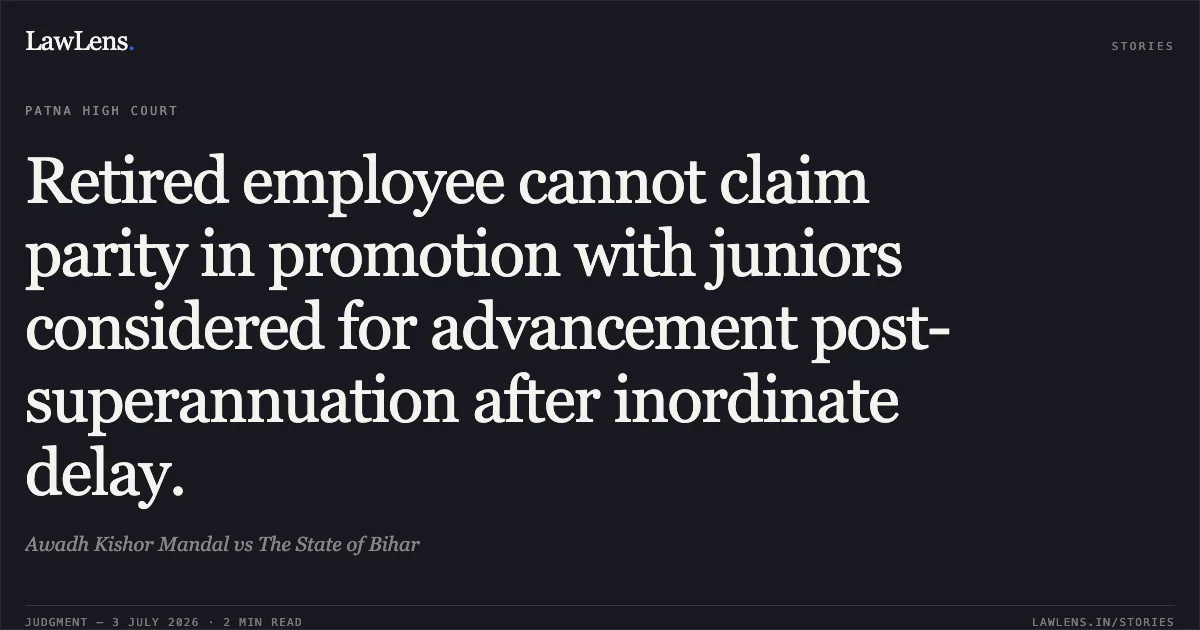
1. Whether a retired employee can claim promotion on the ground of parity with juniors who were considered and promoted after his retirement while they were in active service.
Source reference: para. 62. Whether the writ petition is barred by the doctrine of delay and laches given that the petitioner approached the court approximately twelve years after retirement and ten years after the promotion of his juniors.
Source reference: para. 6Law Applied
The Court applied the principle of "Delay and Laches" and the "Fence-Sitter" doctrine in service jurisprudence.
Source reference: no citationState of Uttar Pradesh v. Arvind Kumar Srivastava (2015) 1 SCC 347, which holds that while similarly situated persons should generally be treated alike, an exception exists for "fence-sitters" who wake up after long delays.
Source reference: para. 8The State of Tamil Nadu v. R. Sasipriya (Civil Appeal Nos. 6883-6884 of 2026), affirming that courts should not encourage stale claims in matters of seniority and promotion where third-party rights have crystallized.
Source reference: para. 7P.S. Sadashivaswamy v. State of Tamil Nadu (1975) 1 SCC 152, establishing that aggrieved parties in service matters must approach the court within six months to a year of the cause of action.
Source reference: para. 12Reasoning
The Court reasoned that at the time the petitioner’s juniors were considered for promotion (2015 and 2016), the petitioner had already retired (2014) and was no longer in active service.
Source reference: para. 6Promotion is generally considered for those in active service based on vacancy and fitness.
Source reference: para. 6The court observed that the petitioner remained "innocuously oblivious" to the situation for over a decade, filing his first representation only in 2025.
Source reference: para. 3, 12Applying the "fence-sitter" logic, the Court held that the petitioner waited for the matter to conclude and only sought relief years after the rights of others had crystallized.
Source reference: para. 7, 10The Court emphasized that equity aids the vigilant, not the indolent, and that entertaining such stale claims would result in a wastage of judicial time.
Source reference: para. 12Holding
The Court answered the issues in the negative, holding that the petitioner is not entitled to parity as he was not in active service when the promotions were granted, and his claim is heavily barred by delay and laches.
The Court dismissed the writ petition, stating it found no merit in the claims of a "fence-sitter" seeking to agitate a stale dispute. All pending applications were disposed of accordingly.
Source reference: para. 13, 14Original Court PDF
Awadh Kishor MandalvsThe State of Bihar
Click to open original judgment
Original judgment, available to read, download and summarize on LawLens.in