Facts
The Bank of Madura ("e-BOM") amalgamated with ICICI Bank in 1993 under Section 44A of the Banking Regulation Act, 1949
Source reference: para. 2Respondent No. 4, an e-BOM employee, was absorbed by the petitioner bank and superannuated on June 30, 2016, while holding the post of Assistant Manager
Source reference: para. 7Unlike original ICICI employees, e-BOM employees were entitled to pension under the Employees' Pension Regulations, 1995, based on their pay at the time of amalgamation
Source reference: para. 4-5Nine years after retirement, Respondent No. 4 raised an industrial dispute via the "Samadhan" Portal claiming higher pension based on his last drawn pay in 2016 rather than his 2001 pay
Source reference: para. 8, 25, 30Following a failure report by the Conciliation Officer, the Deputy Chief Labour Commissioner referred the matter to the Central Government Industrial Tribunal (CGIT)
Source reference: para. 10, 26, 11The petitioner challenged this reference order via a writ petition.
Source reference: no citationIssues
1. Whether a retired employee/pensioner falls within the definition of a "workman" under Section 2(s) of the Industrial Disputes Act, 1947, for the purpose of raising an industrial dispute
Source reference: para. 25, 322. Whether the appropriate Government can refer a dispute to a Tribunal without first forming an opinion on whether the claimant is a "workman"
Source reference: para. 35-363. Whether the action of the management in calculating pension from the 2001 basic pay instead of the 2016 superannuation pay was legal and justified
Source reference: para. 25Law Applied
Section 2(s) of the Industrial Disputes Act, 1947, which defines "workman" as a person currently employed or one who has been dismissed, discharged, or retrenched, notably excluding retirees
Source reference: para. 33Hindustan Lever Ltd. vs. Fourth Industrial Tribunal, which established that the definition of "workman" does not include a person who has superannuated
Source reference: para. 17(i), 33Secretary, Indian Tea Association vs. Ajit Kumar Barat, which mandates that the Government must form a subjective opinion on whether an employee is a workman before making a reference under Section 10
Source reference: para. 17(ii), 34Section 33C(2) regarding the computation of money due, which generally carries a one-year limitation for applications
Source reference: para. 29, 41Reasoning
The Court observed that Respondent No. 4 was a managerial employee (Assistant Manager) at the time of his superannuation, which further excluded him from the "workman" category under Section 2(s)
Source reference: para. 7, 31Applying the Hindustan Lever precedent, the Court reasoned that since the respondent was a retiree and not a dismissed or retrenched employee, he did not satisfy the statutory definition of a workman; consequently, no "industrial dispute" could legally exist
Source reference: para. 33, 38The Court found the impugned reference flawed because the Government referred the question of the respondent's status as a "workman" to the Tribunal (Issue No. 1 of the reference) instead of forming its own opinion as a condition precedent to the reference as required by Indian Tea Association
Source reference: para. 35-37Additionally, the Court noted that the claim was raised after a delay of nine years, which is inconsistent with the typical one-year period prescribed for computation of dues under Section 33C
Source reference: para. 40-41Holding
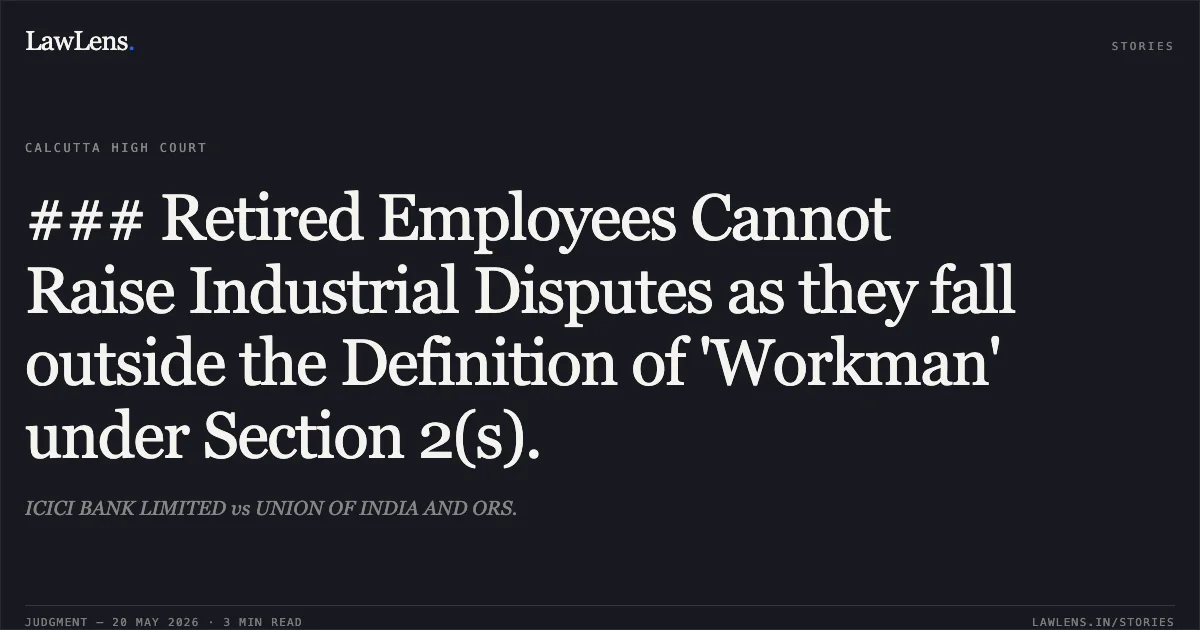
The Court held that a retired employee is not a "workman" under Section 2(s) of the Industrial Disputes Act and thus cannot raise an industrial dispute
the reference order was bad in law as the authority failed to form an opinion on the respondent's status before making the reference
Source reference: para. 36-37The Court quashed and set aside the order of reference dated May 22, 2025, and allowed the writ application
Source reference: para. 42-43Acts & Sections Cited
5 provisions across 2 statutes referred to in this judgment. Linked provisions open on LawLens.
Banking Regulation Act, 19491
Industrial Disputes Act, 19474
Original Court PDF
ICICI BANK LIMITEDvsUNION OF INDIA AND ORS.
Click to open original judgment
Original judgment, available to read, download and summarize on LawLens.in