Facts
The petitioners, retired employees, filed a petition under Article 226 seeking arrears, consequential benefits, and directions to the respondents to decide their representations for parity with similarly situated employees who had received revised pay-scale benefits pursuant to A.L. Thakur v. State of M.P., W.P. No. 16054 of 2003, decided on 27 June 2012.
Source reference: para. 1During hearing, the petitioners restricted their claim to consideration of their representations and grant of the same relief as extended in A.L. Thakur.
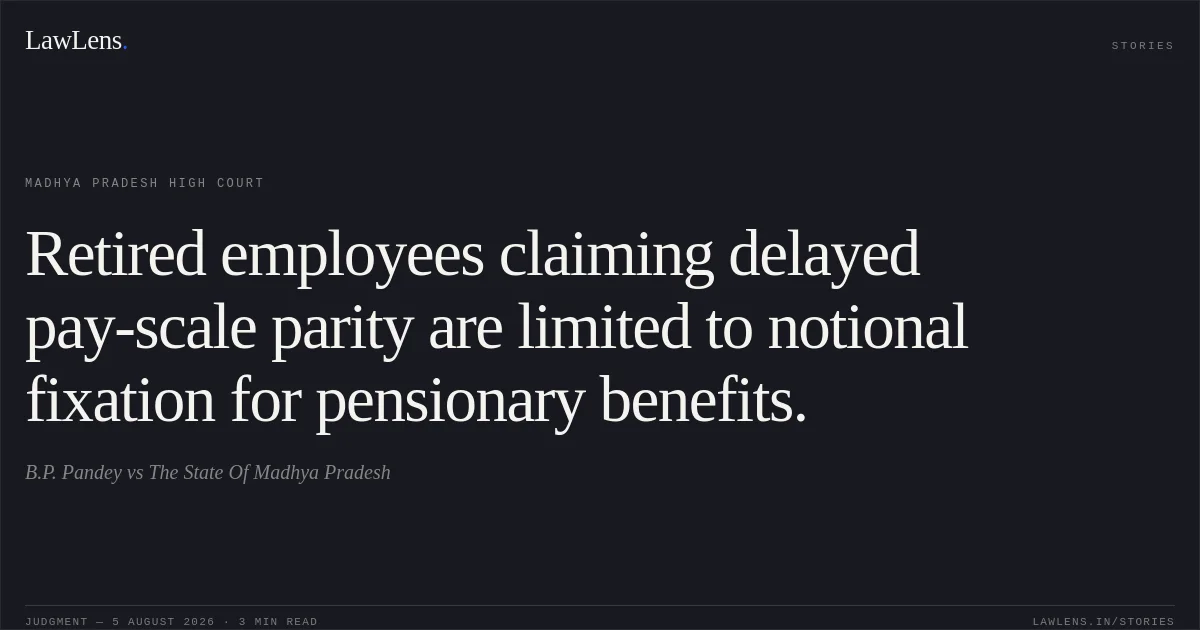
Source reference: para. 2The Court noted that, in Ashok Kumar Saxena v. State of Madhya Pradesh and Others, W.P. No. 14178 of 2019 and connected matters, it had held that retired employees could receive only notional pay fixation for pensionary purposes, while claims for past arrears were barred by delay and limitation.
Source reference: para. 3On that basis, the present petition was considered for limited relief.
Source reference: para. 4Issues
Whether the retired petitioners could claim arrears and other monetary benefits arising from alleged parity in pay scales with similarly situated employees under the judgment in A.L. Thakur, despite the delay in asserting the claim?
Source reference: paras. 2–4Whether the petitioners were entitled at least to consideration of their claim and notional pay fixation for revision of pensionary benefits?
Source reference: paras. 3–5Law Applied
The Court exercised its discretionary jurisdiction under Article 226 of the Constitution and applied the principles of delay, laches, and limitation.
Source reference: para. 3It relied on State of Orissa v. Mamata Mohanty, (2011) 3 SCC 436, for the rule that a recurring cause of action does not justify stale claims for past monetary benefits and that fence-sitters cannot claim parity after prolonged delay.
Source reference: para. 3Under Article 7 of the Schedule to the Limitation Act, 1963, claims for wages are ordinarily subject to a three-year period from the date the amount becomes due.
Source reference: para. 3M.R. Gupta v. Union of India, (1995) 5 SCC 628, recognizes continuing or recurring causes of action for correct pay fixation but restricts recovery of time-barred arrears.
Source reference: para. 3The Court further relied on Karnataka Power Corporation Ltd. v. K. Thangappan, (2006) 4 SCC 322, Shiv Dass v. Union of India, (2007) 9 SCC 274, U.P. Jal Nigam v. Jaswant Singh, (2006) 11 SCC 464, and NDMC v. Pan Singh, (2007) 9 SCC 278, for the proposition that unexplained delay and laches may disentitle a claimant from discretionary writ relief.
Source reference: para. 3However, notional pay fixation may still be granted for revision of pensionary benefits where the claim is otherwise legally justified.
Source reference: paras. 3–4Reasoning
The petitioners were retired employees seeking retrospective monetary benefits based on parity with employees covered by A.L. Thakur.
Source reference: no citationSince the claim concerned arrears allegedly accruing during their service and was pursued after substantial delay, the Court applied the rule that a recurring pay dispute may support correction of pay fixation prospectively or notionally, but does not revive a stale claim for arrears.
Source reference: no citationThe reasoning in Ashok Kumar Saxena was treated as directly applicable: retired employees could not obtain past arrears, but could receive notional fixation for pensionary purposes.
Source reference: para. 3Accordingly, the Court limited the respondents’ obligation to considering the petitioners’ cases for notional fixation and pension revision, rather than directing payment of arrears.
Source reference: para. 4Holding
The petition was partly allowed.
The respondents were directed to consider the petitioners’ cases only for notional pay fixation for the purpose of revising pensionary benefits, in accordance with the principles laid down in Ashok Kumar Saxena.
Source reference: para. 4The claim for arrears and other past monetary benefits was not granted.
Source reference: no citationThe petition was accordingly disposed of.
Source reference: para. 5Original Court PDF
B.P. PandeyvsThe State Of Madhya Pradesh
Click to open original judgment
Original judgment, available to read, download and summarize on LawLens.in