01Facts
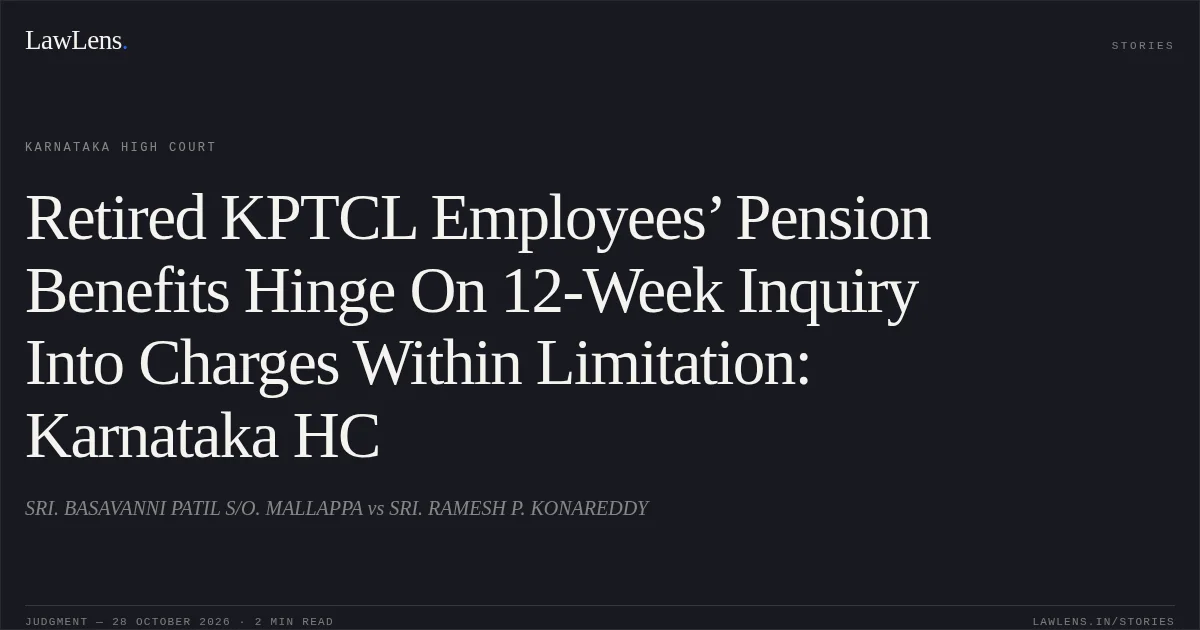
The appeals arose from orders in writ petitions brought by retired KPTCL employees challenging post-retirement disciplinary proceedings and the withholding of their pensionary benefits.
pp. 4–6In Basavanni Patil’s case, the Single Judge quashed charges relating to events outside the four-year period under Regulation 171(b), permitted specified charges at Annexures B, B1 and B2 to proceed, and directed release of retiral and pensionary benefits within eight weeks.
pp. 4–6Mahadev Talwar’s case was decided by reference to that ruling. Patil also filed a contempt petition alleging non-compliance with the order.
pp. 4–6, 10–12KPTCL appealed the directions concerning release of benefits and the treatment of the surviving charges.
pp. 10–1102Issues
i.1. Whether the surviving charges could proceed through a separate charge sheet, confined to allegations already made and within the period permitted by Regulation 171(b).
pp. 11–12ii.2. Whether the directions requiring release of pensionary and retiral benefits within eight weeks should stand, or be made subject to the outcome of the disciplinary enquiry.
pp. 10–12iii.3. Whether the contempt proceedings should continue after the appellate court’s order.
p. 1203Law Applied
Regulation 171(b) of the Karnataka Electricity Board Employees’ Service Regulations, 1966 governs departmental proceedings instituted after retirement: such proceedings require the Board’s sanction and cannot concern events that took place more than four years before institution; they must also follow the prescribed disciplinary procedure.
pp. 7–9The Single Judge’s order referred to State Bank of India v. Navin Kumar Sinha, M.V. Bijlani v. Union of India, Bangalore Electricity Supply Company Ltd. v. Malathi B., and State of Andhra Pradesh v. N. Radhakishan in addressing post-retirement proceedings, delay and pension withholding.
p. 7The Division Bench’s operative ruling preserved the charges held to be within limitation, while requiring that any separate charge sheet contain no new allegations.
pp. 11–12Provisions in the judgment · 3 · Linked ones open on LawLens
KARNATAKA HIGH COURT ACT, 1961 Section 4
Contempt of Courts Act, 1971 Section 11Section 12
04Reasoning
The Division Bench considered that the surviving allegations could be pursued by drawing up a separate charge sheet, provided it was confined to allegations already made and addressed the period the Single Judge had held to be within limitation.
pp. 11–12It therefore sustained the Single Judge’s decision to permit those charges to proceed, but set aside the unconditional directions for payment of benefits within eight weeks. Instead, the benefits covered by those directions were made subject to the enquiry’s outcome, which had to be concluded within twelve weeks.
pp. 11–12With the appellate order determining the challenge to compliance, the Court dropped the contempt proceedings.
p. 1205Holding
The writ appeals were allowed in part.
pp. 11–13The directions to release benefits within eight weeks and related directions were set aside; the surviving charges were permitted to proceed through a separate charge sheet, with no new allegations, and the enquiry was to conclude within twelve weeks.
pp. 11–13The affected benefits were made subject to the enquiry’s result, all contentions were left open, and C.C.C. No. 100158 of 2026 was dropped.
pp. 11–13Original Court PDF
SRI. BASAVANNI PATIL S/O. MALLAPPAvsSRI. RAMESH P. KONAREDDY
Click to open original judgment
Original judgment, available to read, download and summarize on LawLens.in