01Facts
The complainant, a retired principal, alleged that he had not received salary and other monetary benefits due to him.
In W.P. No. 106274/2024, the High Court directed the authorities to consider his representations in accordance with law and complete compliance within four weeks of receiving the order
p. 3 · ¶ 5The complainant subsequently filed this contempt petition, alleging non-compliance.
During the contempt proceedings, the State released amounts to him and informed the educational trust that it considered the trust responsible for the delay and for interest on delayed payments
p. 4 · ¶ 7–8The complainant acknowledged receipt of the amounts but disputed the non-payment of interest and leave encashment benefits; he also sought to implead the trust’s secretary
p. 5 · ¶ 8–902Issues
i.Whether the authorities willfully disobeyed the order in W.P. No. 106274/2024 by failing to comply with its direction to consider the complainant’s representations
pp. 5–7 · ¶ 10, 12–14ii.Whether the trust’s secretary could be proceeded against for contempt of that order, despite the trust not having been a party to the writ petition and no direction having been issued against it
pp. 5–7 · ¶ 11, 1303Law Applied
The petition was brought under Sections 11 and 12 of the Contempt of Courts Act, 1971, read with Article 215 of the Constitution of India
p. 2The Court applied the principle that contempt requires willful disobedience of a court order; the scope of contempt is limited to enforcing the direction actually made, and it cannot be used to impose an obligation on a person against whom the underlying order issued no direction.
The writ order required the authorities to consider the representations in accordance with law; it did not itself direct payment of specified sums
p. 3, 5, 7 · ¶ 5, 10, 13Provisions in the judgment · 2 · Linked ones open on LawLens
Contempt of Courts Act, 1971 Section 11Section 12
04Reasoning
The Court found that the authorities had considered the complainant’s request and released the amounts due, thereby complying with the writ order’s direction to consider his representations
p. 6 · ¶ 12Because the writ order did not direct payment of particular sums, the complainant’s remaining disputes concerning interest and leave encashment did not establish contempt; he could pursue those claims in appropriate proceedings
pp. 5–7 · ¶ 8, 10, 13The trust was not a party to the writ petition, and no direction had been issued against its secretary, so the secretary could not be held in contempt of that order
pp. 6–7 · ¶ 11, 1305Holding
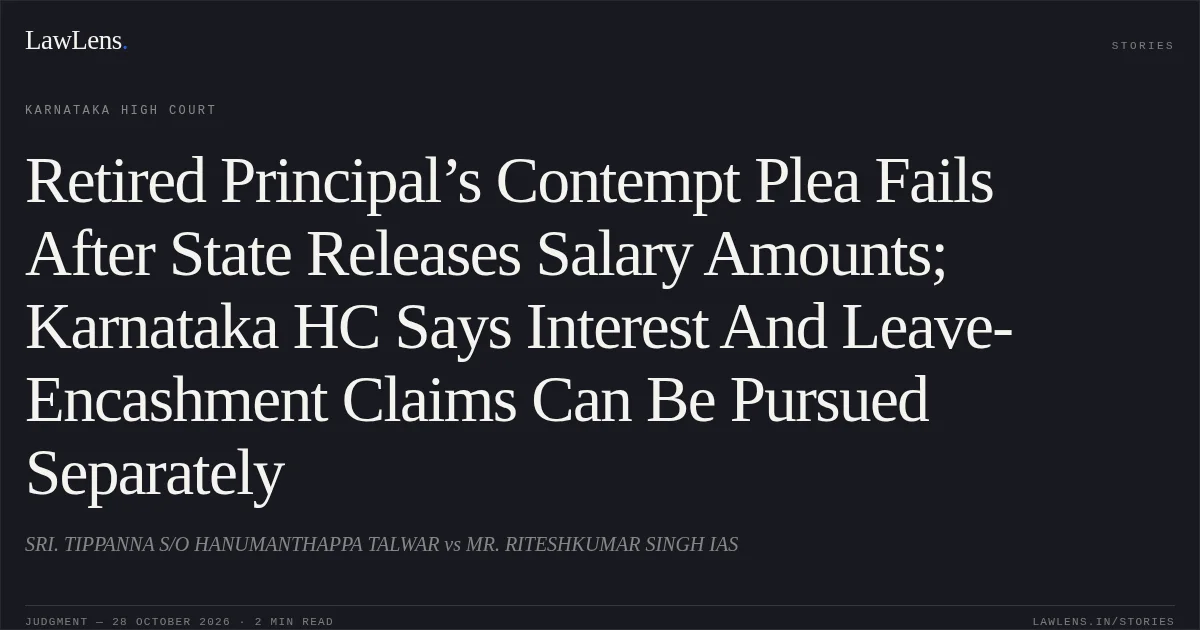
The Court found no willful disobedience by the accused or the persons sought to be impleaded and dismissed the contempt petition.
p. 7 · ¶ 13–15It left the complainant at liberty to pursue any outstanding claims for interest or leave encashment through appropriate proceedings in accordance with law
p. 7 · ¶ 13–15Original Court PDF
SRI. TIPPANNA S/O HANUMANTHAPPA TALWARvsMR. RITESHKUMAR SINGH IAS
Click to open original judgment
Original judgment, available to read, download and summarize on LawLens.in