01Facts
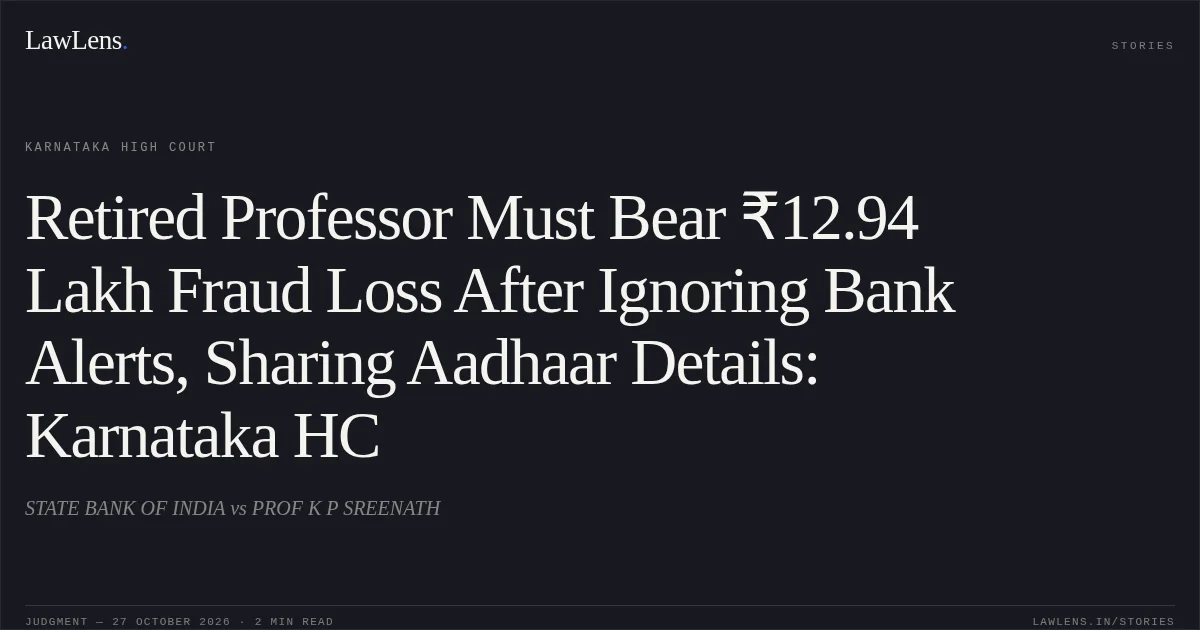
The respondent, a retired professor, alleged that ₹12,93,922 was withdrawn from his SBI account through unauthorised transactions between 12 and 30 April 2019.
pp. 3–5 · ¶ 3–5He reported the transactions to the Bank on 2 May 2019, after discovering them on 30 April.
pp. 3–5 · ¶ 3–5The District Commission directed the Bank to refund the amount with interest and compensation; the State Commission and National Commission affirmed that decision, applying the RBI’s customer-protection circular and finding no established customer negligence.
pp. 7–9 · ¶ 10–15The Bank challenged the National Commission’s order under Articles 226 and 227, contending that the respondent had received transaction alerts, shared his Aadhaar details with an unknown person, and failed to report the transactions promptly.
pp. 17–19 · ¶ 17–1902Issues
i.1. Whether the National Commission’s order affirming the Bank’s liability for the unauthorised transactions warranted interference by the High Court
p. 11 · ¶ 21ii.2. Whether the respondent’s conduct brought the loss within paragraph 7(i) of the RBI Circular dated 6 July 2017, making him liable for the loss due to customer negligence
pp. 14–18 · ¶ 27–3203Law Applied
The Court considered Section 2(11) of the Consumer Protection Act, 2019, under which deficiency in service requires an established fault, omission or negligence in the service provider’s performance.
pp. 19–20 · ¶ 35–36It applied the RBI Circular dated 6 July 2017 on customer protection in unauthorised electronic banking transactions: paragraph 6(ii) provides for zero customer liability in specified third-party breach circumstances where the customer notifies the bank within three working days of receiving communication of the unauthorised transaction; paragraph 7(i) makes the customer liable for the loss until reporting where the unauthorised transaction resulted from the customer’s negligence, including sharing payment credentials.
pp. 14–16 · ¶ 27–28Provisions in the judgment · 2 · Linked ones open on LawLens
Consumer Protection Act, 2019 Section 35Section 2
04Reasoning
The Court concluded that paragraph 7(i), rather than paragraph 6(ii), applied.
pp. 12–18 · ¶ 22–32It relied on the respondent’s receipt of repeated SMS alerts, his operation of the account during the period of the disputed transactions, his admission that he had shared his Aadhaar details with an unknown person, and the Internal Ombudsman’s observation that the OTP might also have been shared.
pp. 12–18 · ¶ 22–32The respondent did not report the transactions until 2 May, while the Bank blocked further attempts after receiving his complaint.
pp. 12–18 · ¶ 22–32On these facts, the Court found customer negligence and no established fault, omission or negligence by the Bank constituting deficiency in service.
pp. 19–20 · ¶ 35–3605Holding
The Court held that the respondent was liable for the loss under paragraph 7(i) of the RBI Circular and that the finding of deficiency in service against the Bank was unsustainable.
p. 20 · ¶ 36It allowed the writ petition and set aside the National Commission’s order dated 15 May 2026; it made no order as to costs.
p. 20 · OrderOriginal Court PDF
STATE BANK OF INDIAvsPROF K P SREENATH
Click to open original judgment
Original judgment, available to read, download and summarize on LawLens.in