01Facts
The plaintiff, Janardhan Dass (since deceased), was appointed as a Constable in 1949 in the erstwhile Patiala State, which later became part of PEPSU and then the State of Punjab.
¶ 2He was born on 05.11.1926 and retired on 30.11.1984 at the age of 58.
¶ 2He claimed that under the Patiala State and PEPSU service regulations, a Constable could serve till 60, and that a lower retirement age could not be imposed without Central approval under the proviso to Section 115(7) of the States Reorganisation Act, 1956 and Section 82(6) of the Punjab Reorganisation Act, 1966.
¶ 2He filed a suit for declaration that the retirement was illegal, with consequential benefits, arrears for three years and two months, and interest.
¶ 2The suit was instituted on 14.12.1991.
¶ 10The defendants pleaded limitation, among other objections.
¶ 3The Trial Court held the retirement illegal but dismissed the suit as time-barred.
¶ 5The First Appellate Court reversed on limitation, treating pension as a recurring cause of action, and decreed the suit with recalculation of benefits as if retirement occurred on 30.11.1986.
¶ 602Issues
i.1. Whether a suit for declaration challenging the order of retirement at 58 years, filed on 14.12.1991, is within limitation under Article 58 of the Limitation Act, 1963.
¶ 10–11.2ii.2. Whether the monthly payment of pension gives rise to a recurring cause of action that revives a time-barred challenge to a one-time retirement order.
¶ 12.1iii.3. Whether consequential reliefs (arrears, recalculated pension, and retiral benefits) survive once the primary relief of declaration is barred by limitation.
¶ 1203Law Applied
The Court applied Article 58 of the Limitation Act, 1963, which prescribes three years for suits seeking declarations, running from when the right to sue first accrues, and held that Article 113 (the residuary article) does not apply where Article 58 governs.
¶ 11The Court relied on the Constitution Bench in S.S. Rathore v. State of Madhya Pradesh, (1989) 4 SCC 582, which applied Article 58 to a declaratory suit challenging a service termination order.
¶ 11Retirement, like dismissal, is treated as a one-time act, and its continuing effect on pension is a consequence, not a fresh cause of action.
¶ 11.1The Court followed the Co-ordinate Bench decision in Parkash Kaur v. State of Punjab, 2024 NCPHHC 47588, which rejected a recurring-cause plea in a Constable's retirement case.
¶ 11.1Consequential reliefs cannot survive once the primary relief is barred, as held in Nikhila Divyang Mehta v. Hitesh P. Sanghvi, 2025 INSC 485.
¶ 12The Court also noted the State's reliance on Krishan Lal Aggarwal v. State of Punjab, 1995(1) SCT 382, on determination of superannuation age by post held.
¶ 7Provisions in the judgment · 10 · Linked ones open on LawLens
States Reorganisation Act, 1956 Section 115
Punjab Reorganisation Act, 1966 Section 82
Code of Civil Procedure, 1908 Section 80Section 151Section 120
Limitation Act, 1963 Section 58Section 56Section 57Section 113
Administrative Tribunals Act, 1985 Section 21
04Reasoning
The Court held that the right to sue accrued on 30.11.1984, the date of retirement, and that the suit, filed on 14.12.1991, was time-barred under Article 58 by more than four years, with no explanation for the delay.
¶ 11.1–11.2The First Appellate Court erred in treating the pension claim as a recurring cause of action.
¶ 11.1The Court found that the claim was not one for pension simpliciter, because the relief sought included entitlement to service till 60, recalculation, and disbursement of gratuity and other retiral benefits, none of which is recurring.
¶ 12.1The plaint framed the rights and arrears only as consequences of the declaration, with no independent prayer for recovery, so those reliefs fell with the barred primary relief.
¶ 12Restricting arrears to three years before the suit could not cure the bar.
¶ 12.1Because the suit failed on limitation, the Court found it unnecessary to examine the legality of the retirement.
¶ 1305Holding
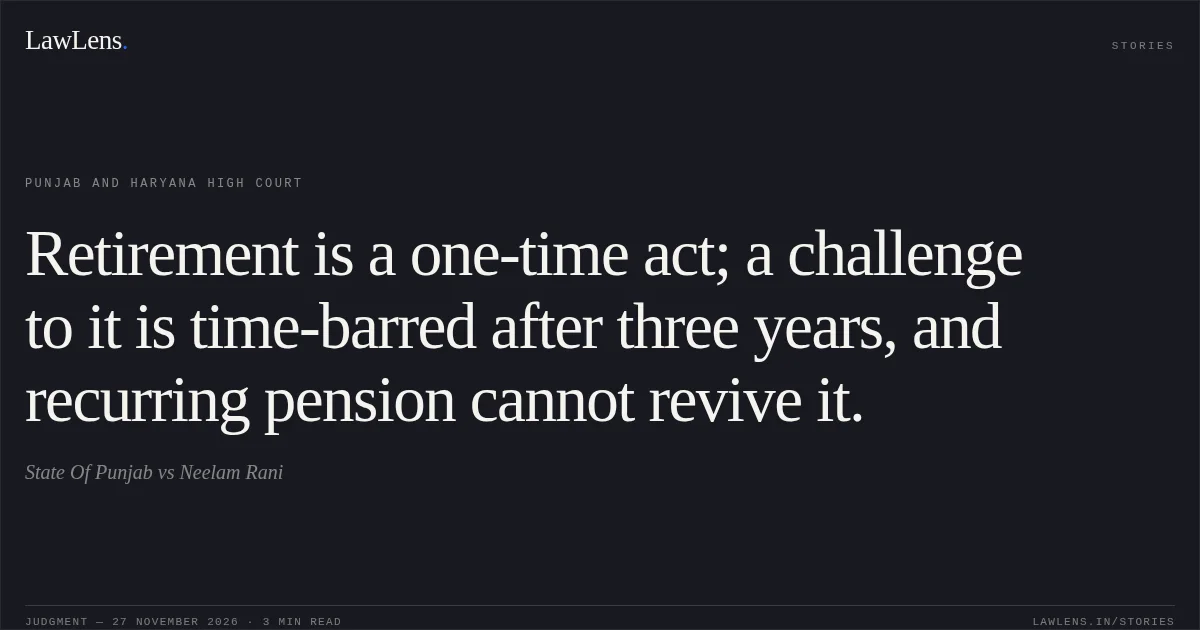
The Court answered that the suit was time-barred under Article 58 and that the pension claim did not create a recurring cause of action.
¶ 11.2, 12.1Consequential reliefs could not survive the barred declaration.
¶ 12The Court held that the First Appellate Court erred in reversing the Trial Court on limitation.
¶ 13The Regular Second Appeal was allowed, the judgment and decree dated 05.08.1999 were set aside, and the Trial Court's judgment and decree dated 26.08.1996 dismissing the suit were restored.
¶ 14In the interest of justice under Order 41 Rule 33 read with Order 42 Rule 1 and Section 151 CPC, any amount already paid to the plaintiff or his legal representatives under the First Appellate Court's decree shall not be recovered.
¶ 15Original Court PDF
State Of PunjabvsNeelam Rani
Click to open original judgment
Original judgment, available to read, download and summarize on LawLens.in