Facts
The Petitioner, an Indian resident of Mumbai and frequent international traveler, arrived at IGI Airport, New Delhi, from Dubai on 11.10.2013.
Source reference: p. 2He submitted a Customs Declaration Form declaring ‘Nil’ dutiable goods but was intercepted after crossing the Green Channel.
Source reference: p. 3A search of his baggage recovered 477 gold chains and two gold biscuits (totaling 2,716.5 grams).
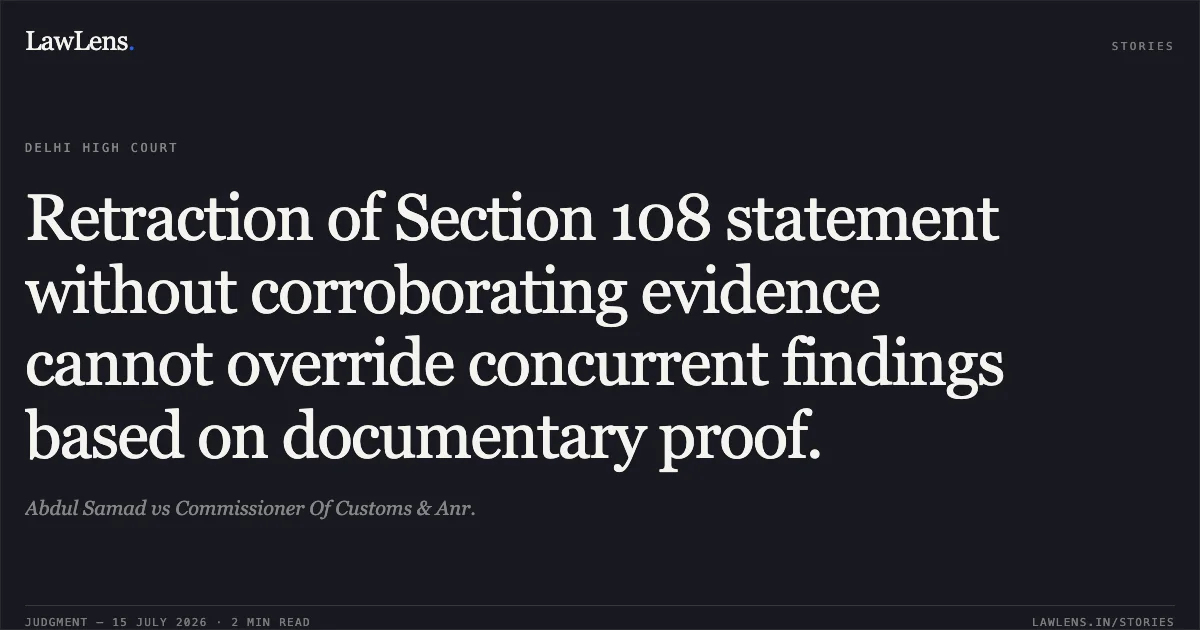
Source reference: p. 2In a statement recorded under Section 108 of the Customs Act, 1962, on 12.10.2013, the Petitioner admitted to intending to sell the gold in India and described methods used to avoid detection.
Source reference: p. 3He later retracted this statement on 15.10.2013 after obtaining bail, alleging coercion.
Source reference: p. 4The Adjudicating Authority ordered confiscation and imposed a penalty of Rs. 13,23,225/-, which was upheld by the Commissioner (Appeals) and the Revisional Authority.
Source reference: p. 4The Petitioner moved the High Court challenging these concurrent findings.
Source reference: p. 5Issues
1. Whether the court should interfere with the concurrent findings of fact that the Petitioner attempted to import gold without mandatory declaration.
Source reference: p. 1-2, para. 12. Whether the Petitioner was intercepted at the aerobridge before he could reach the Red Channel to make a declaration.
Source reference: p. 8, para. 143. Whether the non-preservation of CCTV footage caused such prejudice as to vitiate the findings.
Source reference: p. 9, para. 184. Whether a statement recorded under Section 108 of the Customs Act and subsequently retracted can be relied upon as evidence.
Source reference: p. 11, para. 21Law Applied
The court applied the provisions regarding confiscation of undeclared goods under the Customs Act, 1962.
Source reference: p. 2It emphasized the evidentiary value of statements under Section 108, noting that voluntary disclosures made by experienced travelers carry significant weight.
Source reference: p. 9, 11Regarding judicial review under Article 226 of the Constitution, the court relied on the established principle that a High Court does not sit as an appellate authority to re-appreciate evidence but only intervenes in cases of perversity, manifest illegality, or lack of evidence.
Source reference: p. 12, para. 25Reasoning
The Court rejected the Petitioner’s claim of being intercepted at the aerobridge, noting his ‘Nil’ declaration form contradicted his alleged intent to declare.
Source reference: p. 8The Court observed that the Petitioner was a frequent traveler (21 trips in 7 months) and was well-versed in customs procedures.
Source reference: p. 8-9Regarding the CCTV footage, the Court held that since the preservation order was passed seven months after the incident—long after the automatic erasure period—its absence did not invalidate the findings based on other documentary evidence.
Source reference: p. 10On the issue of the Section 108 statement, the Court found it voluntary, noting it spanned 11 pages with signatures on each page, contained intricate personal and financial details, and was retracted only after release on bail, making the retraction an "afterthought".
Source reference: p. 11Finally, the Court held that the concurrent findings by three authorities were based on a "plausible and legally sustainable view" of the facts and did not warrant interference under writ jurisdiction.
Source reference: p. 13Holding
The Court answered all issues in the negative, holding that there was no jurisdictional error or perversity in the lower orders.
The Writ Petition was dismissed, and the orders of the Adjudicating Authority, Commissioner (Appeals), and Revisional Authority—upholding the confiscation of gold and the imposition of penalty—were affirmed.
Source reference: p. 13-14Acts & Sections Cited
1 provisions across 1 statute referred to in this judgment. Each provision opens on LawLens.
Customs Act,19621
Original Court PDF
Abdul SamadvsCommissioner Of Customs & Anr.
Click to open original judgment
Original judgment, available to read, download and summarize on LawLens.in