Facts
The petitioner was selected in the 2015 recruitment process for Assistant Teachers in Science and Mathematics and was appointed as an Assistant Teacher (Mathematics) on 21 September 2015. He joined on 24 September 2015 and his services were subsequently confirmed.
Source reference: paras. 3–4In 2018, a complaint alleged that he had obtained appointment on the basis of forged educational certificates. His salary was stopped pending verification, although the inquiry subsequently found his High School, Intermediate and B.Sc. certificates to be genuine; verification of his B.Ed. qualification was stated to be pending.
Source reference: paras. 5–12The petitioner had earlier been appointed under the 2004 Special BTC Selection, but that appointment had later been cancelled retrospectively on the allegation that a B.Ed. marksheet used for the earlier appointment was forged; an FIR was also lodged.
Source reference: paras. 13–14, 30–33By order dated 20 April 2019, the District Basic Education Officer terminated the petitioner’s services.
Source reference: paras. 15–22, 25–29Issues
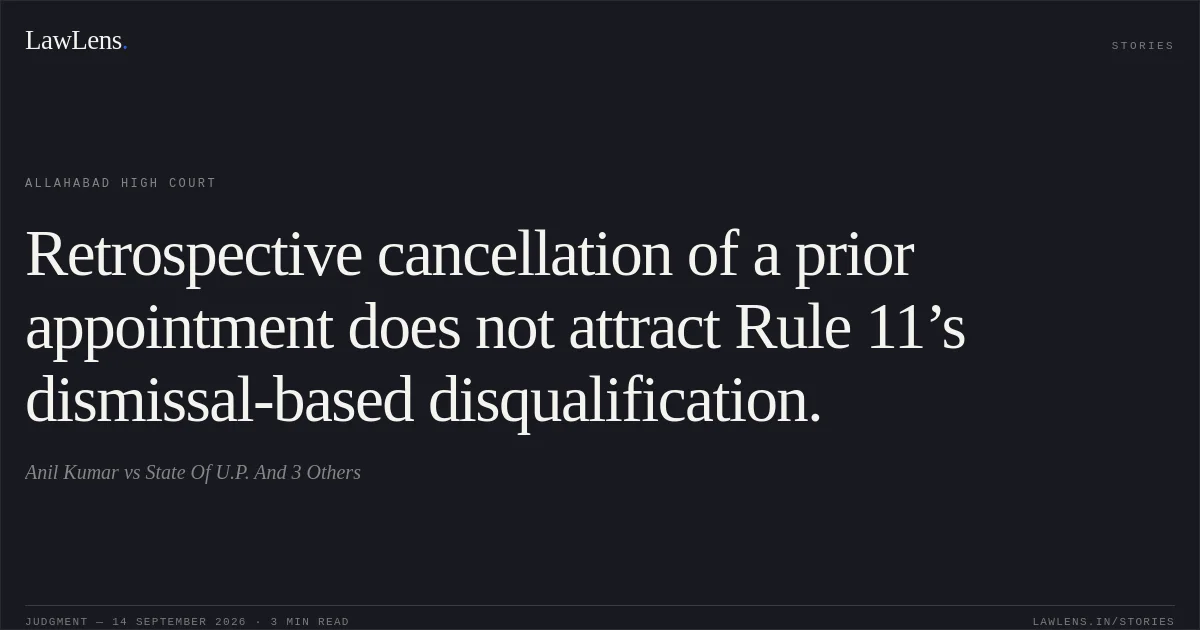
Whether retrospective cancellation of the petitioner’s earlier appointment could be treated as dismissal or removal from service so as to attract the disqualification under Rule 11 of the Uttar Pradesh Basic Education (Teachers) Service Rules, 1981?
Source reference: paras. 23–26, 36Whether the petitioner could be held guilty of suppression of material facts when the advertisement, application form or verification declaration did not specifically require disclosure of the earlier cancellation of appointment or pending criminal proceedings?
Source reference: paras. 28, 31–37Whether the petitioner’s subsequent appointment could be terminated for alleged suppression or use of forged credentials without a proper disciplinary inquiry and compliance with principles of natural justice?
Source reference: paras. 17–20, 25, 39Whether the alleged earlier forged certificate or its non-disclosure had a proximate nexus with the petitioner’s eligibility for, or acquisition of, the 2015 appointment?
Source reference: para. 40Law Applied
Rule 11 of the Uttar Pradesh Basic Education (Teachers) Service Rules, 1981 requires the appointing authority to satisfy itself that a candidate’s character renders him suitable for appointment; the statutory disqualification relied upon by the respondents was held to concern dismissal from service, which could not be equated with retrospective cancellation of an appointment.
Source reference: paras. 23–24, 36Rule 3 of the Uttar Pradesh Basic Educational Staff Rules, 1973 recognises removal and dismissal as disciplinary penalties, ordinarily carrying distinct consequences, and therefore punitive termination must follow the prescribed disciplinary procedure.
Source reference: para. 25The Court relied on Avtar Singh v. Union of India, (2016) 8 SCC 471, for the principle that suppression ordinarily requires a specific disclosure obligation in the application, verification form, declaration, advertisement or governing rules.
Source reference: para. 37The substance of the action, rather than its nomenclature, determines whether disciplinary proceedings are required; an authority cannot avoid natural justice by describing punitive termination as cancellation of appointment.
Source reference: para. 39Reasoning
The Court held that the petitioner’s earlier appointment had been cancelled retrospectively and that no disciplinary order of dismissal or removal had been passed against him. Accordingly, the cancellation could not automatically attract the disqualification contemplated under Rule 11.
Source reference: para. 36The respondents also failed to establish that the petitioner had been specifically required to disclose the earlier cancellation or criminal proceedings; consequently, the allegation of suppression could not be sustained merely on the basis of a general duty of disclosure.
Source reference: para. 37Further, the alleged forgery of the earlier B.Ed. certificate did not, by itself, establish that the petitioner knowingly participated in fraud or had knowledge of its invalidity.
Source reference: para. 38Since the 2015 appointment was based on separately submitted qualifications and there was no finding that the earlier certificate facilitated or influenced that appointment, the necessary nexus between the alleged omission and the acquisition of the subsequent appointment was absent.
Source reference: para. 40The Court also held that, insofar as the termination was founded on alleged misconduct or deliberate suppression, the respondents were required to follow the applicable disciplinary procedure rather than terminate the petitioner without a proper inquiry.
Source reference: para. 39Holding
The Court answered the issues in favour of the petitioner. It held that retrospective cancellation of the earlier appointment was not equivalent to dismissal, that suppression had not been established in the absence of a specific disclosure requirement, and that the alleged earlier forged certificate had no demonstrated nexus with the petitioner’s 2015 appointment.
The termination order dated 20 April 2019 was quashed, and the writ petition was allowed.
Source reference: para. 41Original Court PDF
Anil KumarvsState Of U.P. And 3 Others
Click to open original judgment
Original judgment, available to read, download and summarize on LawLens.in