Facts
The petitioner was appointed as a Cleaner in the Agriculture Engineering Department on 27 April 1974 and was promoted as a Driver in 1990.
Source reference: paras. 2–4He received the benefit of the Government’s Kramonnati scheme with effect from 19 April 1999, resulting in placement in the pay scale of Rs. 4,000–6,000.
Source reference: paras. 2–4In 2006, he was promoted as a Mechanic in the lower pay scale of Rs. 3,500–5,200 and joined the post after being informed that refusal to join could result in withdrawal of the Kramonnati benefit.
Source reference: paras. 2–4He retired on 30 June 2012 while drawing Rs. 14,650 in the grade pay of Rs. 2,400.
Source reference: para. 5After his retirement, the respondents retrospectively revised his pay with effect from 1 January 2006, fixed his last pay at Rs. 14,220, and directed recovery of Rs. 32,829 from his retiral dues on the ground of erroneous pay fixation.
Source reference: paras. 6, 12–15The petitioner challenged the action under Article 226 of the Constitution, contending that the reduction and recovery were made without notice or opportunity of hearing and that the recovery was impermissible under the principles laid down in State of Punjab v. Rafiq Masih.
Source reference: paras. 1, 7–9The respondents relied on the petitioner’s undertaking consenting to recovery and on High Court of Punjab & Haryana v. Jagdev Singh.
Source reference: paras. 16–18Issues
1. Whether the respondents could retrospectively reduce the petitioner’s pay after his retirement and thereby revise his retiral benefits without issuing notice or providing an opportunity of hearing.
Source reference: paras. 20–212. Whether recovery of alleged excess payment from the petitioner’s retiral dues was legally permissible where the petitioner was a Class III employee, the excess payment continued for more than five years, and the recovery was ordered after retirement.
Source reference: paras. 22–253. Whether the undertaking furnished by the petitioner authorising recovery of excess payment validated the recovery in the circumstances of the case.
Source reference: paras. 24–25Law Applied
The Court applied Article 226 of the Constitution and the principles of natural justice, holding that an adverse order retrospectively affecting pay and retiral benefits cannot ordinarily be passed without notice and an opportunity of hearing.
Source reference: paras. 7–8, 20It relied on State of Punjab v. Rafiq Masih (White Washer), (2015) 4 SCC 334, which identifies circumstances in which recovery of excess payment is impermissible, including recovery from Class III/Class IV employees, retired employees or employees nearing retirement, and recovery relating to payments made for more than five years.
Source reference: para. 22The Court considered High Court of Punjab & Haryana v. Jagdev Singh, (2016) 14 SCC 267, but applied the Full Bench ruling in State of M.P. v. Jagdish Prasad Dubey, W.A. No. 815 of 2017, order dated 6 March 2024, which holds that an undertaking may permit recovery only subject to the hardship principles in Rafiq Masih, compliance with the procedure under Rules 65 and 66 of the M.P. Civil Services (Pension) Rules, 1976, and proof that the undertaking was voluntarily given; an undertaking given at the stage of retiral benefits cannot automatically validate recovery for an old pay refixation.
Source reference: para. 24The Court also referred to Central Inland Water Transport Corporation Ltd. v. Brojo Nath Ganguly, (1986) 3 SCC 156, in holding that a forced undertaking is not enforceable unless shown to have been given voluntarily.
Source reference: para. 25Reasoning
The Court found that the petitioner’s pay had been reduced retrospectively only after his retirement and that no notice or hearing had preceded the decision.
Source reference: para. 20Although the respondents alleged erroneous fixation and relied on the petitioner’s undertaking, the undertaking could not displace the requirement of natural justice or justify an adverse determination made unilaterally.
Source reference: no citationThe alleged excess payment had continued from December 2006 until retirement, the petitioner had not contributed to the pay-fixation error, and there was no allegation of fraud or misrepresentation.
Source reference: para. 21The petitioner also fell squarely within the protective categories identified in Rafiq Masih: he was a Class III employee, had already retired when recovery was ordered, and the alleged excess payment extended over more than five years.
Source reference: paras. 22–23Applying Jagdish Prasad Dubey, the Court held that the undertaking relied upon by the respondents could not be enforced for a pay-fixation error originating years earlier, particularly when its voluntary nature had not been established.
Source reference: paras. 24–25Holding
The Court quashed the order dated 16 July 2012 insofar as it retrospectively reduced the petitioner’s pay and directed recovery from his retiral dues.
The respondents were directed to recompute the petitioner’s retiral benefits on the basis of his unreduced last pay of Rs. 14,650 with a grade pay of Rs. 2,400, issue a fresh Pension Payment Order, and release the consequential benefits in accordance with law.
Source reference: para. 26Any amount already recovered from his gratuity or other retiral dues was ordered to be refunded.
Source reference: para. 26The writ petition was accordingly disposed of.
Source reference: para. 27Original Court PDF
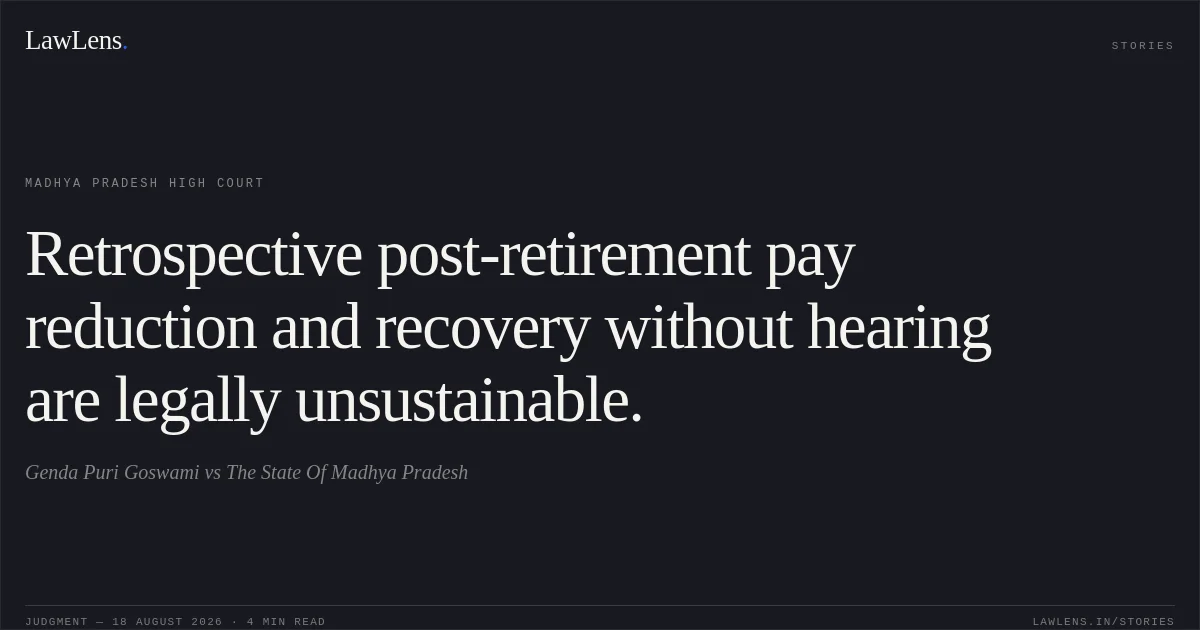
Genda Puri GoswamivsThe State Of Madhya Pradesh
Click to open original judgment
Original judgment, available to read, download and summarize on LawLens.in