Facts
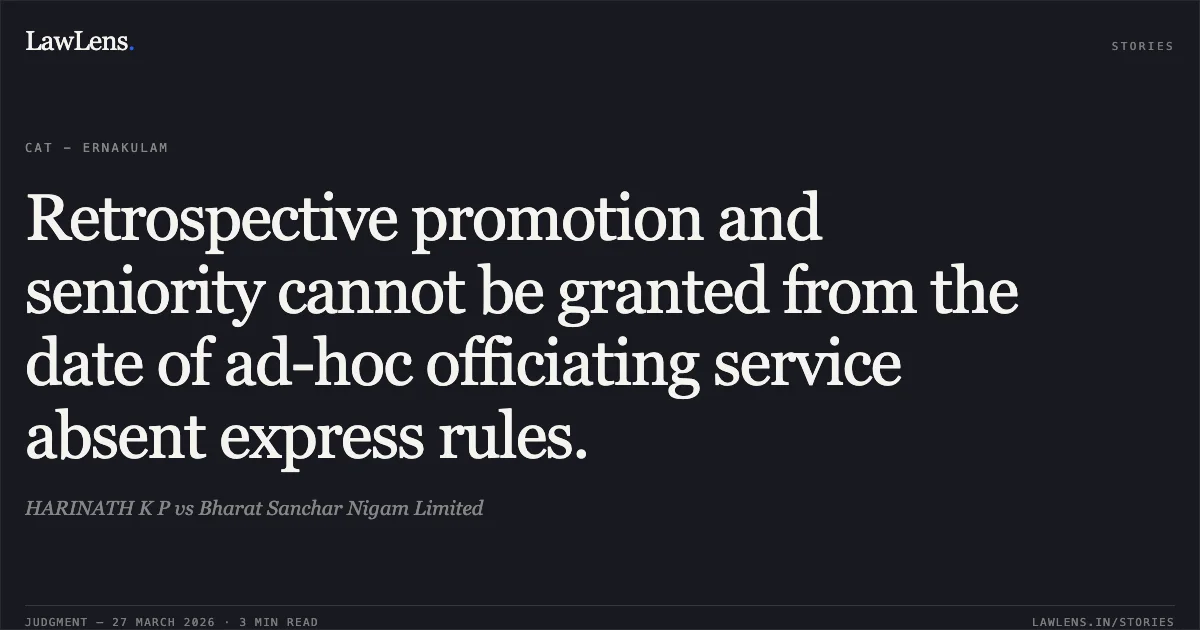
The applicant, a retired Sub Divisional Engineer (SDE) of BSNL, was granted temporary/ad-hoc promotion to the SDE cadre on December 19, 2001
Source reference: para. 1Under the relevant Recruitment Rules, 25% of SDE posts were to be filled via a Limited Departmental Competitive Examination (LDCE)
Source reference: para. 1The applicant appeared for the 2002 LDCE but failed
Source reference: para. 6He subsequently cleared the LDCE notified in 2007 (intended to fill vacancies from 2001-2006) and was regularly promoted as SDE effective December 11, 2008
Source reference: para. 2He retired from service in 2011
Source reference: para. 5In July 2015, more than seven years after his regular promotion and four years after retirement, the applicant submitted a representation seeking notional regularisation of his SDE service from December 2001
Source reference: para. 2, 5The respondents rejected this representation via an order dated October 8, 2015 (Annexure A-6), stating that seniority and benefits apply only from the date of regular promotion
Source reference: para. 2Issues
1. Whether the Original Application is barred by limitation under Section 21 of the Administrative Tribunals Act, 1985
Source reference: para. 122. Whether the applicant is entitled to notional regularisation and consequential benefits in the post of SDE with effect from his ad-hoc promotion date of December 27, 2001
Source reference: para. 12Law Applied
The Tribunal primarily applied Section 21 of the Administrative Tribunals Act, 1985, regarding the statutory period of limitation for filing applications
Source reference: para. 14It relied on the Supreme Court’s ruling in Chief Executive Officer v. S. Lalitha (2025), which established that the period of limitation cannot be deferred or stretched by making highly belated representations
Source reference: para. 13On the merits of retrospective promotion, the Tribunal applied the precedent from BSNL v. S.K. Dubey (2014), which held that in the absence of specific rules, an employee cannot be granted seniority or promotion from a retrospective date if they were not "born in the cadre" at that time
Source reference: para. 16Furthermore, it affirmed the principle that the occurrence of a vacancy does not confer an indefeasible right to promotion
Source reference: para. 17Reasoning
Regarding the technicality of limitation, the Tribunal found that the cause of action arose in 2008 (date of regular promotion) or at the latest in 2011 (date of retirement)
Source reference: para. 13The 2015 representation was deemed "highly belated" and legally insufficient to reset the limitation clock
Source reference: para. 13On the merits, the Tribunal noted that while the applicant officiated as an SDE on an ad-hoc basis from 2001, he had failed the competitive examination (LDCE) in 2002
Source reference: para. 6, 9His eventual success in the 2007 LDCE only entitled him to regular promotion from the date he actually joined the post in 2008
Source reference: para. 16The Tribunal reasoned that filling vacancies is a policy decision of the establishment, and the relevant Recruitment Rules did not mandate yearly LDCEs or provide for retrospective notional benefits
Source reference: para. 8, 17Consequently, the applicant’s reliance on his ad-hoc tenure to claim regularisation was rejected as it contradicted settled service jurisprudence
Source reference: para. 16-17Holding
The Tribunal dismissed the Original Application
It held that the application was barred by limitation under Section 21 of the Administrative Tribunals Act due to the inordinate and unexplained delay in seeking relief
Source reference: para. 13-14On the merits, the Tribunal held that the applicant had no vested right to retrospective regularisation from 2001, as his regular appointment was contingent upon qualifying for the LDCE, which he only achieved in 2008
Source reference: para. 16-17No order was made as to costs
Source reference: para. 18Original Court PDF
HARINATH K PvsBharat Sanchar Nigam Limited
Click to open original judgment
Original judgment, available to read, download and summarize on LawLens.in