Facts
The Petitioner, a Reader at Bharati College, was appointed Director of the Directorate of Hindi Medium Implementation (DHMI) on September 3, 2007
Source reference: p. 3Before joining, she sought clarity on her retirement age, as teachers retired at 65 while non-teachers retired at 62
Source reference: p. 3On December 27, 2007, the University’s Executive Council (EC) passed Resolution No. 126, treating her post as a "teaching post" for retirement purposes specifically because she came from the teaching fraternity
Source reference: p. 3Relying on this, she allowed her lien at Bharati College to lapse
Source reference: p. 8Years later, following a 2014 UGC communication disapproving the 65-year retirement age for the DHMI Director, the University issued an order in March 2017 retrospectively superannuating her as of April 30, 2012
Source reference: p. 4-5The University re-characterized her five years of completed service as "contractual" and sought to recover approximately ₹38.9 Lakhs in "excess" salary
Source reference: p. 5-6Issues
1. Whether EC Resolution No. 126 operated as a case-specific protection regarding the Petitioner’s retirement age based on promissory estoppel
Source reference: p. 14 / para. 21(ii)2. Whether the University could retrospectively withdraw service benefits and re-characterize regular service as contractual without natural justice
Source reference: p. 14 / para. 21(iv)3. Whether the University is legally entitled to recover alleged excess payments from a retired employee in the absence of fraud or misrepresentation
Source reference: p. 14 / para. 21(v)Law Applied
The court applied the doctrine of Promissory Estoppel, which prevents a public authority from resiling from a representation if a person has altered their position to their detriment based on that promise
Source reference: Motilal Padampat Sugar Mills, p. 17; Indo Afghan Agencies, p. 17The Court distinguished between ultra vires acts and "irregular" exercises of power, noting that the EC held the Power of Relaxation under Rule 22/18 of the University Non-Teaching Employees Rules
Source reference: p. 18-19; Ashok Kumar Chopra, p. 18The court applied the principles from State of Punjab v. Rafiq Masih, which prohibits recovery from retired employees when it is inequitable or where no fraud/misrepresentation exists
Source reference: p. 24The Court further relied on D.S. Nakara v. Union of India, affirming that pension and salary are earned rights, not bounties
Source reference: p. 27Reasoning
The Court reasoned that Resolution No. 126 was not a general policy change but a case-specific assurance tailored to the Petitioner’s "teaching fraternity" status
Source reference: p. 16Because the Petitioner allowed her lien to lapse based on this formal communication, the University was estopped from withdrawing the protection after she could no longer return to her original post
Source reference: p. 17The Court found the University’s retrospective action—treating her as retired five years prior—to be a "post facto re-characterisation" that lacked any legal basis, as no contract existed at the time
Source reference: p. 22-23The UGC's 2014 disapproval was found inapplicable to the Petitioner's specific circumstances since the University failed to disclose the subsisting lien and specific EC assurance to the UGC
Source reference: p. 20The Court held that imposing such adverse civil consequences without a hearing violated the principles of natural justice
Source reference: p. 21; Binapani DeiSince the Petitioner did not commit fraud, recovery was deemed impermissible under the Rafiq Masih framework
Source reference: p. 24-25Holding
The Court allowed the writ petition, quashing the retrospective superannuation and the recovery orders.
The Court held that the Petitioner must be treated as having retired on April 30, 2017.
Source reference: p. 28The Court directed the University to: (i) release all unpaid salary and increments up to April 2017; (ii) recompute retiral benefits based on the 2017 retirement date; (iii) cease all recovery efforts and refund any adjusted amounts; and (iv) pay interest at 9% per annum on all delayed payments, increasing to 12% if not paid within six weeks.
Source reference: p. 28-29The ruling was clarified as a case-specific relief that does not establish a general precedent for the DHMI Director post.
Source reference: p. 27Original Court PDF
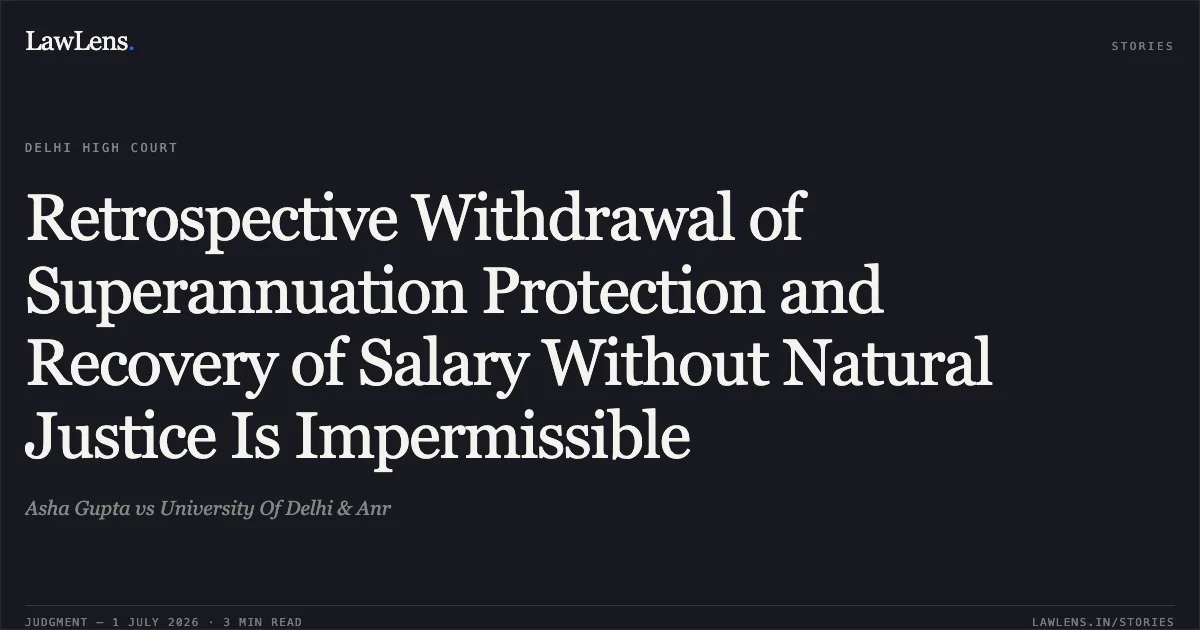
Asha GuptavsUniversity Of Delhi & Anr
Click to open original judgment
Original judgment, available to read, download and summarize on LawLens.in