Facts
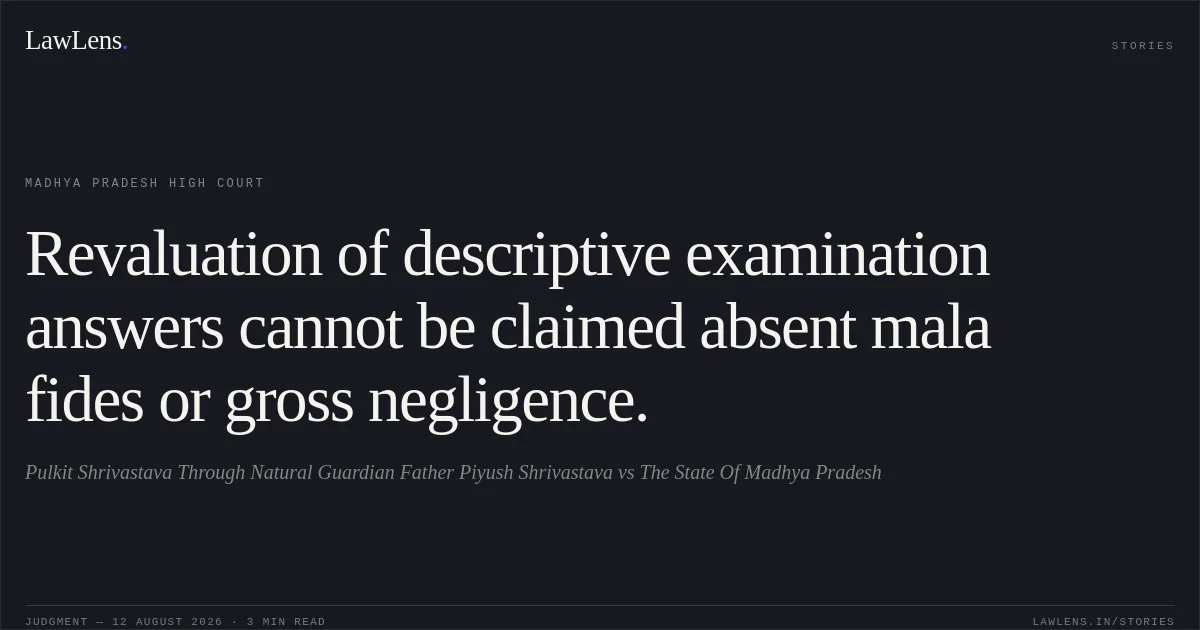
The petitioner, a Class XII student, filed a writ petition under Article 226 of the Constitution seeking re-evaluation of his answer scripts in English and Mathematics, contending that he was meritorious and had received fewer marks than deserved in those subjects despite securing distinction in the remaining subjects.
Source reference: para. 1–2The petitioner relied on High Court of Tripura through Registrar General v. Tirtha Sarathi Mukherjee and the decision in Saket Tiwari v. M.P. Board of Secondary Education.
Source reference: para. 2Respondent No. 2 opposed the petition, submitting that the petitioner had already applied for re-totalling, which disclosed no change in marks.
Source reference: para. 3It was further argued that the English answer script showed that the petitioner had failed to provide a conclusion to one answer, and the examiner had accordingly awarded marks in accordance with his assessment.
Source reference: para. 3The High Court noted that the questions and answers in the relevant subjects were descriptive in nature.
Source reference: para. 4Issues
Whether the petitioner was entitled to a direction for re-evaluation of his English and Mathematics answer scripts merely because he believed that fewer marks had been awarded than deserved.
Source reference: para. 1–4Whether the circumstances disclosed mala fides, tampering, or gross negligence resulting in serious injustice so as to justify judicial interference under Article 226 of the Constitution despite the absence of a general right to re-evaluation.
Source reference: para. 5–6Whether the authorities relied upon by the petitioner warranted re-evaluation where the answers were descriptive rather than objective in nature.
Source reference: para. 7Law Applied
The Court applied the principle that a candidate has no right to seek re-evaluation unless the applicable examination rules expressly provide for it; provisions permitting scrutiny, re-totalling, or rechecking do not by themselves create such a right.
Source reference: para. 5In exceptional cases, a constitutional court may order production or re-evaluation of answer scripts where mala fides, tampering, or gross negligence causing substantial injustice is established, but not merely because another examiner might award different marks or because of ordinary errors or differences in perception.
Source reference: para. 5The Court further relied on Ran Vijay Singh v. State of U.P., (2018) 2 SCC 357, which cautions that sympathy or perceived individual injustice cannot justify unsettling the examination process and that courts must avoid undermining the finality and certainty of examination results.
Source reference: para. 6The Court also distinguished authorities concerning objective-type questions, where answers are capable of comparatively exact verification, from descriptive examinations involving evaluative judgment.
Source reference: para. 7Reasoning
The Court found that the petitioner’s answer scripts involved descriptive questions, requiring the examiner to assess the quality, completeness, reasoning, and presentation of the answers.
Source reference: para. 3–4In the English answer script, the petitioner had allegedly omitted a conclusion in one answer, and the examiner’s award of marks was therefore an exercise of academic assessment rather than an apparent mathematical or clerical error.
Source reference: para. 3–4The petitioner had already obtained re-totalling, which resulted in no alteration of marks, and he did not establish mala fides, tampering, or gross negligence causing injustice of the kind required under Pranshu Indurkhya.
Source reference: para. 3, 5The Court held that a mere assertion that higher marks ought to have been awarded, particularly in a descriptive examination, reflects at most a difference in evaluative perception and does not justify re-evaluation.
Source reference: para. 5The decisions relied upon by the petitioner were held inapplicable because they concerned objective questions, whereas the present case involved descriptive answers requiring examiner discretion.
Source reference: para. 7Holding
The Court answered the issues against the petitioner and held that he had no enforceable right to re-evaluation of his English and Mathematics answer scripts.
No case of mala fides, tampering, gross negligence, or exceptional injustice was established, and the descriptive nature of the answers required judicial restraint.
Source reference: para. 5–7The writ petition was consequently found to be without merit and was dismissed.
Source reference: para. 8Original Court PDF
Pulkit Shrivastava Through Natural Guardian Father Piyush ShrivastavavsThe State Of Madhya Pradesh
Click to open original judgment
Original judgment, available to read, download and summarize on LawLens.in