Facts
The petitioners challenged the order dated 08.07.2009 passed by the Tahsildar, Pargana Ashoknagar, in Revenue Case No. 32-A-6/2008-2009, by which land including Survey No. 593/600 was treated and recorded as Government land.
Source reference: p.1The petitioners relied on a chain of registered conveyances beginning with the sale deed dated 06.08.1964 executed by Maratha Setagi Sangh through Sheshrao Tayde in favour of Ajit Singh Raghuwanshi, followed by the sale deeds dated 24.03.2006 in favour of Late Ashok Chaudhari and Abhay Kumar Jain, and the sale deed dated 27.05.2008 by which Abhay Kumar Jain transferred his share to petitioner No.1.
Source reference: pp.1, 7, 12An earlier Civil Suit No. 23-A/2008, instituted by Baburao claiming to represent Kshetriya Maratha Samaj, Guna, concerned several survey numbers, including Survey No. 593, and was dismissed on 08.07.2008. The petitioners and their predecessor-in-title were not parties to that suit.
Source reference: pp.2–3, 8The petitioners asserted that they first became aware of the Tahsildar’s order in 2025 when a proposed loan transaction was obstructed, obtained a certified copy on 21.07.2025, and thereafter approached the High Court.
Source reference: p.4Issues
Whether the Tahsildar could treat the disputed property as Government land without issuing notice to the petitioners or their predecessor-in-title, despite the existence of registered conveyances and corresponding revenue entries.
Source reference: pp.4, 9–10Whether the judgment in Civil Suit No. 23-A/2008 could operate against the petitioners, who were not parties to that litigation and claimed through a distinct chain of title.
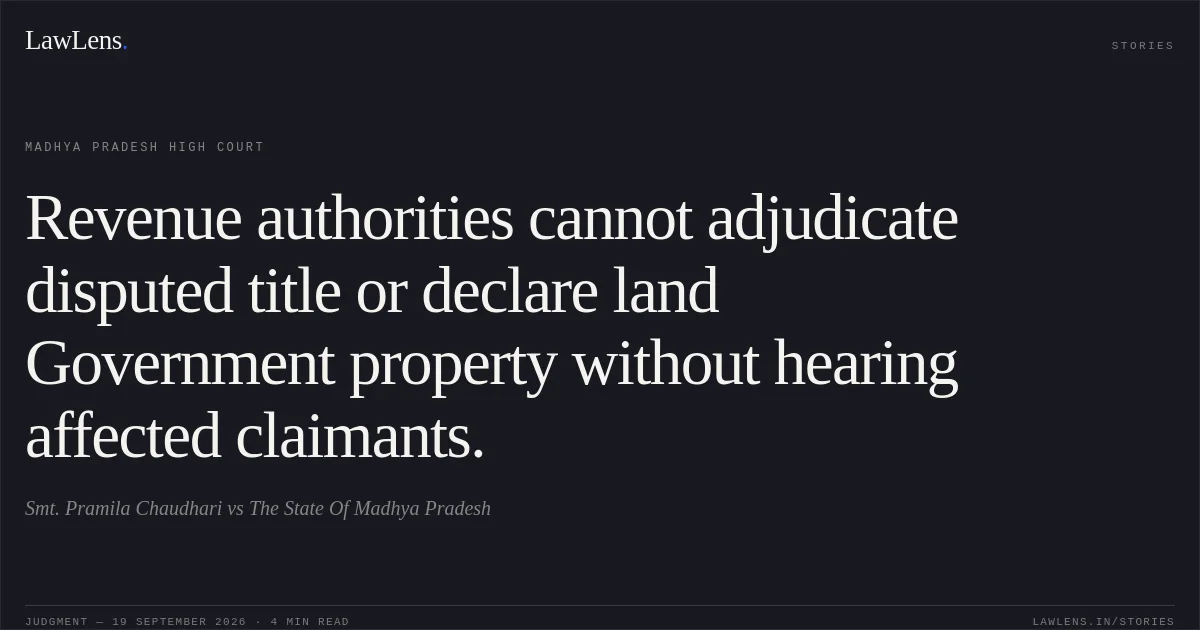
Source reference: pp.8–9, 12Whether a revenue authority could conclusively adjudicate disputed proprietary rights and declare land to be Government property in the absence of demonstrated statutory authority.
Source reference: pp.9–10Whether the writ petition was liable to be dismissed on the grounds of disputed questions of title, alternative civil remedy, and delay and laches.
Source reference: pp.6, 11Law Applied
The Court applied Article 226 of the Constitution, particularly the power to judicially review administrative and revenue orders for want of jurisdiction and violation of natural justice.
Source reference: pp.4, 9–10The Court applied the principle that an order directly prejudicing a person’s asserted proprietary or possessory rights cannot ordinarily be passed without notice and a reasonable opportunity of hearing.
Source reference: pp.4, 9–10The Court reiterated that mutation entries are fiscal in nature and do not, by themselves, confer title, although registered conveyances and existing revenue entries constitute circumstances requiring the authority to hear the persons claiming under those instruments.
Source reference: p.7Relying on Kutchi Lal Rameshwar Ashram Trust Evam Anna Kshetra Trust through Velji Devshi Patel v. Collector, Haridwar and Others, 2017 Supreme (SC) 960, the Court held that an administrative authority cannot assume the jurisdiction of a Civil Court to conclusively determine disputed questions of civil title in the absence of statutory authority.
Source reference: pp.5, 9–10Reasoning
The Court found that the petitioners’ claim was not based merely on an isolated mutation entry but on a continuous chain of registered conveyances from 1964 onwards, supported by revenue and municipal entries.
Source reference: pp.7, 12Although such documents did not require the Court to declare the petitioners’ absolute title, they required the revenue authority to identify and hear the persons claiming through them before making an adverse Government-land declaration.
Source reference: p.7The earlier civil suit could not automatically bind the petitioners because neither they nor their predecessor-in-title were parties, and the plaintiff’s claim through Kshetriya Maratha Samaj, Guna had not been shown to be legally identical with or successor to Maratha Setagi Sangh, through which the petitioners traced their title.
Source reference: pp.8–9Since the impugned order conclusively treated the land as Government property, rather than merely correcting a fiscal entry, it attracted the requirements of natural justice.
Source reference: p.9Further, if the dispute was genuinely one of title, the Tahsildar could not assume the role of a Civil Court and finally determine it without demonstrated statutory authority.
Source reference: pp.9–10Subsequent proceedings before the SDO and Additional Commissioner could not retrospectively cure the foundational breach of jurisdiction and natural justice.
Source reference: p.10The Court also accepted the petitioners’ explanation that they discovered the order only in 2025, and held that delay did not justify perpetuating an order allegedly passed without hearing.
Source reference: p.11Holding
The High Court allowed the writ petition and quashed the Tahsildar’s order dated 08.07.2009 in Revenue Case No. 32-A-6/2008-2009, holding that it was passed in violation of natural justice and without demonstrated authority to conclusively adjudicate the disputed proprietary rights.
Consequential revenue entries or actions founded solely on that order were also quashed to that extent.
Source reference: p.13The respondents were directed to restore or mutate the revenue record in accordance with the registered sale deeds and subsequent devolution of interest, after verifying the identity, survey particulars, area, and extent of the property, within 30 days of receiving the certified order.
Source reference: p.14The Court clarified that such mutation would remain a fiscal entry and would not amount to a declaration of the petitioners’ absolute title; the respective title rights of the petitioners and the State were left open for adjudication by the competent forum.
Source reference: p.14No order as to costs was made.
Source reference: p.14Original Court PDF
Smt. Pramila ChaudharivsThe State Of Madhya Pradesh
Click to open original judgment
Original judgment, available to read, download and summarize on LawLens.in