Facts
The petitioners purchased agricultural lands in Village Pikhor, Taluka Maliya Hatina, via registered sale deeds dated 06.12.2012
Source reference: p. 2These lands were originally part of "Badimedi Estate" held by Amirmiya Bada Saheb (d. 1975). Following his death, his son Saiyed Mahmad mutation heirship Entry No. 2306 in 2008
Source reference: p. 4Although initially disputed by a third party, a settlement was reached and the Mamlatdar certified the entry on 16.03.2009
Source reference: p. 5The petitioners' subsequent purchase entries (Nos. 2740, 2741, 2742) were certified in 2013
Source reference: p. 5-6However, in 2016 (six years later), private respondents challenged the 2009 heirship entry. Despite a settlement between the private parties during the appeal, the Deputy Collector, Collector, and SSRD successively set aside the 2009 heirship entry and the petitioners' 2013 purchase entries, primarily on the ground that the vendor lacked title
Source reference: p. 6-10The District Collector also initiated suo-motu revision proceedings to cancel the petitioners' sale deed entries
Source reference: p. 7Issues
1. Whether the revenue authorities exceeded their jurisdiction by adjudicating upon the title of the vendor and the validity of registered sale deeds
Source reference: p. 8 / para. 13.12. Whether the exercise of suo-motu revisionary powers and the condonation of a six-year delay in challenging revenue entries were legally sustainable
Source reference: p. 8 / para. 5.1 & 5.33. Whether the authorities erred in ignoring the inter-se settlements between the private parties regarding the land
Source reference: p. 9 / para. 5.2Law Applied
Rule 108 of the Gujarat Land Revenue Rules regarding the certification and revision of mutation entries
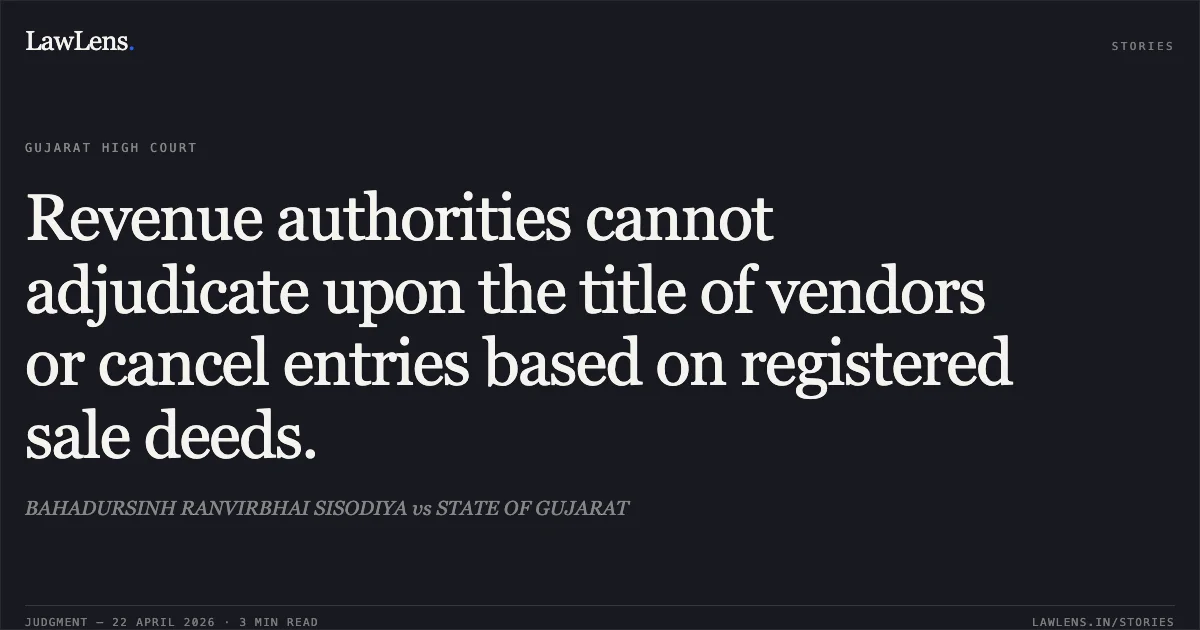
Source reference: p. 8-10Revenue authorities under the Land Revenue Code cannot adjudicate upon the complexity of titles or the validity of registered sale deeds, which falls under the exclusive jurisdiction of Civil Courts
Source reference: p. 16Suo-motu powers must be exercised within a "reasonable period" and revenue entries are primarily for fiscal purposes and do not confer title
Source reference: p. 18Registered sale deeds carry a presumption of validity under Section 135(C) of the Code [Jhaverbhai Savjibhai Patel v. Kanchanben Nathubhai Patel (2005); Heir of Niruben Chimanbhai Patel v. State of Gujarat (2022)]
Source reference: p. 17, 20Reasoning
The Court reasoned that once the State had previously determined the land was "freehold" and not subject to a government lien (referencing orders from 1933 and 1977), the authorities had no basis to interfere in private successions
Source reference: p. 11-13The High Court found the Deputy Collector's decision to condone a six-year delay without sufficient cause, while simultaneously deciding the merits, was procedurally flawed
Source reference: p. 16Critically, the Court held that the Collector exceeded his jurisdiction by concluding the vendor was not the owner; such a determination can only be made by a Civil Court
Source reference: p. 16Since the registered sale deeds remained unchallenged in a court of competent jurisdiction, the revenue authorities were legally bound to maintain the entries based on those deeds
Source reference: p. 17The Court emphasized that the authorities failed to consider the settlements filed by the parties, which should have resolved the private dispute
Source reference: p. 15Holding
The Court answered the issues in the affirmative, holding that the revenue authorities acted beyond their jurisdiction and against settled legal principles regarding suo-motu powers and title adjudication
The High Court quashed and set aside the orders of the Deputy Collector (10.01.2017), Collector (08.06.2017 and 17.07.2018), and SSRD (24.02.2018). The petition was allowed, effectively restoring the mutation entries in favor of the petitioners
Source reference: p. 21Acts & Sections Cited
1 provisions across 1 statute referred to in this judgment. Each provision opens on LawLens.
Bombay Tenancy and Agricultural Lands Act-19481
Original Court PDF
BAHADURSINH RANVIRBHAI SISODIYAvsSTATE OF GUJARAT
Click to open original judgment
Original judgment, available to read, download and summarize on LawLens.in