01Facts
The petitioners claimed ownership and possession of 2 acres 8 guntas in Sy. No. 57, relying on revenue entries and a family partition recorded in a compromise in O.S. No. 1328/2014.
¶ 2The Assistant Commissioner reduced the recorded extent to 2 acres 1 gunta; the petitioners contended that this was done without notice or inquiry.
¶ 2, 9The Deputy Commissioner dismissed their review petition.
¶ 3, 7, 10The State submitted that 11 guntas had been used by the PWD Department for canal construction.
¶ 3, 7, 1002Issues
i.Whether the Assistant Commissioner could reduce the land extent in the revenue records without notice to the affected petitioners or conducting an inquiry.
¶ 5, 9–10ii.Whether the reduction could be sustained on the ground that 11 guntas had been used for a public purpose, without addressing the petitioners’ constitutional property and compensation rights.
¶ 1003Law Applied
Article 300A of the Constitution protects a person from deprivation of property except in accordance with law. Although the State may exercise its power of eminent domain for public purposes, that power must be exercised consistently with Article 300A; the State’s assertion that land was used for a public purpose does not, by itself, permit revenue authorities to alter the land extent without notice and an inquiry, or to disregard any applicable entitlement to compensation.
¶ 10No specific statute or precedent was cited.
¶ 1004Reasoning
The Assistant Commissioner’s order did not disclose that notice had been issued or an inquiry held before the recorded extent was reduced.
¶ 9The Deputy Commissioner noted that 11 guntas had been acquired for canal construction, but the asserted public purpose did not dispense with the need for a lawful process or resolve the petitioners’ claim to compensation.
¶ 10The orders therefore could not stand, and the matter required reconsideration after giving the petitioners an opportunity to be heard and providing reasons for any reduction.
¶ 1105Holding
The High Court allowed the petition and quashed the Assistant Commissioner’s and Deputy Commissioner’s orders.
¶ 11(i)–(ii)It remitted the matter to the Assistant Commissioner to conduct an inquiry, hear the petitioners, and give reasons for any proposed reduction in the recorded extent.
¶ 11(iii)If the land was reduced because it had been used for a public purpose, the petitioners were entitled to seek compensation under the applicable law; the parties remained at liberty to take further steps in accordance with law.
¶ 11(iv)–(vi)Original Court PDF
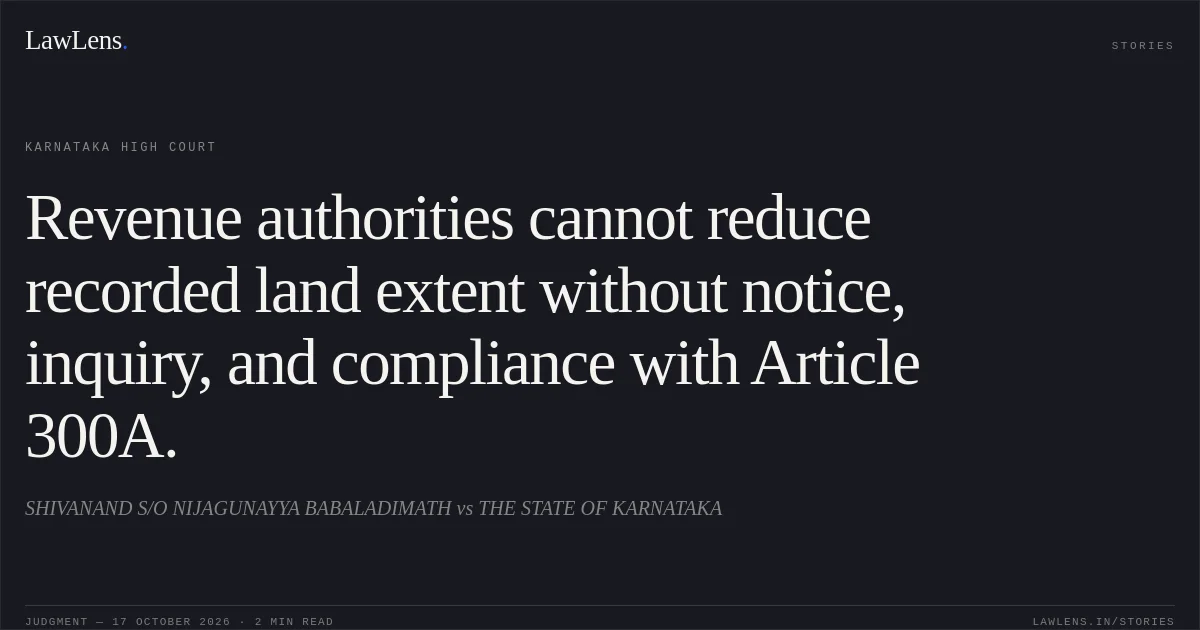
SHIVANAND S/O NIJAGUNAYYA BABALADIMATHvsTHE STATE OF KARNATAKA
Click to open original judgment
Original judgment, available to read, download and summarize on LawLens.in