Facts
The petitioners claimed through Dala Bylappa, who acquired 31 acres 27 guntas in Sy. No. 62, Madappanahalli Village, at a public auction in 1927; after his death, the land was transferred to his son Narasimhaiah.
Source reference: para. 13In 2004, Narasimhaiah sought restoration of the land from Phada. The Deputy Commissioner ordered restoration on 30 June 2012, but later purported to review that order and directed that the Government’s name be entered in the revenue records.
Source reference: paras. 14, 20The review order was quashed in earlier writ proceedings; following remand by the Supreme Court, the High Court again quashed it, and the State’s appeal was dismissed. In contempt proceedings, the authorities undertook to restore the revenue entries.
Source reference: paras. 15–17The Tahsildar subsequently filed Appeal No. 481/2024 before the Karnataka Appellate Tribunal challenging the 22 September 2012 order, while the petitioners in the connected petition challenged proceedings in RRT (2)(NA) CR.190/2009-10.
Source reference: paras. 4–5Issues
1. Whether the Tahsildar’s appeal before the Karnataka Appellate Tribunal, brought after prior proceedings had upheld restoration of the revenue entries, could continue.
Source reference: paras. 18–202. Whether the proceedings in RRT (2)(NA) CR.190/2009-10 should be quashed in light of the earlier litigation and the asserted finality of the restoration proceedings.
Source reference: para. 21Law Applied
Rule 119 of the Karnataka Land Revenue Rules, 1966 provides for restoration of a forfeited occupancy or alienated holding on payment of the arrears and related sums, subject to the Rule’s conditions.
Source reference: para. 13Sections 127 and 136(3) of the Karnataka Land Revenue Act, 1964 were relevant to the recording of revenue entries and the proceedings concerning them.
Source reference: paras. 14, 20The Court relied on the principle that a quasi-judicial authority has no inherent power to review its own order; such power must be conferred by statute. It referred to N. Chandareddy v. State of Karnataka, ILR 2016 KAR 3275, and the authorities cited there on the limits of review jurisdiction.
Source reference: para. 20It also relied on Benedict Denis Kinny v. Tulip Brian Miranda and Prachi Prasad Parab v. State of Maharashtra, (2021) 12 SCC 780, concerning judicial intervention where authorities arbitrarily revive stale claims.
Source reference: para. 21Reasoning
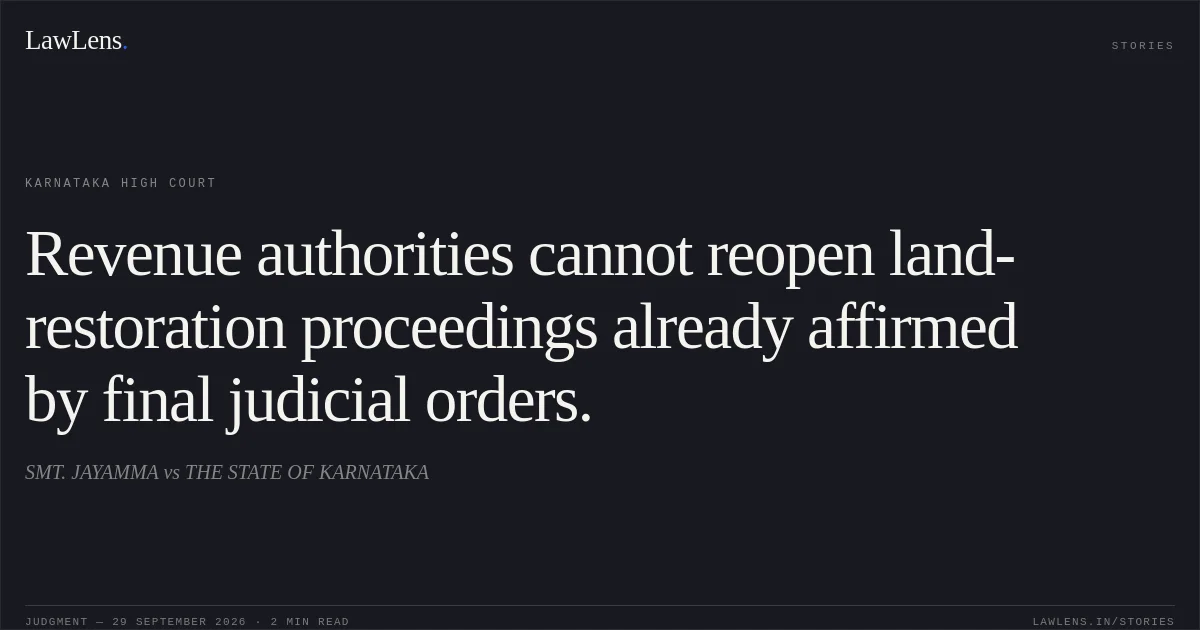
The Court found that the restoration order of 30 June 2012 had survived successive proceedings: the later review order was quashed, the State’s appeal was dismissed, and the authorities undertook to restore the entries.
Source reference: paras. 14–17In that context, the Tahsildar’s later appeal challenging the 22 September 2012 order was, in the Court’s view, an attempt to reopen a matter already concluded by the prior proceedings; it was also initiated after about 12 years without an acceptable explanation.
Source reference: paras. 18–20The Court rejected the State’s allegations concerning the petitioners’ documents as insufficient, at that stage, to justify reviving the proceedings after such delay.
Source reference: para. 20It consequently held that the connected RRT proceedings also could not continue.
Source reference: para. 21Holding
The High Court allowed both writ petitions.
It quashed Appeal No. 481/2024 before the Karnataka Appellate Tribunal and directed the Tahsildar to implement the orders in W.A. No. 1289/2023 and C.C.C. No. 418/2023 within two weeks of receiving a certified copy of the judgment.
Source reference: para. 22(i)–(iii)It also quashed the proceedings in RRT (2)(NA) CR.190/2009-10.
Source reference: para. 22(iv)Acts & Sections Cited
6 provisions across 1 statute referred to in this judgment. Linked provisions open on LawLens.
Karnataka Land Revenue Act, 19646
Original Court PDF
SMT. JAYAMMAvsTHE STATE OF KARNATAKA
Click to open original judgment
Original judgment, available to read, download and summarize on LawLens.in