Facts
M.R.R. Setty claimed ownership of 28 guntas in Survey No. 2 of Dasarahalli Village, purchased through eight sale deeds executed in 1929.
Source reference: no citationFollowing a City Title Survey in 1974, the property was assigned CTS Nos. 174/1 to 174/5.
Source reference: no citationThe municipal authorities sanctioned construction of a residential apartment complex on the property in 2004–2005 and issued an Occupancy Certificate in June 2006.
Source reference: para. 4In 2014, acting on a third-party complaint alleging encroachment upon Yediyur Lake, the Joint Director/Registrar of Land Records issued a notice under Section 56 of the Karnataka Land Revenue Act, 1964, cancelling the earlier enquiry order and directing a fresh enquiry concerning several CTS numbers, including those held by Setty.
Source reference: para. 3Setty challenged the notice before the Karnataka High Court, contending that the revisional power was barred by the three-year limitation prescribed in the proviso to Section 56(3).
Source reference: para. 5The learned Single Judge quashed the proceedings as time-barred, but the Division Bench allowed the State’s appeal on the ground that a fresh enquiry was necessary to determine whether the lake had been encroached upon.
Source reference: paras. 6–7Setty’s review petition was subsequently dismissed.
Source reference: para. 8During the pendency of the proceedings before the Supreme Court, Setty died and his widow and two sons were brought on record as legal representatives.
Source reference: para. 8Issues
Whether the Joint Director/Registrar of Land Records could exercise revisional jurisdiction under Section 56 of the Karnataka Land Revenue Act, 1964, more than three years after the relevant order, when no appeal had been preferred against that order.
Source reference: paras. 9–10Whether the alleged public interest in protecting Yediyur Lake or the need to conduct a fresh enquiry could justify bypassing the express limitation prescribed by the proviso to Section 56(3).
Source reference: paras. 10–11, 15–16Whether Section 52 of the Act, or the amended Section 25 concerning inherent powers of a Revenue Court, could sustain the impugned proceedings despite the limitation under Section 56(3).
Source reference: paras. 11–13Law Applied
Section 56(1) of the Karnataka Land Revenue Act, 1964 authorises the competent Tribunal or Revenue/Survey Officer to call for and examine the record of proceedings of a subordinate officer to test their legality or propriety; Section 56(2) permits modification, annulment or reversal after notice and hearing.
Source reference: para. 9However, the proviso to Section 56(3) expressly restricts exercise of revisional power in respect of an unappealed order to a period of three years from the date of that order.
Source reference: para. 9Section 52, which applies specified provisions of the Limitation Act, 1963 to appeals under the Act, cannot be invoked to override the specific limitation governing revisions under Section 56.
Source reference: para. 11Section 25, including its 2025 amendment concerning inherent powers and review by a Revenue Court, applies only where the authority is exercising the jurisdiction of a Revenue Court under Section 24; an administrative allotment of CTS numbers is not such a quasi-judicial determination.
Source reference: para. 13Independently, the Court relied on State of Gujarat v. Patil Raghav Natha, (1969) 2 SCC 187, and subsequent authorities, including SEBI v. Sunil Krishna Khaitan, (2023) 2 SCC 643, for the principle that revisional or supervisory powers must be exercised within a reasonable period, particularly where delay causes prejudice or third-party rights arise.
Source reference: para. 14Reasoning
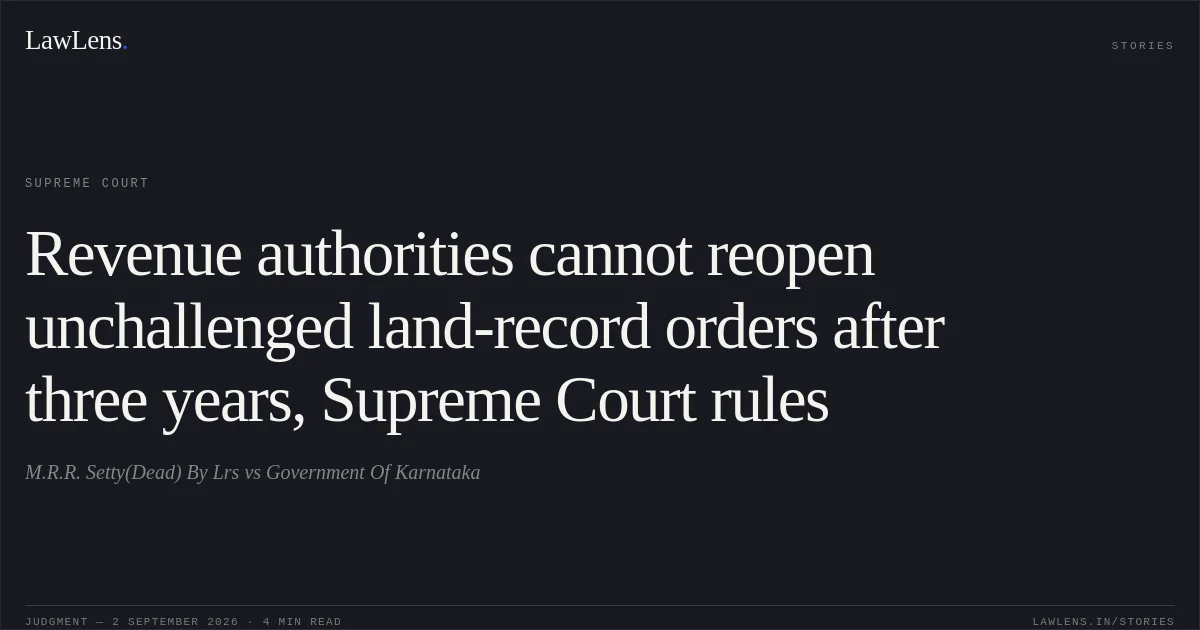
The Court held that the proviso to Section 56(3) contained a clear and mandatory temporal restriction: where no appeal had been preferred, revisional jurisdiction could be exercised only within three years of the order sought to be revised.
Source reference: paras. 9, 15The CTS allotments dated back to 1974, whereas the impugned notice was issued in 2014—approximately 35 years beyond the statutory period.
Source reference: paras. 6, 15The property had also been treated as private property for decades, and the authorities had sanctioned construction and issued an Occupancy Certificate, resulting in the creation of third-party interests before the notice was issued.
Source reference: paras. 4, 15The alleged encroachment of a public lake could not authorise the authorities to disregard the express limitation in Section 56(3).
Source reference: no citationSection 52 was inapplicable because it concerned appeals, not revisions, and could not be used to defeat the specific statutory limitation.
Source reference: para. 11The amended Section 25 was also irrelevant because the original CTS allotment was an administrative exercise and not an order passed by a Revenue Court exercising jurisdiction under Section 24.
Source reference: para. 13Since the revisional jurisdiction was invoked without statutory authority at its inception, the fact that no final adverse order had yet been passed did not prevent judicial review of the notice itself.
Source reference: para. 16Holding
The Supreme Court answered the issues in favour of the appellants.
It held that the Joint Director/Registrar of Land Records had no jurisdiction to initiate revision proceedings under Section 56 after the expiry of the prescribed three-year period, and that the alleged need to protect Yediyur Lake could not overcome that statutory bar.
Source reference: paras. 15–16The Division Bench judgment dated 09.01.2020, insofar as it concerned Writ Appeal No. 6405 of 2017, and the order dismissing the review petition dated 16.06.2023 were set aside.
Source reference: para. 17–18The notice dated 26.04.2014 was quashed insofar as it related to the appellants’ land.
Source reference: para. 17–18The parties were directed to bear their own costs.
Source reference: para. 17–18Acts & Sections Cited
4 provisions across 2 statutes referred to in this judgment. Each provision opens on LawLens.
Code of Civil Procedure, 19081
Limitation Act, 19633
Original Court PDF
M.R.R. Setty(Dead) By LrsvsGovernment Of Karnataka
Click to open original judgment
Original judgment, available to read, download and summarize on LawLens.in