Facts
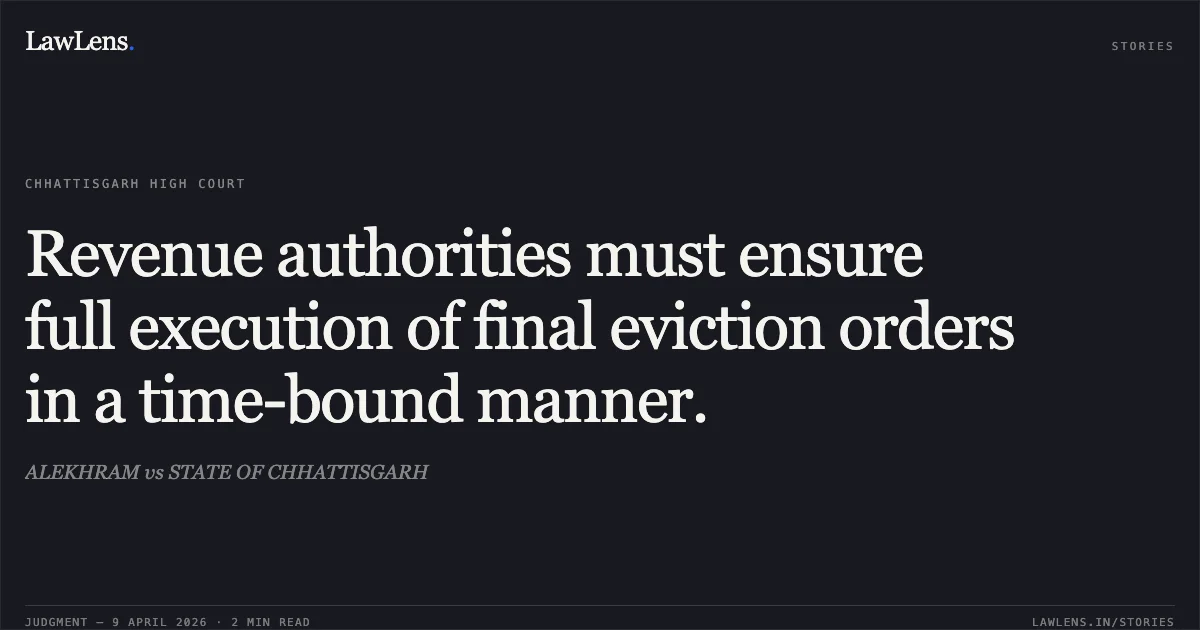
The Petitioner initiated proceedings against private Respondent No. 5 under Section 248 of the Chhattisgarh Land Revenue Code, 1959, resulting in an eviction order passed by the Tehsildar/Additional Tehsildar, Saraipali, on 09.05.2022
Source reference: para. 3Respondent No. 5 unsuccessfully challenged this order before the Sub-Divisional Officer (Revenue) and the Commissioner, Raipur Division, with the final appeal dismissed on 24.12.2024
Source reference: para. 3The Petitioner alleged that on 11.09.2025, the authorities only achieved partial compliance with the eviction order, leaving the illegal obstructions partially intact
Source reference: para. 3, 6Consequently, the Petitioner approached the High Court under Article 226 seeking a direction for complete removal of the obstructions
Source reference: para. 2During proceedings, it was admitted that the Petitioner had not yet filed a formal application for full compliance before the concerned Revenue Authority
Source reference: para. 3Issues
Whether the Petitioner is entitled to a writ of mandamus for the execution of an eviction order when he has not yet moved the original Revenue Authority for full compliance
Source reference: para. 3, 6Law Applied
The Court primarily considered the scope of writ jurisdiction under Article 226 of the Constitution of India for enforcing administrative orders
Source reference: para. 2Section 248 of the Chhattisgarh Land Revenue Code, 1959, which governs the summary eviction of persons in unauthorized possession of land
Source reference: para. 3The principle that the Revenue Authority who passes an eviction order holds the primary responsibility to ensure its execution and compliance, rather than delegating the task to a third party such as a Gram Panchayat
Source reference: para. 6Reasoning
The Court noted that the eviction order had attained finality following the dismissal of the second appeal
Source reference: para. 3Addressing the Petitioner's grievance of "partial compliance," the Court observed that the Petitioner had bypassed the necessary step of requesting the Tehsildar to ensure the total removal of encroachments before seeking extraordinary relief from the High Court
Source reference: para. 3, 4The Court expressed surprise that the Tehsildar had directed the Gram Panchayat to remove the encroachment instead of ensuring compliance personally or through revenue staff
Source reference: para. 6Justice Chandravanshi reasoned that since the execution was an ongoing administrative process, the Petitioner should first exhaust his remedy by filing a specific application for full compliance before the executing officer
Source reference: para. 5, 6This approach allows the Revenue Authority to resolve factual disputes regarding the extent of the removal within a defined period
Source reference: para. 6Holding
The High Court disposed of the writ petition without interfering on the merits, granting the Petitioner liberty to file an application for full compliance of the order dated 09.05.2022 before the Tehsildar/Additional Tehsildar, Saraipali
The Court issued a mandatory direction that, upon filing such an application, the concerned Tehsildar must act in accordance with the law to ensure full compliance within 45 days of receipt of the order
Source reference: para. 6No order was made as to costs
Source reference: para. 8Acts & Sections Cited
1 provisions across 1 statute referred to in this judgment. Linked provisions open on LawLens.
Chhattisgarh Land Revenue Code, 19591
Original Court PDF
ALEKHRAMvsSTATE OF CHHATTISGARH
Click to open original judgment
Original judgment, available to read, download and summarize on LawLens.in