Facts
The land in Sy.No.375, admeasuring Acs.13-38 guntas at Achampet Mandal, originally stood in the name of late Mahaboob Ali. After his death, a dispute arose between his sons, Vikaruddin and Gulam Hyder, regarding their respective shares. Pursuant to an earlier remand by the High Court, the Tahsildar recognised Vikaruddin’s entitlement to a half share in the property.
Source reference: para. 3Vikaruddin had agreed to sell one-fourth of his half share, measuring Acs.1-29 guntas, to the petitioner under an agreement of sale dated 03.12.1997. As Vikaruddin did not execute the sale deed, the petitioner instituted O.S.No.124 of 2012 for specific performance. Although the suit was initially dismissed, the petitioner’s appeal, A.S.No.57 of 2019, was allowed; the matter was thereafter carried in S.A.No.14 of 2025 before the High Court, where an order of status quo was granted.
Source reference: paras. 3.1–3.2, 9–10Meanwhile, respondent No.4, through respondent No.5 as his GPA holder, obtained permission from respondent No.3 on 11.04.2014 for conversion of Acs.2-16 guntas in Sy.No.375 from agricultural to non-agricultural use. The petitioner’s appeal against the conversion order, NALA Appeal No.D3/1892/2016, was dismissed by respondent No.2 on 13.12.2019, principally on the grounds that the agreement of sale lacked specific boundaries and that the petitioner’s specific-performance suit had been dismissed. The petitioner challenged both orders in the present writ petition.
Source reference: paras. 3.3, 4.1, 9Issues
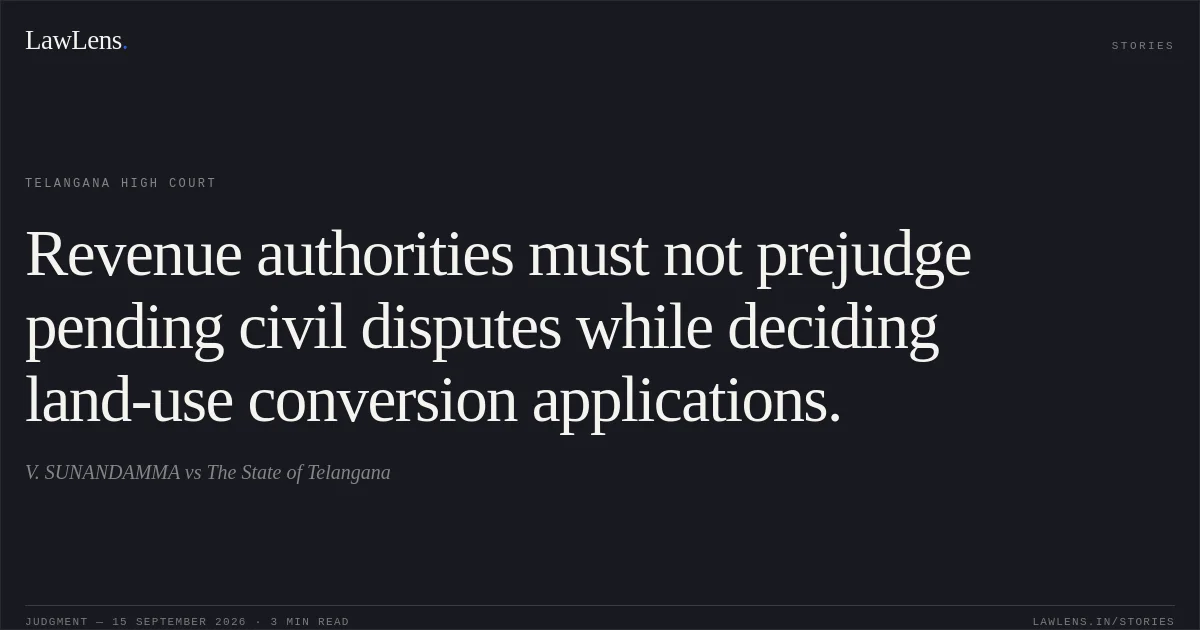
Whether the revenue authorities could sustain an order permitting conversion of land when the petitioner’s claimed interest under an agreement of sale and the rival parties’ title, shares, possession, and identity of the property were the subject of pending civil proceedings.
Source reference: paras. 11–13Whether respondent No.2 erred in treating the dismissal of the petitioner’s specific-performance suit as conclusive, despite the pendency and subsequent developments in the appellate proceedings.
Source reference: para. 10Whether the absence of specific boundaries in the agreement of sale was sufficient to reject the petitioner’s objection to the conversion of part of the joint property, particularly when the petitioner claimed an undivided share.
Source reference: para. 11Law Applied
The Court applied the principles of natural justice and the constitutional protection against deprivation of property except by authority of law under Article 300-A, as invoked in the writ petition.
Source reference: para. 1It further applied the settled principle that revenue authorities exercising jurisdiction over land conversion are not competent to adjudicate complicated questions of title, partition, identity, extent, or competing civil rights; such issues must be determined by the competent Civil Court.
Source reference: paras. 11–13The Court also held that an authority deciding a statutory appeal must consider the complete and current status of pending civil proceedings and cannot treat a trial-court judgment as conclusive when it has been carried in appeal.
Source reference: para. 10Reasoning
Respondent No.2 improperly relied on the trial court’s dismissal of O.S.No.124 of 2012, because that decision had not attained finality and appellate proceedings were pending when the NALA appeal was decided. The petitioner’s claim under the agreement of sale therefore could not be treated as conclusively negatived solely by the trial court’s judgment.
Source reference: para. 10Further, the dispute regarding whether the agreement concerned an undivided share or a defined portion of the land, and whether the property had already been partitioned, involved disputed questions of title, extent, and identity. These questions fell outside the permissible scope of revenue adjudication.
Source reference: para. 11By deciding the conversion appeal without properly considering the pending civil proceedings and by relying on disputed assumptions concerning the parties’ rights, the revenue authorities risked prejudging issues reserved for the Civil Court.
Source reference: paras. 12–13Holding
The High Court held that the reasons assigned by respondent No.2 for dismissing the NALA appeal were unsustainable.
The writ petition was allowed, and the conversion order dated 11.04.2014 passed by respondent No.3 in File No.G/346/2014, as confirmed by respondent No.2’s order dated 13.12.2019 in NALA Appeal No.D3/1892/2016, was set aside. No order as to costs was made, and pending miscellaneous petitions were closed.
Source reference: paras. 14–16Original Court PDF
V. SUNANDAMMAvsThe State of Telangana
Click to open original judgment
Original judgment, available to read, download and summarize on LawLens.in