Facts
The petitioners purchased land from Mohan Gupta, whose name was recorded in revenue records following a sale deed executed by a deity's representative
Source reference: para. 2, 4The respondents filed a mutation application in 2014 based on a 1991 sale deed from one Ramprasad, who had allegedly purchased the land from the original owner, Chhakodi, in 1978
Source reference: para. 4While the Tehsildar initially dismissed the respondents' mutation application due to delay and lack of consideration, higher revenue authorities (SDO, Additional Commissioner, and Board of Revenue) subsequently allowed the mutation in favor of the respondents
Source reference: para. 3, 4The petitioners challenged these orders under Article 227 of the Constitution, alleging they were passed without a proper hearing and ignored 20 years of unchallenged revenue entries
Source reference: para. 4Issues
1. Whether the revenue authorities exceeded their jurisdiction by deciding complex questions of title during mutation proceedings instead of referring the parties to a Civil Court
Source reference: para. 5, 102. Whether the High Court, under its supervisory jurisdiction under Article 227, should interfere with the concurrent findings of the revenue courts
Source reference: para. 6, 7Law Applied
The court applied Sections 109 and 110 of the Madhya Pradesh Land Revenue Code (MPLRC), which govern the mutation of names in revenue records upon acquisition of rights
Source reference: para. 10The High Court’s power is limited to correcting jurisdictional errors or patent perversity rather than acting as a court of appeal as elucidated in Mohd. Yunus v. Mohd. Mustaqim [(1983) 4 SCC 566] and Shalini Shyam Shetty v. Rajendra Shankar Patil [(2010) 8 SCC 329]
Source reference: para. 7, 8, 9Reasoning
The Court observed that both parties asserted competing claims of ownership based on distinct chains of registered sale deeds and settlement deeds spanning several decades
Source reference: para. 4, 5It reasoned that revenue authorities possess limited quasi-judicial power focused on updating records and are not competent to conduct a "roving inquiry" to determine whose title is superior when complex legal transfers are involved
Source reference: para. 5, 10The Court found that when title is bona fide disputed between parties holding registered instruments, the proper course of action for revenue authorities is to relegate the matter to a Civil Court
Source reference: para. 5While acknowledging the limited scope of Article 227, the Court determined that the controversy required a definitive adjudication of title that only a competent Civil Court could provide
Source reference: para. 10Holding
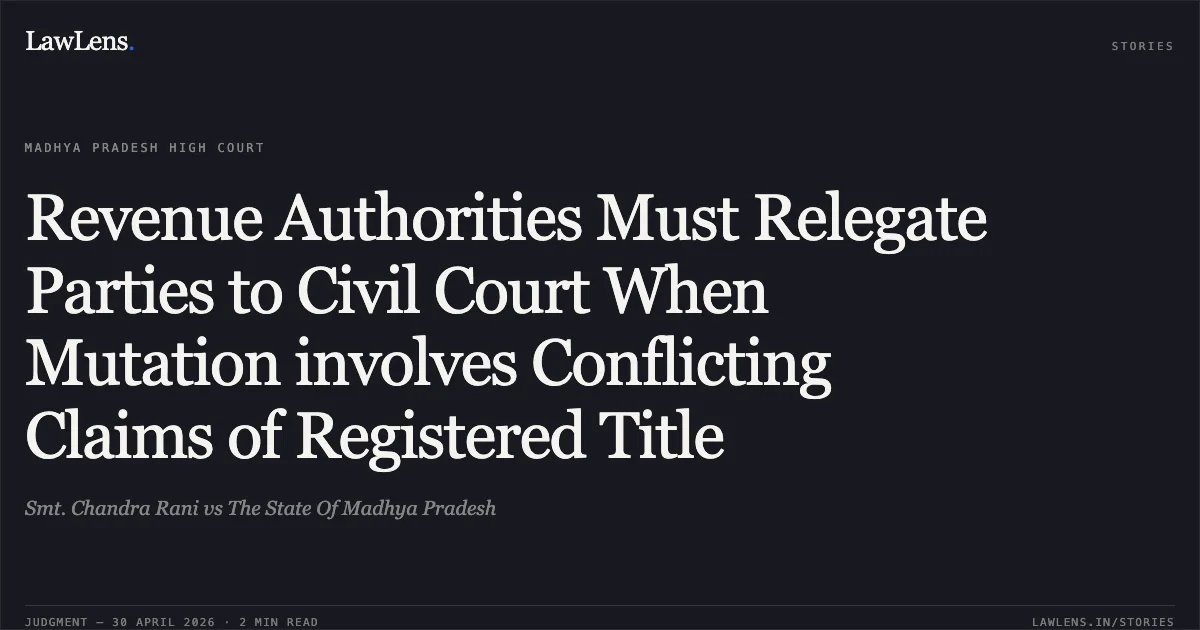
The Court disposed of the petition by directing the parties to establish their respective rights before a competent Civil Court
It held that the question of mutation can only be finalized based on a decree from such a court
Source reference: para. 11Consequently, the Court ordered that the current revenue entries remain status quo and be subject to the final outcome of the civil litigation
Source reference: para. 11, 12Acts & Sections Cited
3 provisions across 2 statutes referred to in this judgment. Each provision opens on LawLens.
MP Land Revenue Code 19592
Code of Civil Procedure, 19081
Original Court PDF
Smt. Chandra RanivsThe State Of Madhya Pradesh
Click to open original judgment
Original judgment, available to read, download and summarize on LawLens.in


